
Explore this animal in Size of Extinct Animals ↗
66 / Cenozoic
Livyatan
Livyatan melvillei
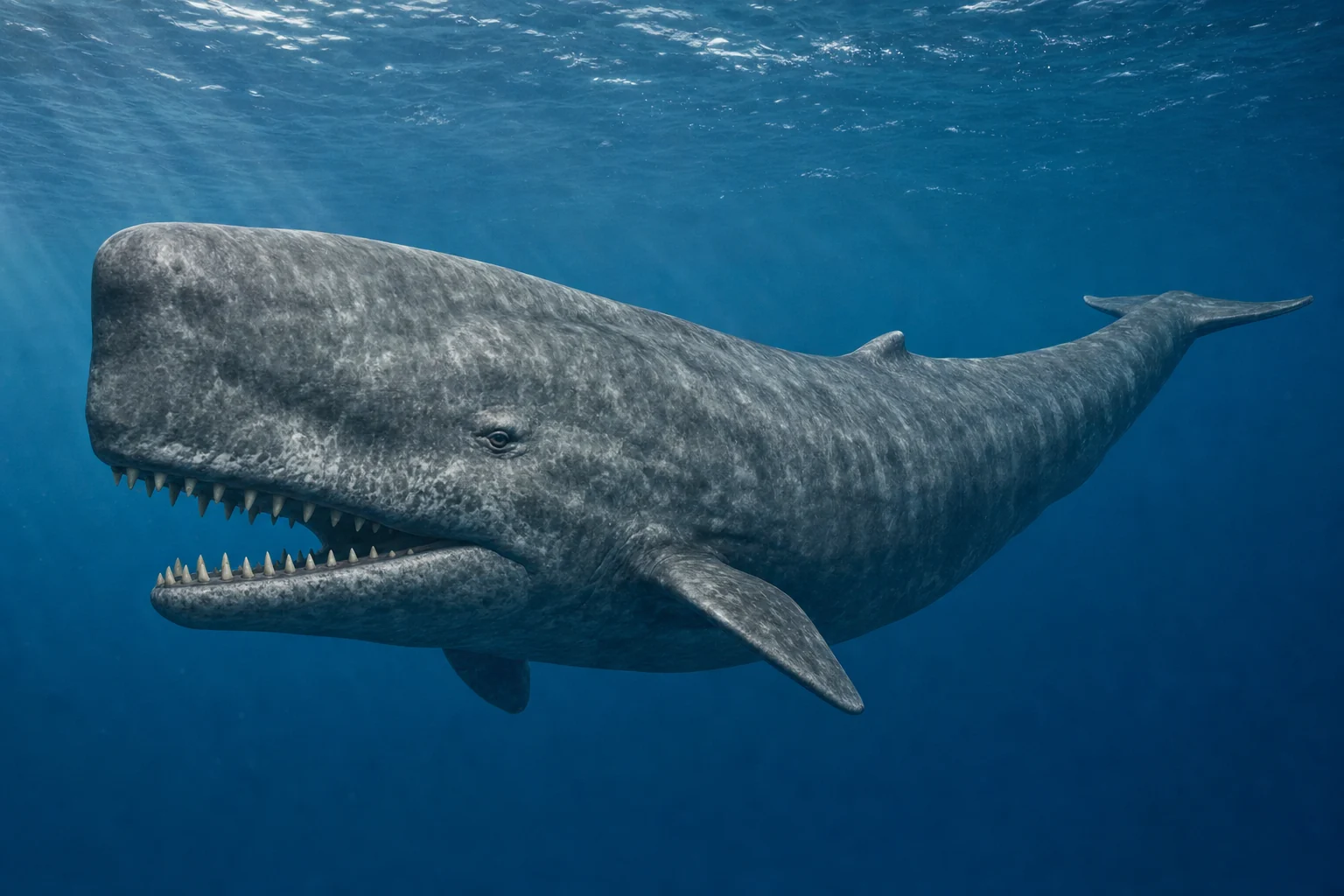
Huge teeth in both jaws armed a macropredatory sperm whale.
 View original image · 1536 × 1024
- Time range
- About 9.5–8.9 million years ago
- Final stage
- Late Miocene
- Geographic range
- Southeastern Pacific · Present-day Peru
01 / ANSWER FIRST
What was Livyatan?
Livyatan melvillei was a giant macroraptorial sperm whale from Miocene Peru with enormous enamel-coated teeth in both upper and lower jaws.
It is known mainly from one skull, mandible and teeth. Estimates around 13–18 metres depend on comparison with living sperm whales and other raptorial physeteroids, so a precise body length or mass is not directly measured.
02 / QUICK FACTS
Livyatan at a glance
- Scientific name
- Livyatan melvillei
- Age
- About 12–9 million years ago
- Estimated length
- Roughly 13–18 m
- Skull length
- About 3 m
- Largest teeth
- More than 36 cm including root
- Teeth
- Functional upper and lower teeth
- Diet
- Likely medium-sized baleen whales
- Key locality
- Pisco Formation, Peru
03 / CORE QUESTION
Livyatan versus Megalodon: what does evidence show?
Both were giant marine predators and overlapped broadly in Miocene oceans, likely targeting some of the same marine mammals. Their teeth and feeding systems differed: Livyatan gripped with large conical teeth, while Megalodon sliced with broad serrated teeth.
No fossil records a fight, kill or stable dominance hierarchy between them. Body size, swimming performance and behaviour are uncertain enough that a winner-style comparison is entertainment, not a scientific conclusion.
Read the complete comparison guideHow to read the numbers
This page separates direct evidence, comparative inference and unresolved debate.
04 / LIFE & DISCOVERY TIMELINE
One exceptional skull reveals a vanished whale predator
Raptorial sperm whales diversify
Large toothed physeteroids share seas with expanding baleen whales.
Skull excavated
A Peruvian desert specimen preserves jaws and giant teeth.
Species described
Nature reports Leviathan melvillei as a macroraptorial whale.
Livyatan replacement name
A preoccupied genus name is replaced by Hebrew Livyatan.
05 / ANATOMY
A sperm-whale skull built to seize large prey
Three-metre skull
A robust rostrum and huge temporal region anchored jaw muscles.
Two functional tooth rows
Both jaws carried deeply rooted, enamel-coated conical teeth.
Largest biting teeth
Some teeth exceed 36 centimetres including their long roots.
Supracranial basin
A large basin likely housed a spermaceti organ unlike simple suction feeders.
06 / DIET & BEHAVIOUR
What did Livyatan eat?
Skull and tooth design support gripping and tearing medium-sized whales and other large vertebrates, though no confirmed stomach contents survive.
Read the complete guide07 / DIET & BEHAVIOUR
Did it deep-dive like a sperm whale?
Its large teeth and proposed baleen-whale prey suggest surface or shelf hunting; deep-diving ability remains unknown.
08 / RANGE & HABITAT
Where did Livyatan live?
The holotype comes from Peru's Pisco Basin; large related teeth elsewhere may broaden the group but are not all diagnostic Livyatan melvillei.
Cerro Colorado
The type skull anchors anatomy and age.
Southeast Pacific
Productive upwelling supported whales, seals and sharks.
Pisco Formation
Exceptional preservation records a rich marine food web.
Possible wider relatives
Isolated giant teeth require cautious open identification.
09 / FOSSIL EVIDENCE
How do scientists know about Livyatan?
Holotype skull
Associated cranium and jaw establish taxonomic identity.
Teeth in sockets
Position and roots reveal functional upper and lower dentition.
Muscle attachment
Large temporal fossae constrain powerful jaw closure.
Associated fauna
Baleen whales and sharks reconstruct prey and competition opportunities.
10 / DISAPPEARANCE & DEBATE
Why did Livyatan disappear?
Livyatan's exact last appearance and extinction cause are poorly resolved because its fossil record is sparse.
Changes in baleen-whale size, ocean productivity and competition could affect a giant predator, but isolated teeth and broad assignments cannot support one timed cause.
12 / FREQUENTLY ASKED QUESTIONS
Livyatan FAQ
How big was Livyatan?
Whole-body estimates commonly span roughly 13–18 metres.
How large were its teeth?
The largest exceeded 36 centimetres including the root.
Was it a sperm whale?
It was a stem macroraptorial member of the sperm-whale superfamily.
Did it eat whales?
Medium-sized baleen whales are the strongest prey hypothesis, but stomach contents are absent.
Did Livyatan fight Megalodon?
No direct fossil evidence records a fight.
Why was its name changed?
Leviathan was already used, so the genus became Livyatan.
04 / SOURCES & FURTHER READING
Check the source record
Use the scientific name to compare taxonomy, occurrence records and the fossil record. Database coverage and classifications may differ.
05 / REVISION HISTORY
How has this record changed?
- Rewrote an extinction cause that presented environmental or faunal turnover as established; it is now given as context the record does not prove.
- Expanded into a bilingual S-tier hub with two evidence-led guides.
- Verified authoritative entity sources and added three responsive reconstruction sizes.
- Initial bilingual species record published.
06 / CORRECTIONS & ADDITIONS