
Explore this animal in Size of Extinct Animals ↗
71 / Cenozoic
Woolly Rhinoceros
Coelodonta antiquitatis
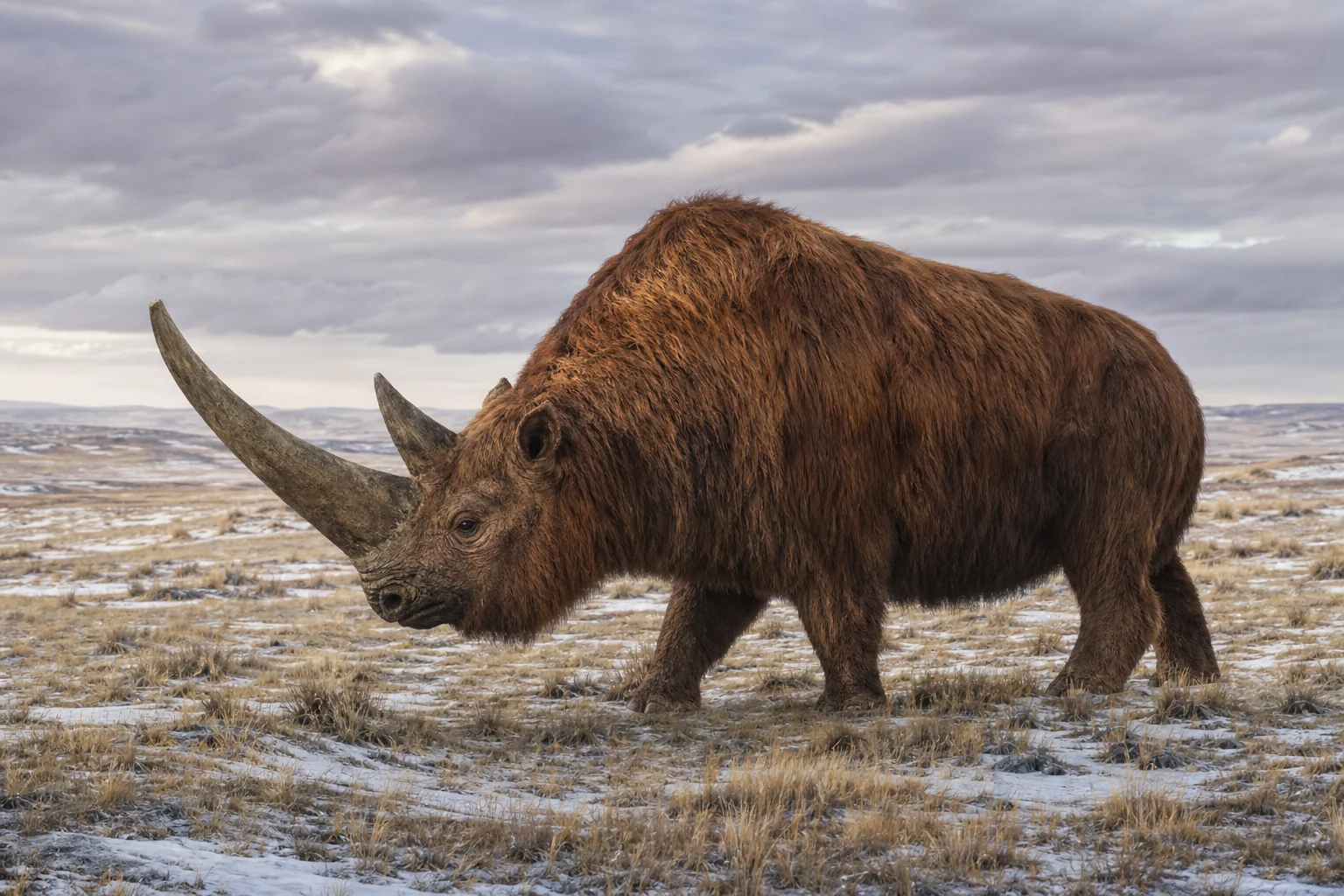
A thick coat and flattened horn equipped this rhinoceros for cold, dry mammoth steppe.
 View original image · 1536 × 1024
- Time range
- About 350,000–14,000 years ago
- Final stage
- End of the Pleistocene
- Geographic range
- Northern Eurasia
01 / ANSWER FIRST
What was the woolly rhinoceros?
Coelodonta antiquitatis was a large, shaggy rhinoceros adapted to the cold dry mammoth steppe of Pleistocene Eurasia.
Mummies preserve thick underfur, guard hair, skin and two keratin horns. A low-slung head and broad front horn helped crop low vegetation and may have swept snow, but direct feeding wear is stronger evidence than the snowplough image.
02 / QUICK FACTS
Woolly rhinoceros at a glance
- Scientific name
- Coelodonta antiquitatis
- Age
- ~350,000–14,000 years ago
- Length
- About 3.2–3.8 m
- Mass
- Roughly 1.8–2.7 tonnes
- Horns
- Two; broad front horn
- Diet
- Low-growing grasses and herbs
- Range
- Northern Eurasia
- Extinction
- About 14,000 years ago
03 / CORE QUESTION
Why did the woolly rhinoceros go extinct?
Genomes indicate stable diversity close to extinction rather than a long genetic meltdown. Radiocarbon and ecological models instead track rapid warming, wetter winters, deeper snow and fragmentation of dry steppe grazing habitat.
Humans overlapped and hunted rhinoceroses, and newer models allow low persistent hunting to amplify habitat loss. Evidence weighs climate strongly while keeping regional human pressure in the combined explanation.
Read the complete extinction evidence guideHow to read the numbers
This page separates direct evidence, comparative inference and unresolved debate.
04 / LIFE & DISCOVERY TIMELINE
A cold-adapted grazer tracked into its final millennia
Classic form spreads
Woolly rhinoceroses occupy northern Eurasian steppe.
Maximum range
Cold dry habitats connect Europe and Siberia.
Habitat contracts
Warming and moisture reorganise steppe vegetation.
Final Siberian populations
Direct dates and genomes place a rapid terminal loss.
05 / ANATOMY
Built for wind, cold and low forage
Double coat
Dense underfur and long guard hairs insulated the body.
Two horns
Keratin horns grew throughout life and preserve growth bands.
Low head
Long skull and high shoulder supported ground-level grazing.
Compact extremities
Small ears and short tail reduced exposed surface area.
06 / DIET & BEHAVIOUR
What did woolly rhinos eat?
Mouth form, wear, stomach contents and isotopes favour dry grasses and herbs rather than woody browse.
Read the complete guide07 / DIET & BEHAVIOUR
Were they solitary?
Adult rhinos were probably often solitary like living species, but tracks and art cannot establish a universal social system.
08 / RANGE & HABITAT
Where did woolly rhinoceroses live?
Their range stretched from western Europe across Siberia to northeastern Asia, following cold dry steppe rather than ice sheets themselves.
Western Europe
Caves and river terraces preserve bones and art.
Central Eurasia
Open steppe supported broad grazing populations.
Siberian permafrost
Mummies preserve skin, hair, horns and stomach remains.
Northeast Asia
Fossils and DNA document eastern lineages and final refugia.
09 / FOSSIL EVIDENCE
How do scientists know about woolly rhinoceroses?
Frozen bodies
Soft tissue reveals coat, lips, feet and sex.
Horn keratin
Growth layers preserve age and seasonal information.
Cave art
Human images record hump, coat and horn outline.
Ancient genomes
DNA tests diversity, relationships and terminal population history.
10 / DISAPPEARANCE & DEBATE
Was extinction caused by climate or humans?
Rapid climate-driven habitat fragmentation is strongly supported, with low persistent human hunting potentially weakening connected populations.
Stable near-final genomes argue against gradual inbreeding collapse. The most useful model explains how specialised dry-steppe grazing became vulnerable as climate and mortality acted together.
12 / FREQUENTLY ASKED QUESTIONS
Woolly rhinoceros FAQ
How big was a woolly rhinoceros?
About 3.2–3.8 metres long and roughly 1.8–2.7 tonnes.
Did it have two horns?
Yes, with a very large flattened front horn.
Was it covered in wool?
Yes. Mummies preserve dense underfur and long guard hair.
Did it live on glaciers?
No. It lived on cold, dry, largely snow-light steppe.
What did it eat?
Mostly low grasses and herbaceous plants.
When did it go extinct?
About 14,000 years ago in northeastern Siberia.
04 / SOURCES & FURTHER READING
Check the source record
Use the scientific name to compare taxonomy, occurrence records and the fossil record. Database coverage and classifications may differ.
05 / REVISION HISTORY
How has this record changed?
- Expanded into a bilingual S-tier hub with two evidence-led guides.
- Verified authoritative entity sources and added three responsive reconstruction sizes.
- Initial bilingual species record published.
06 / CORRECTIONS & ADDITIONS