
GIANT DEER TOPIC HUB · EXTINCTION
Why Did the Giant Deer Go Extinct? Antler Costs and Evidence
Test the famous antler-extinction story against nutrition, habitat, climate, human overlap and late Siberian survival.
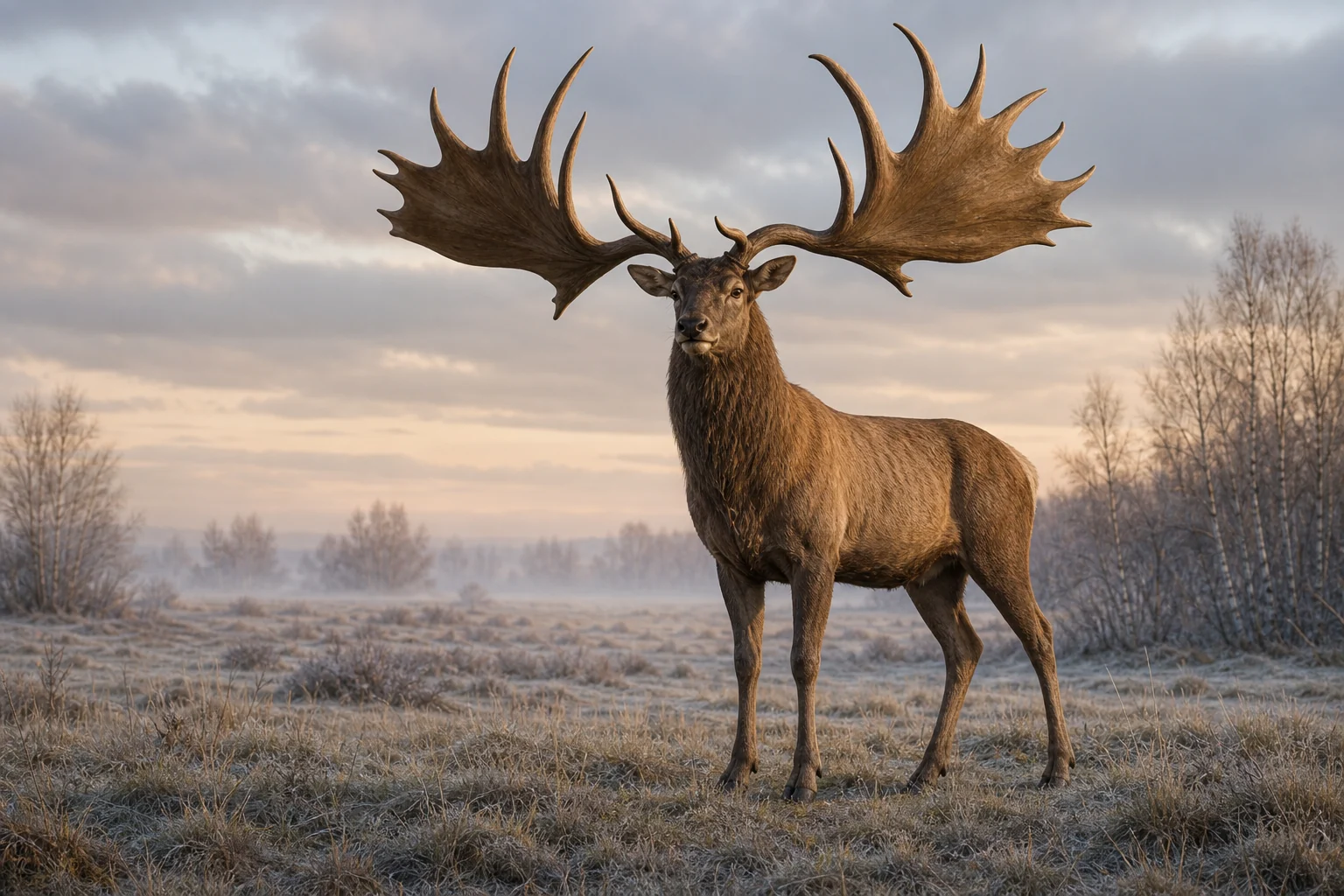 View full-resolution reconstruction ↗
This is an original generative reconstruction, not a photograph or scientific plate. Measurements and interpretations below are tied to named sources.
01 / ANTLER COST
How expensive were the antlers?
Males rebuilt tens of kilograms of bone annually, drawing on dietary minerals and skeletal reserves. Cost rose when forage quality fell, but healthy populations had evolved to meet it.
02 / MALADAPTATION MYTH
Were the antlers an evolutionary mistake?
No. Their proportional size fits a very large deer and sexual selection can sustain costly structures when mating benefits exceed costs. Extinction does not retroactively make a successful trait pathological.
03 / HABITAT
How did warming affect the landscape?
Post-glacial vegetation shifts reduced some open, mineral-rich feeding grounds and expanded denser woodland in western regions. Effects differed across Eurasia, matching staggered disappearance.
04 / HUMANS
Did people hunt giant deer?
Cave art and archaeological remains confirm human familiarity and occasional use. Current evidence does not quantify hunting everywhere, so it is a pressure in a combined model rather than a universal sole cause.
05 / LATE SURVIVAL
When did the last giant deer live?
Dated remains from western Siberia extend survival to about 7,700 years ago, millennia after western European losses. The refugial record disproves a simultaneous Ice Age-end extinction.
06 / VERDICT
What best explains extinction?
Regional habitat and nutritional stress, demographic isolation and human pressure interacted. Antlers mattered because they raised male mineral demand, not because they grew uncontrollably or trapped every animal in forests.
FREQUENTLY ASKED QUESTIONS
Questions readers ask
Was the Irish elk an elk?
No. It was a giant deer, not a close member of the elk genus Cervus.
Did it live only in Ireland?
No. Its range extended across Europe and northern Asia.
How wide were the antlers?
The largest spans approached about 3.5 metres.
Could giant deer run?
Yes. Limb anatomy indicates capable running despite the antlers.
Did antlers cause extinction?
Not alone; they added nutritional cost within broader environmental and human pressures.
When did the last giant deer live?
Dated western Siberian remains are about 7,700 years old.
SOURCES & FURTHER READING
Evidence used in this guide
Measurements and interpretations are tied to museum resources or peer-reviewed studies; disputed conclusions include evidence on both sides.
- 01The Irish elk ↗Natural History Museum, London
Museum synthesis of size, antlers, art, locomotion and regional extinction.
- 02The extinction of the giant deer ↗Quaternary International
Radiocarbon review of the species' final chronology.
- 03Biomechanics of Megaloceros antlers ↗Royal Society Open Science
Mechanical study testing how giant antlers were used in combat.