
GIANT DEER TOPIC HUB · SIZE & ANTLERS
Giant Deer Size, Antlers and Body Comparison
How tall was Megaloceros giganteus, how wide were its antlers and was the Irish elk really an elk?
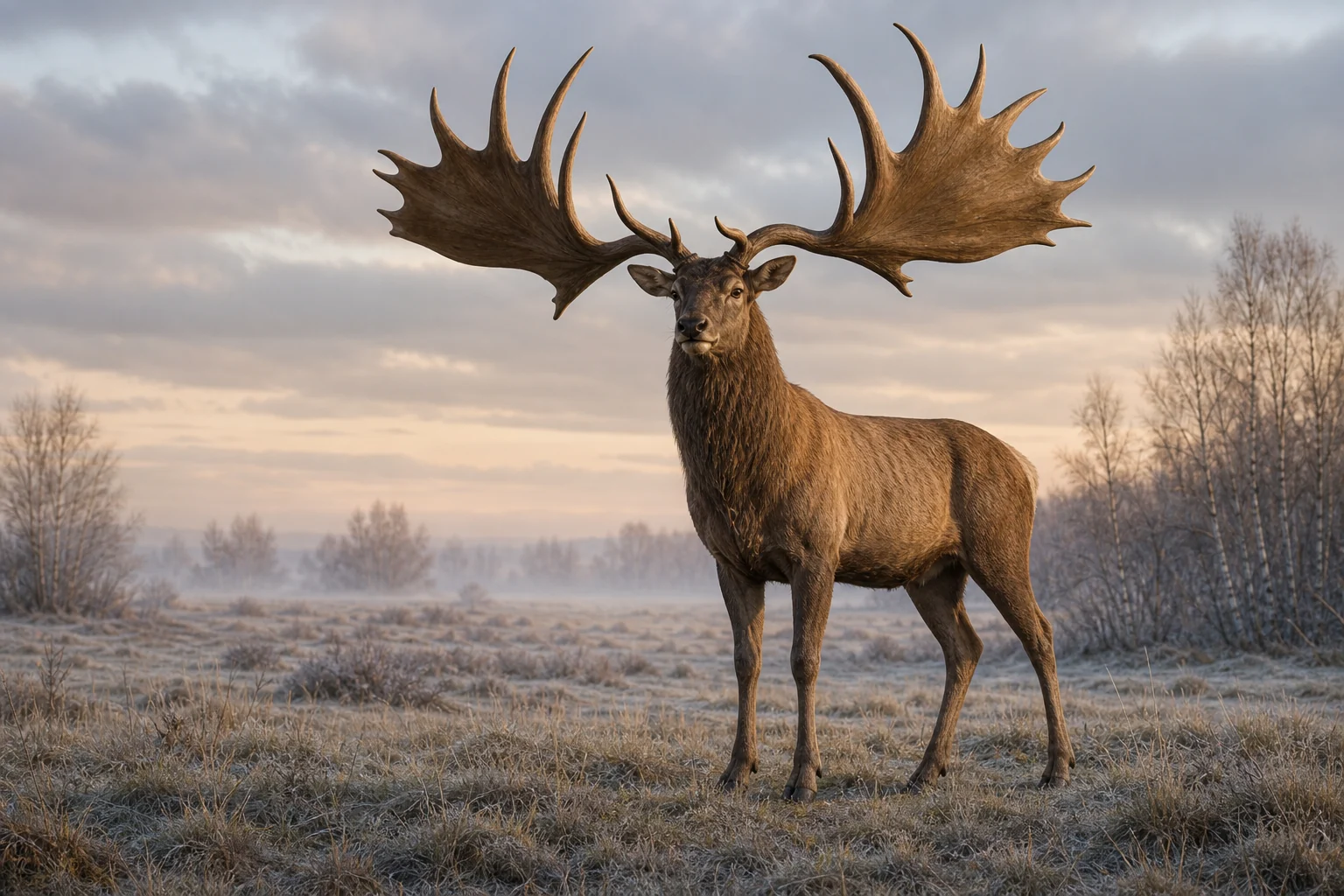 View full-resolution reconstruction ↗
This is an original generative reconstruction, not a photograph or scientific plate. Measurements and interpretations below are tied to named sources.
01 / BODY SIZE
How large was the giant deer?
Large males approached two metres at the shoulder, exceeding most living deer. Sex, age and population affect size, so the highest skeleton is not the typical adult.
02 / ANTLER SPAN
How wide were the largest antlers?
Exceptional antlers span about 3.5 metres and weigh near 40 kilograms. Those are upper records; museum displays often select the most spectacular males.
03 / ANNUAL GROWTH
Did it carry the same antlers for life?
No. Like living deer, males shed antlers and rebuilt them under velvet. That annual cycle demanded protein, calcium and phosphorus but also enabled repair and renewed display.
04 / NAME
Was the Irish elk an elk?
No. Megaloceros belongs to the deer family but is not the living wapiti or moose called elk in different English dialects. 'Giant deer' is the clearer common name.
05 / BODY PLAN
Could it run with such broad antlers?
Long limbs and deer-like joints support effective running. Broad antlers altered turning clearance, especially in dense vegetation, but did not make normal locomotion impossible.
06 / LIFE APPEARANCE
What does cave art add?
Palaeolithic images record a shoulder hump, neck marking and antler posture that bones alone cannot show. Colour details still vary among artists and are not all independently verified.
FREQUENTLY ASKED QUESTIONS
Questions readers ask
Was the Irish elk an elk?
No. It was a giant deer, not a close member of the elk genus Cervus.
Did it live only in Ireland?
No. Its range extended across Europe and northern Asia.
How wide were the antlers?
The largest spans approached about 3.5 metres.
Could giant deer run?
Yes. Limb anatomy indicates capable running despite the antlers.
Did antlers cause extinction?
Not alone; they added nutritional cost within broader environmental and human pressures.
When did the last giant deer live?
Dated western Siberian remains are about 7,700 years old.
SOURCES & FURTHER READING
Evidence used in this guide
Measurements and interpretations are tied to museum resources or peer-reviewed studies; disputed conclusions include evidence on both sides.
- 01The Irish elk ↗Natural History Museum, London
Museum synthesis of size, antlers, art, locomotion and regional extinction.
- 02The extinction of the giant deer ↗Quaternary International
Radiocarbon review of the species' final chronology.
- 03Biomechanics of Megaloceros antlers ↗Royal Society Open Science
Mechanical study testing how giant antlers were used in combat.