
Explore this animal in Size of Extinct Animals ↗
70 / Cenozoic
Elasmotherium
Elasmotherium sibiricum
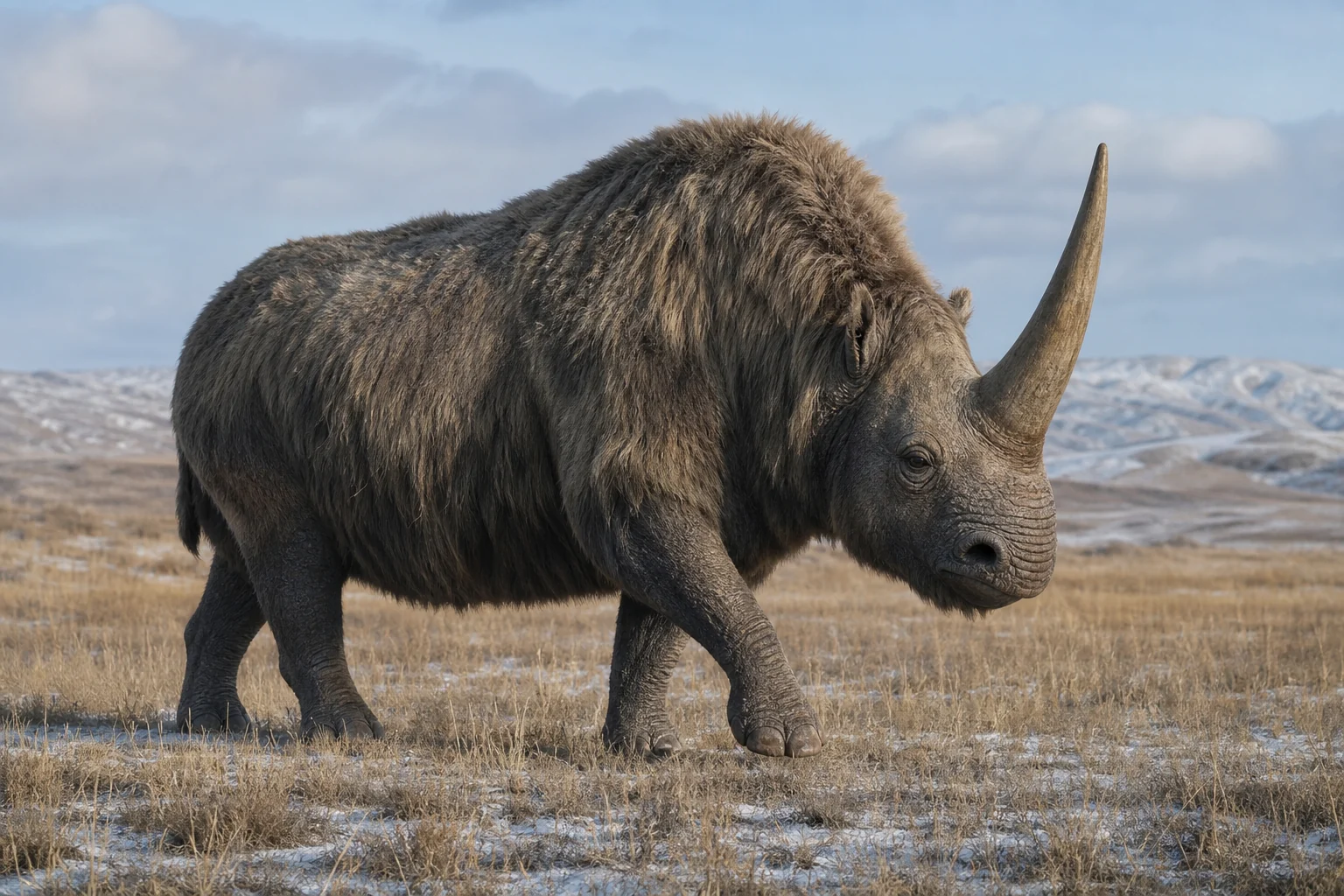
This enormous grazing rhinoceros probably supported a large horn on its forehead.
 View original image · 1536 × 1024
- Time range
- About 2.6 million–39,000 years ago
- Final stage
- Late Pleistocene
- Geographic range
- Eurasian steppe
01 / ANSWER FIRST
What was Elasmotherium?
Elasmotherium sibiricum was a huge long-legged rhinoceros and the last known member of an ancient elasmothere lineage.
It is nicknamed the Siberian unicorn, but no horn is preserved because rhinoceros horn is keratin. A large roughened boss on the forehead supports a substantial horn while leaving its exact length, shape and sex variation unknown.
02 / QUICK FACTS
Elasmotherium at a glance
- Scientific name
- Elasmotherium sibiricum
- Last secure date
- At least 39,000 years ago
- Mass
- About 3.5 tonnes
- Identity
- Last elasmothere rhinoceros
- Horn
- Inferred from frontal boss
- Teeth
- High-crowned folded enamel
- Diet
- Specialised dry-steppe grazer
- Range
- Eastern Europe and Central Asia
03 / CORE QUESTION
Did Elasmotherium really have a giant horn?
The skull bears a broad vascularised frontal dome capable of anchoring keratin, making a horn likely. Yet the popular two-metre lance is not a fossil measurement; keratin length and curvature cannot be recovered from the boss alone.
New dates, isotopes and DNA transformed the species more than the horn image. It survived far later than once thought and occupied a narrow dry-steppe dietary niche, which likely made rapid environmental change costly.
Read the complete horn-evidence guideHow to read the numbers
This page separates direct evidence, comparative inference and unresolved debate.
04 / LIFE & DISCOVERY TIMELINE
A deep rhinoceros lineage surviving into human time
Elasmothere lineage diverges
DNA places its branch deep beside modern-rhino ancestry.
Steppe specialist
Elasmotherium occupies eastern European and Asian dry grasslands.
Early extinction assumed
Undated fossils suggested disappearance around 200,000 years ago.
Direct dates reset history
Twenty-three radiocarbon-dated individuals prove late survival.
05 / ANATOMY
A long-legged grazer with a specialised skull
Frontal boss
A large roughened dome anchored blood-rich horn tissue.
High-crowned teeth
Deep enamel folds resisted wear from abrasive grasses.
Long limbs
Robust elongated legs supported movement across open ground.
Heavy skull
A long low head kept the mouth near ground-level forage.
06 / DIET & BEHAVIOUR
What did Elasmotherium eat?
Stable isotopes and dental form support a narrow diet of dry-steppe grasses.
Read the complete guide07 / DIET & BEHAVIOUR
Could it run?
Long limbs imply capable travel, but mass and joint geometry do not support horse-like speed claims.
08 / RANGE & HABITAT
Where did Elasmotherium live?
Secure late records cluster in eastern Europe, southern Russia, Kazakhstan and western Siberia within dry open steppe.
Eastern Europe
Direct dates reveal unexpectedly late populations.
Southern Urals
Cave and open-site remains constrain final chronology.
Kazakhstan
Steppe corridors connected the core range.
Western Siberia
Continental dry habitats supported the eastern population.
09 / FOSSIL EVIDENCE
How do scientists know about Elasmotherium?
Radiocarbon dates
Twenty-three directly dated individuals reset extinction timing.
Stable isotopes
Carbon and nitrogen identify a specialised dry-steppe niche.
Ancient DNA
Sequences place elasmotheres outside all living-rhino branches.
Skull morphology
The frontal boss supports a horn while bounding what can be claimed.
10 / DISAPPEARANCE & DEBATE
Why did Elasmotherium go extinct?
Its highly specialised dry-steppe grazing niche likely became vulnerable during climatic and vegetation turnover before the Last Glacial Maximum.
Humans overlapped in time, but direct hunting evidence is lacking. The strongest study links dietary specialisation and environmental change while treating human contribution as unresolved.
12 / FREQUENTLY ASKED QUESTIONS
Elasmotherium FAQ
Was Elasmotherium a unicorn?
It was a rhinoceros probably bearing one large horn, not the mythical horse-like unicorn.
Is the horn preserved?
No. Keratin decayed; only the skull boss survives.
How large was it?
Large adults are often estimated around 3.5 tonnes.
What did it eat?
It was a specialised grazer of dry-steppe grasses.
Did humans see it?
Its late dates overlap humans in Eurasia, but direct encounters are not documented.
When did it disappear?
It survived until at least 39,000 years ago.
04 / SOURCES & FURTHER READING
Check the source record
Use the scientific name to compare taxonomy, occurrence records and the fossil record. Database coverage and classifications may differ.
05 / REVISION HISTORY
How has this record changed?
- Rewrote an extinction cause that presented environmental or faunal turnover as established; it is now given as context the record does not prove.
- Expanded into a bilingual S-tier hub with two evidence-led guides.
- Verified authoritative entity sources and added three responsive reconstruction sizes.
- Initial bilingual species record published.
06 / CORRECTIONS & ADDITIONS