
ELASMOTHERIUM TOPIC HUB · EXTINCTION
Why Did Elasmotherium Go Extinct?
Use revised radiocarbon dates, isotopes, dental specialisation and climate history to explain the last Siberian unicorn populations.
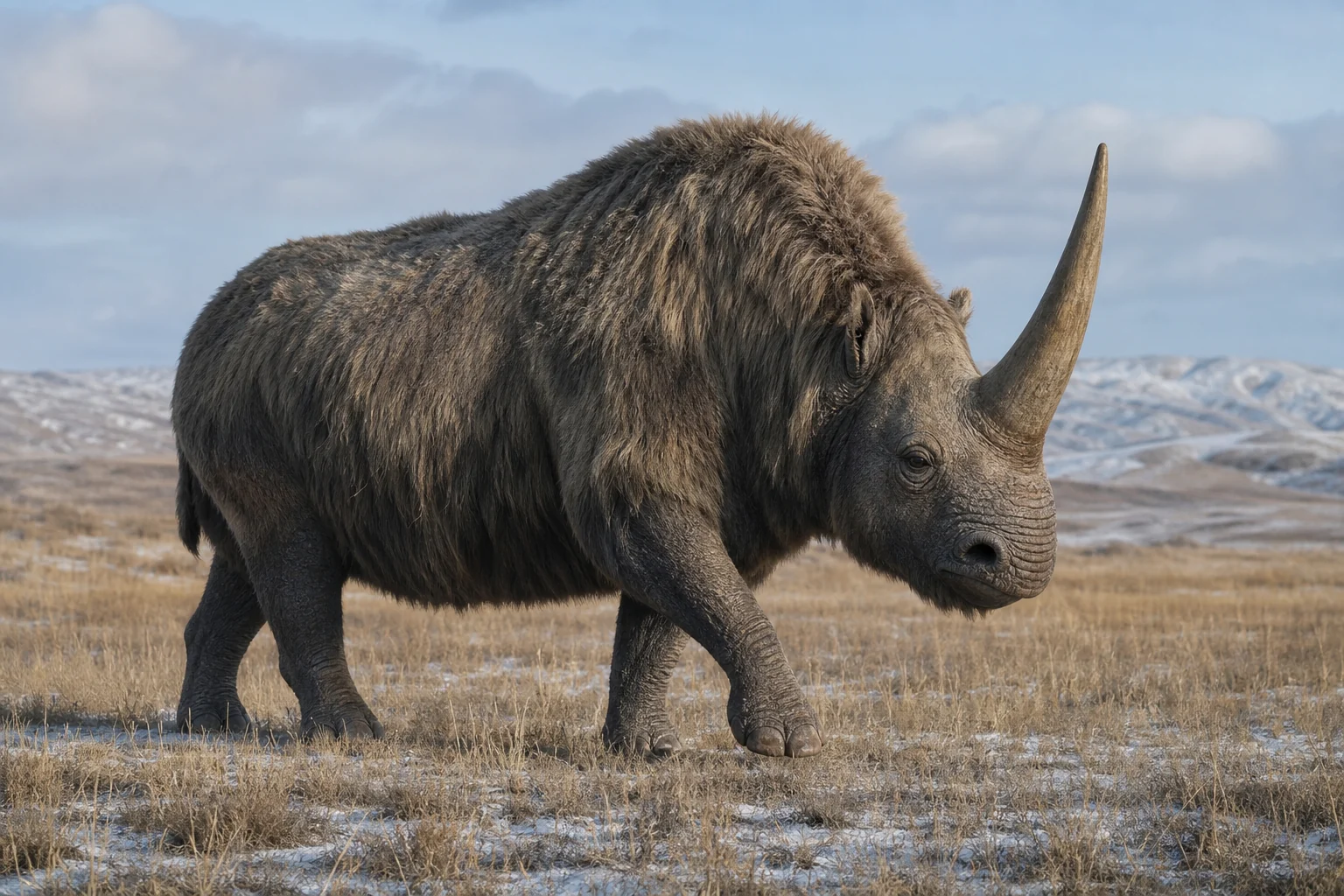 View full-resolution reconstruction ↗
This is an original generative reconstruction, not a photograph or scientific plate. Measurements and interpretations below are tied to named sources.
01 / REDATING
When did Elasmotherium actually survive?
Direct radiocarbon dating of multiple specimens produced ages as young as roughly 39,000 years. Older claims of disappearance hundreds of thousands of years earlier reflected undated or indirect assumptions.
02 / DIET
How specialised was its diet?
Dental wear and stable isotopes identify a strong grazing signal in open dry steppe. High-crowned teeth handled abrasive plants well but could not create suitable forage when ecosystems changed.
03 / CLIMATE
What changed around the last populations?
Late Marine Isotope Stage 3 brought strong climatic oscillation, colder conditions and restructuring of Eurasian vegetation. Grass-rich habitats became patchier and less reliable.
04 / HUMAN OVERLAP
Did humans hunt it to extinction?
Modern humans and Neanderthals overlapped it in time, but secure kill sites are lacking. Human pressure cannot be ruled out, yet direct evidence is weaker than the dietary and environmental case.
05 / RARITY
Why are late fossils rare?
The species was probably already uncommon and geographically restricted. Sparse fossils can reflect low population density, patchy preservation and limited sampling as well as true decline.
06 / VERDICT
What best explains the extinction?
Loss and fragmentation of specialised grazing habitat is the strongest current explanation. Small population size and possible human pressure may have lowered resilience, but a single final event is not documented.
FREQUENTLY ASKED QUESTIONS
Questions readers ask
Was Elasmotherium a unicorn?
It was a rhinoceros probably bearing one large horn, not the mythical horse-like unicorn.
Is the horn preserved?
No. Keratin decayed; only the skull boss survives.
How large was it?
Large adults are often estimated around 3.5 tonnes.
What did it eat?
It was a specialised grazer of dry-steppe grasses.
Did humans see it?
Its late dates overlap humans in Eurasia, but direct encounters are not documented.
When did it disappear?
It survived until at least 39,000 years ago.
SOURCES & FURTHER READING
Evidence used in this guide
Measurements and interpretations are tied to museum resources or peer-reviewed studies; disputed conclusions include evidence on both sides.
- 01Evolution and extinction of Elasmotherium sibiricum ↗Nature Ecology & Evolution · DOI 10.1038/s41559-018-0722-0
Direct dating, isotope ecology, DNA and extinction interpretation.
- 02Rhinoceros family genomes ↗Cell · DOI 10.1016/j.cell.2021.07.032
Ancient and living genomes reconstruct rhinoceros relationships.
- 03Siberian unicorns grazed Asia ↗Nature
Research summary of late survival and dietary specialisation.