
Explore this animal in Size of Extinct Animals ↗
63 / Cenozoic
Paraceratherium
Paraceratherium transouralicum
The largest known land mammal was a hornless rhinoceros relative built to browse high foliage.
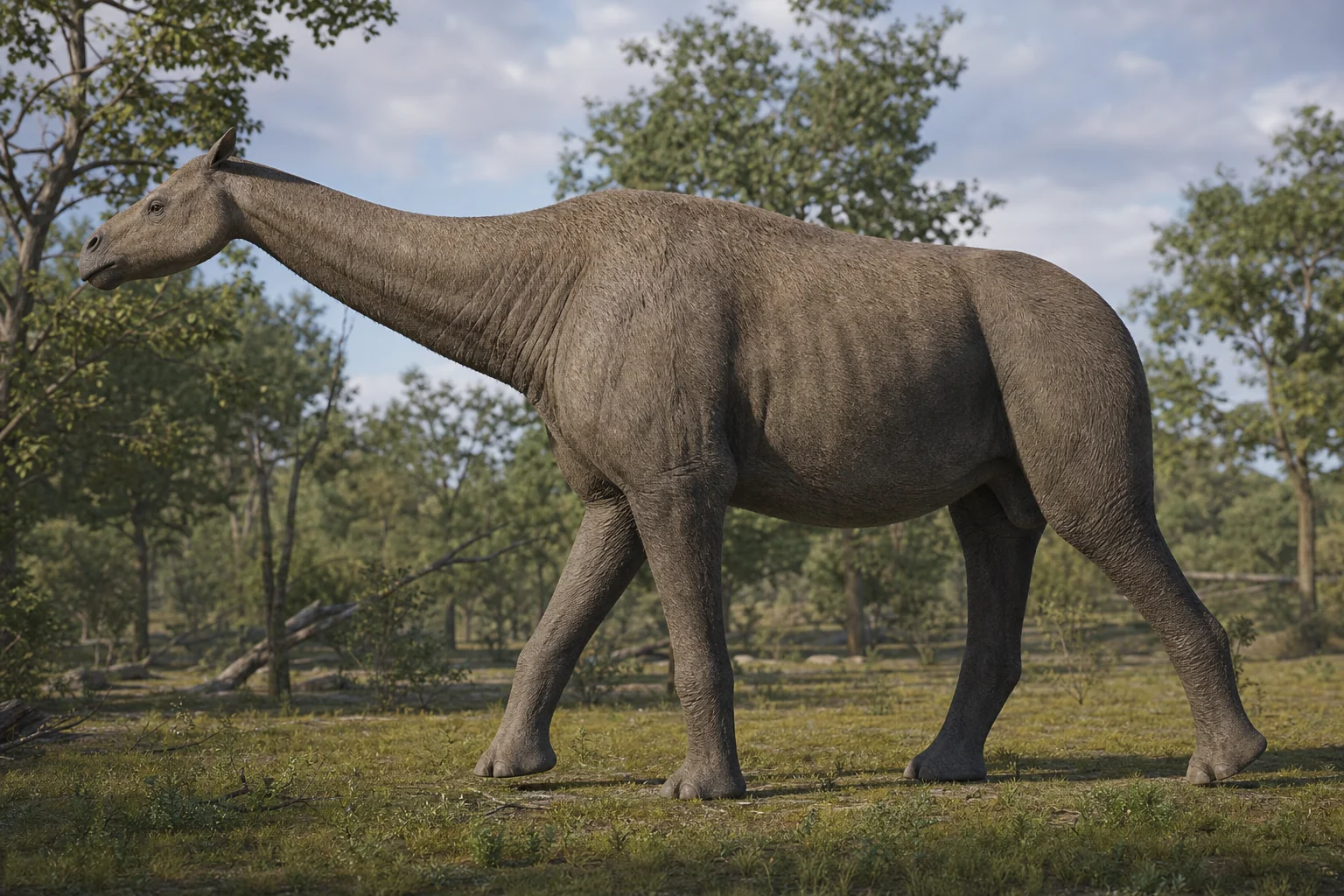 View original image · 1536 × 1024
- Time range
- About 34–23 million years ago
- Final stage
- End of the Oligocene
- Geographic range
- Central Asia
01 / ANSWER FIRST
What was Paraceratherium?
Paraceratherium was a gigantic hornless rhinoceros relative that browsed trees and shrubs across Oligocene Asia.
No complete skeleton exists, and several historical genus names were built from different body parts. Large individuals are often reconstructed near 4.8 metres at the shoulder and up to about 17–20 tonnes, but estimates vary widely.
02 / QUICK FACTS
Paraceratherium at a glance
- Scientific name
- Paraceratherium transouralicum
- Age
- ~34–23 million years ago
- Shoulder height
- Large individuals up to ~4.8 m
- Mass
- Often ~11–17 tonnes; uncertain
- Identity
- Hornless rhinoceros relative
- Diet
- High browsing herbivore
- Range
- Central and southern Asia
- Skeleton
- Composite and incomplete
03 / CORE QUESTION
Was Paraceratherium the largest land mammal?
It is among the largest land mammals that can be sized from substantial bones. Limb circumference and volumetric comparisons often yield 11–17 tonnes for large individuals, while older 30-tonne images exceed strong support.
Fragmentary giant elephants may rival or exceed it, but their estimates are also uncertain. A scientifically useful answer reports specimens, methods and ranges rather than declaring a permanent single champion.
Read the complete size-evidence guideHow to read the numbers
This page separates direct evidence, comparative inference and unresolved debate.
04 / LIFE & DISCOVERY TIMELINE
A giant reconstructed from scattered Asian skeletons
Indricothere radiation
Large hornless rhinocerotoids spread after Eocene turnover.
Separate genera named
Skulls and limb bones receive Baluchitherium and Indricotherium names.
Composite identity clarified
Many names are united or compared within Paraceratherium.
Lineage disappears
Climate, vegetation and faunal turnover reshape Asian ecosystems.
05 / ANATOMY
A towering browser without a horn
Long neck
Large cervical vertebrae raised the head into tree browse.
Hornless skull
Nasal bones lack the rough horn attachment of true horned rhinos.
Long limbs
Columnar bones supported mass while increasing browsing height.
Grasping upper lip
Skull form suggests a mobile lip for leaves, not a trunk.
06 / DIET & BEHAVIOUR
What did Paraceratherium eat?
High-crowned body posture and teeth support leaves, twigs and shrubs, with regional plant availability shaping diet.
Read the complete guide07 / DIET & BEHAVIOUR
How did such a giant move?
Straight strong limbs supported steady walking; speed and running gait cannot be read directly from isolated bones.
08 / RANGE & HABITAT
Where did Paraceratherium live?
Paraceratherium fossils span a broad Asian belt of seasonal woodland, scrub and open habitats.
Pakistan
Bugti deposits preserve foundational skull and limb material.
Kazakhstan
Large P. transouralicum remains anchor body estimates.
Mongolia and China
Multiple species and relatives record eastward spread.
Tibetan corridor
New fossils test highland and dispersal routes.
09 / FOSSIL EVIDENCE
How do scientists reconstruct Paraceratherium?
Limb bones
Circumference and length constrain support and mass.
Skulls and jaws
Teeth reveal browsing and taxonomic differences.
Vertebrae
Cervicals support neck length and head height.
Composite mounts
Museum skeletons visualise scale but mix specimens and inferred parts.
10 / DISAPPEARANCE & DEBATE
Why did Paraceratherium disappear?
Paraceratherium vanished near the end of the Oligocene during major Asian climate, vegetation and mammal-community change; a single cause is not demonstrated.
Cooling, drying, forest change and new proboscidean herbivores altered resources. Competition is plausible but cannot be isolated from habitat turnover and slow giant-mammal reproduction.
12 / FREQUENTLY ASKED QUESTIONS
Paraceratherium FAQ
How big was Paraceratherium?
Large individuals may have stood about 4.8 metres at the shoulder and weighed roughly 11–17 tonnes.
Was it a rhinoceros?
It was a giant hornless rhinoceros relative.
Did it have a horn?
No convincing horn attachment is present on the skull.
Did it have a trunk?
A mobile upper lip is plausible; a true elephant-like trunk is unsupported.
What did it eat?
Leaves, twigs and shrubs reached with its tall body and long neck.
Was it the largest land mammal?
It is among the largest reliably sized examples, but fragmentary elephants may rival it.
04 / SOURCES & FURTHER READING
Check the source record
Use the scientific name to compare taxonomy, occurrence records and the fossil record. Database coverage and classifications may differ.
05 / REVISION HISTORY
How has this record changed?
- Expanded into a bilingual S-tier hub with two evidence-led guides.
- Verified authoritative entity sources and added three responsive reconstruction sizes.
- Initial bilingual species record published.
06 / CORRECTIONS & ADDITIONS