
Explore this animal in Size of Extinct Animals ↗
32 / Paleozoic
Hallucigenia
Hallucigenia sparsa
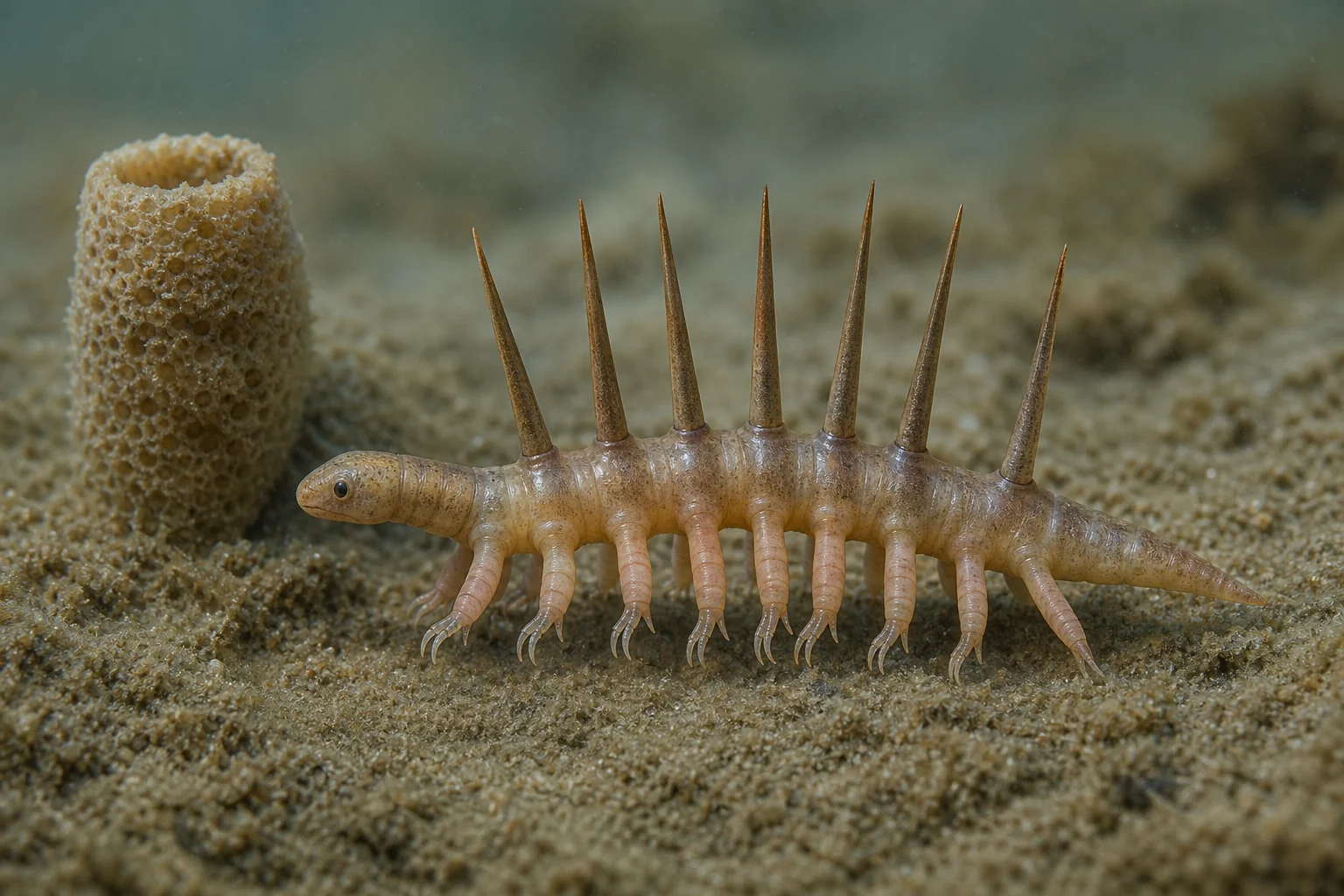
Paired spines guarded a soft-bodied walker once reconstructed upside down.
 View original image · 1536 × 1024
- Time range
- About 508 million years ago
- Final stage
- Middle Cambrian
- Geographic range
- Laurentian and South China shallows
01 / ANSWER FIRST
What was Hallucigenia?
Hallucigenia sparsa was a tiny spiny lobopodian that lived on Cambrian seafloors about 508 million years ago and belongs near the velvet-worm branch of the animal tree.
Its soft legs and rigid dorsal spines were so unfamiliar that the first whole-body reconstruction put the animal on its spines and treated a stain as its head. Better specimens later reversed both orientation and direction.
02 / QUICK FACTS
Hallucigenia at a glance
- Scientific name
- Hallucigenia sparsa
- Age
- About 508 million years ago
- Body length
- Commonly 10–35 mm
- Identity
- Lobopodian panarthropod
- Defence
- Seven pairs of dorsal spines
- Locomotion
- Soft clawed walking legs
- Diet
- Uncertain; likely small organic food
- Key locality
- Burgess Shale, Canada
03 / CORE QUESTION
Why was Hallucigenia reconstructed upside down?
Compression fossils reduce a three-dimensional soft animal to a dark film. Early workers interpreted paired dorsal spines as stilts and the true soft legs as tentacles, while the actual head was hidden in the rock.
Additional specimens preserved paired claws, a recognisable head and repeated leg anatomy. Preparing the hidden end revealed eyes, mouth and pharyngeal teeth, turning a historical error into a lesson about testing reconstructions across multiple fossils.
Read the complete reconstruction-history guideHow to read the numbers
This page separates direct evidence, comparative inference and unresolved debate.
04 / LIFE & DISCOVERY TIMELINE
From fossil puzzle to velvet-worm relative
First description
Walcott treated isolated remains as an annelid worm related to Canadia.
Upside-down reconstruction
Conway Morris named Hallucigenia and placed the animal on its rigid spines.
Orientation corrected
Chinese lobopodians and Burgess specimens showed that tentacles were legs and spines were dorsal.
Claws and head resolved
Microscopy revealed layered claws, eyes, mouth and pharyngeal armature.
05 / ANATOMY
A tiny armoured walker
Seven spine pairs
Long mineralised spines rose above the trunk and probably deterred predators; their living covering is not preserved.
Clawed lobopods
Flexible legs ended in paired claws built from stacked elements, a structure compared with velvet-worm claws and jaws.
Small head
The head carried simple eyes and a terminal mouth; internal teeth lined the foregut rather than forming external jaws.
Curved trunk
A narrow flexible body connected repeated leg and spine pairs, but fossil posture exaggerates bends produced during burial.
06 / DIET & BEHAVIOUR
What did Hallucigenia eat?
Its small terminal mouth and pharyngeal teeth could process small particles or soft food, but no diagnostic gut contents establish a precise diet.
Read the complete guide07 / DIET & BEHAVIOUR
How did it move?
Paired soft legs likely stepped across or just above the seafloor. Exact gait and speed remain inferred from anatomy and living velvet worms.
08 / RANGE & HABITAT
Where did Hallucigenia live?
Hallucigenia sparsa is best known from the Burgess Shale, while related Hallucigenia species and lobopodians occur in other Cambrian deposits.
Burgess Shale
Fine-grained deposits in British Columbia preserve soft legs, internal anatomy and spines together.
Tropical shelf margin
The community lived below a carbonate escarpment in a marine basin near the Cambrian equator.
Chengjiang relatives
Chinese lobopodian fossils helped establish the correct orientation and broader body plan.
Global lobopodian record
Related forms reveal a wider Cambrian radiation without making every specimen H. sparsa.
09 / FOSSIL EVIDENCE
How do scientists reconstruct Hallucigenia?
Multiple orientations
Specimens flattened from different angles distinguish paired structures from stains and overlaps.
Electron microscopy
High-resolution imaging revealed claw layers and carbon films invisible in ordinary light.
Head preparation
Removing a thin rock layer exposed eyes, mouth and pharyngeal teeth at the true anterior end.
Comparative anatomy
Velvet worms and other lobopodians test which traits belong to the panarthropod stem.
10 / DISAPPEARANCE & DEBATE
What remains uncertain about Hallucigenia?
Its broad body plan and orientation are secure, but exact diet, colour, gait and the function of every trunk appendage remain unresolved.
The fossil record preserves anatomy far better than behaviour. Responsible reconstructions separate directly visible claws, legs and spines from ecological scenes inferred through relatives and sediment.
12 / FREQUENTLY ASKED QUESTIONS
Hallucigenia FAQ
How large was Hallucigenia?
Most specimens are only about 10–35 millimetres long.
Did Hallucigenia walk on its spines?
No. It walked on soft paired legs; the rigid spines projected from its back.
How many eyes did Hallucigenia have?
The head is reconstructed with one simple eye on each side.
Was Hallucigenia an arthropod?
It was a panarthropod lobopodian near the lineage linking velvet worms and arthropods, not a crown-group arthropod.
What did Hallucigenia eat?
The exact diet is unknown; small soft or particulate food is plausible.
Why is Hallucigenia famous?
Its radically revised reconstruction became a classic example of how new fossils correct scientific interpretations.
04 / SOURCES & FURTHER READING
Check the source record
Use the scientific name to compare taxonomy, occurrence records and the fossil record. Database coverage and classifications may differ.
05 / REVISION HISTORY
How has this record changed?
- Expanded into a bilingual S-tier hub with anatomy and reconstruction-history evidence guides.
- Verified authoritative entity sources and added three responsive reconstruction sizes.
- Initial bilingual species record published.
06 / CORRECTIONS & ADDITIONS