
ELASMOTHERIUM TOPIC HUB · HORN & ANATOMY
Elasmotherium Horn, Size and the Siberian Unicorn Evidence
How large was Elasmotherium sibiricum and what can its skull really tell us about the famous giant horn?
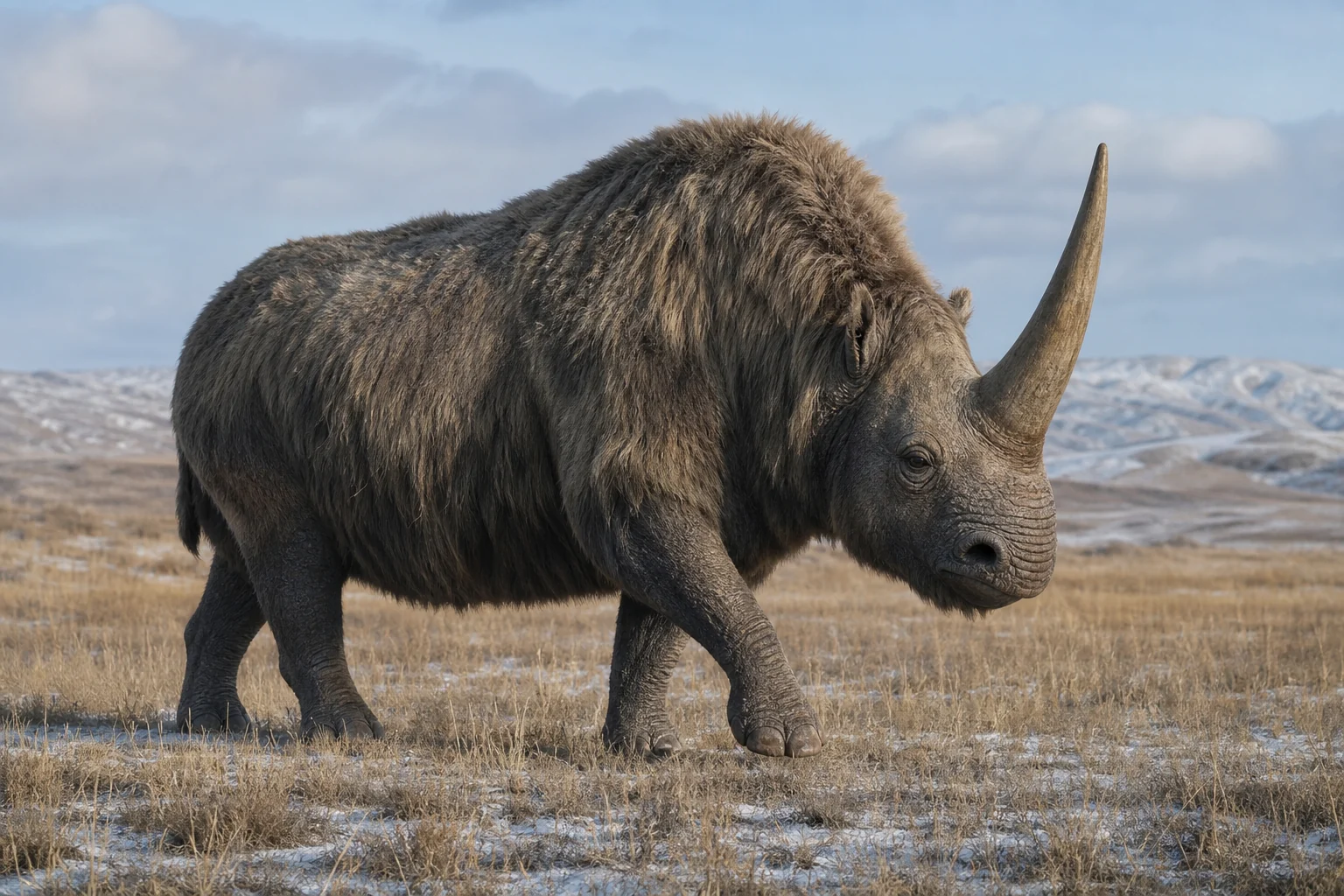 View full-resolution reconstruction ↗
This is an original generative reconstruction, not a photograph or scientific plate. Measurements and interpretations below are tied to named sources.
01 / SIZE
How large was Elasmotherium?
Skeletons support a long, deep-bodied rhinoceros around four metres or more, with mass estimates of several tonnes. Fragmentary specimens make exact maxima model-dependent.
02 / NASAL BOSS
What evidence supports a giant horn?
A broad domed nasal boss has rough vascularised attachment texture for keratin. It strongly supports a substantial horn base, not the precise spear-shaped horn common in artwork.
03 / MISSING HORN
Why is the horn not fossilised?
Rhinoceros horns are compacted keratin fibres rather than bone and usually decay. Without permafrost soft tissue or mineral replacement, shape must be inferred from attachment and living relatives.
04 / POSITION
Was the horn on its forehead?
The support lies over the nasal region, though the large boss extends high on the skull. Calling it a forehead unicorn can misplace the anatomy and exaggerate resemblance to a horse.
05 / GRAZING BODY
What did the rest of the body do?
Long high-crowned teeth processed abrasive steppe plants, while strong limbs carried a large torso across open ground. It was a specialised rhinoceros, not a horse with one horn.
06 / RECONSTRUCTION
How should artists show uncertainty?
Use a large rhinoceros body and a prominent nasal horn, but avoid claiming a measured horn length. Alternative silhouettes or a caption can distinguish bone-supported anatomy from keratin reconstruction.
FREQUENTLY ASKED QUESTIONS
Questions readers ask
Was Elasmotherium a unicorn?
It was a rhinoceros probably bearing one large horn, not the mythical horse-like unicorn.
Is the horn preserved?
No. Keratin decayed; only the skull boss survives.
How large was it?
Large adults are often estimated around 3.5 tonnes.
What did it eat?
It was a specialised grazer of dry-steppe grasses.
Did humans see it?
Its late dates overlap humans in Eurasia, but direct encounters are not documented.
When did it disappear?
It survived until at least 39,000 years ago.
SOURCES & FURTHER READING
Evidence used in this guide
Measurements and interpretations are tied to museum resources or peer-reviewed studies; disputed conclusions include evidence on both sides.
- 01Evolution and extinction of Elasmotherium sibiricum ↗Nature Ecology & Evolution · DOI 10.1038/s41559-018-0722-0
Direct dating, isotope ecology, DNA and extinction interpretation.
- 02Rhinoceros family genomes ↗Cell · DOI 10.1016/j.cell.2021.07.032
Ancient and living genomes reconstruct rhinoceros relationships.
- 03Siberian unicorns grazed Asia ↗Nature
Research summary of late survival and dietary specialisation.