
DIMETRODON TOPIC HUB · SAIL FUNCTION
What Was the Dimetrodon Sail For?
Compare thermal, display and growth evidence.
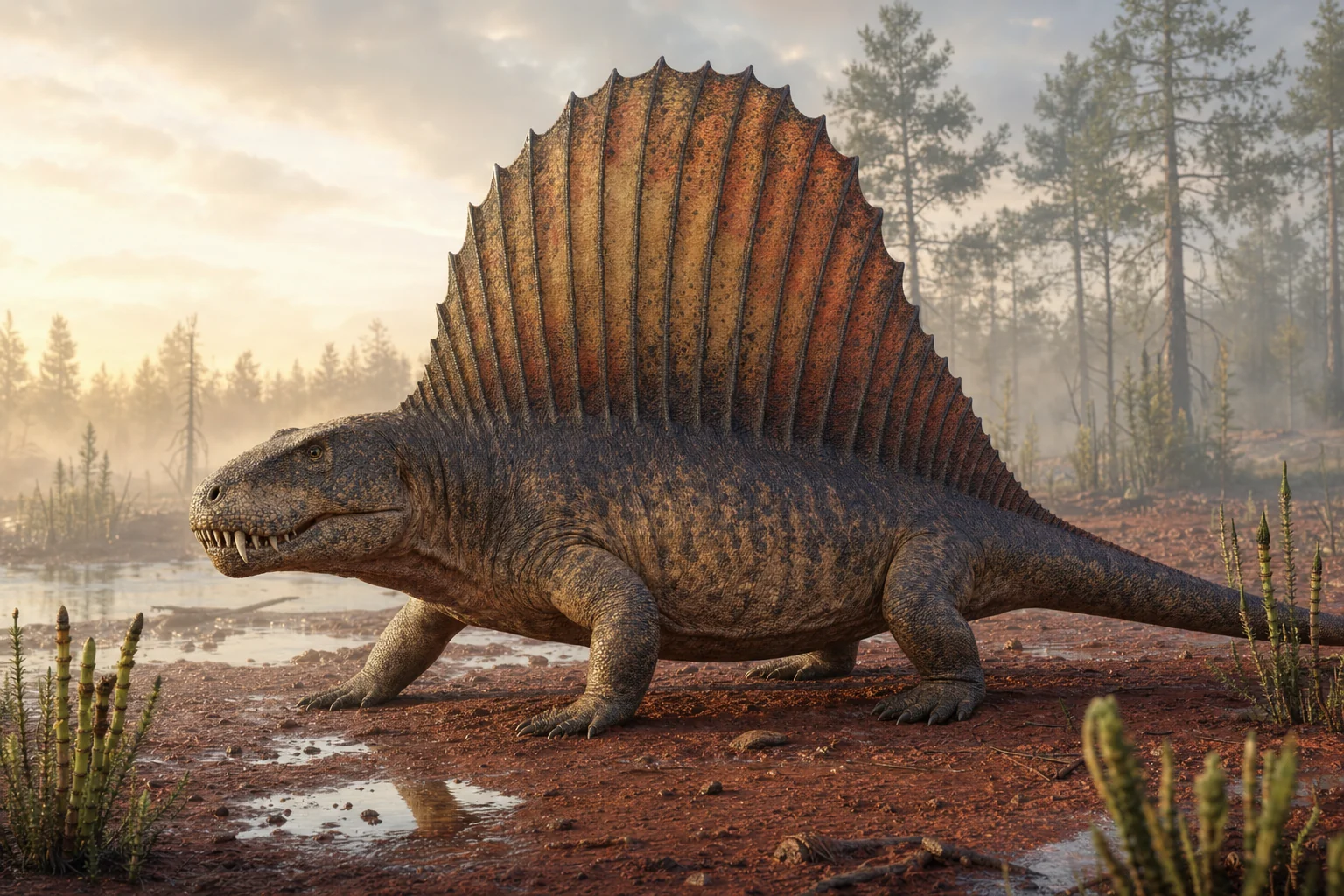 View full-resolution reconstruction ↗
This is an original generative reconstruction, not a photograph or scientific plate. Measurements and interpretations below are tied to named sources.
01 / SHORT ANSWER
What was the sail for?
Blood vessels and broad surface area inspired heat-gain and cooling models, but vascular bone does not reveal total soft tissue or prove thermoregulation as the main selected function.
Sails varied with species, size and growth and would have been conspicuous in profile. Display, recognition, apparent size and thermoregulation may all have contributed rather than one exclusive purpose.
02 / ECOLOGY
What did Dimetrodon eat and how did it live?
What did Dimetrodon eat?: Fish, amphibians and other tetrapods were potential prey, varying strongly among differently sized species.
Was it warm-blooded?: The sail debate does not establish mammal-like endothermy; physiology is inferred indirectly from bone, growth and ecology.
03 / PLACE & TIME
Where did Dimetrodon live?
Most famous fossils come from red-bed river and floodplain deposits of Texas and Oklahoma, with related species in New Mexico and Europe.
Texas red beds: Abundant skeletons anchor anatomy and growth.
Oklahoma: Additional species and size classes occur.
New Mexico: Western records extend the range.
Seasonal lowlands: Channels and drought-prone ponds concentrated prey.
04 / SOURCE RECORD
How do scientists know about Dimetrodon?
Skeletons: Many individuals preserve skull, spine and limbs.
Histology: Spine and limb growth record age and vascularity.
Tooth wear: Damage and replacement reveal feeding mechanics.
Phylogeny: Skull openings and anatomy place it among synapsids.
05 / SCIENTIFIC DEBATE
What remains uncertain?
Primary sail function.
Soft-tissue sail thickness.
Species-level size estimates.
Metabolic physiology.
06 / EVIDENCE VERDICT
Why is Dimetrodon not a dinosaur?
It lived earlier and belongs to Synapsida, the branch that later produced mammals; dinosaurs lie on the separate archosaur side of the amniote tree.
The familiar sail is a superficial resemblance to some dinosaurs, not a taxonomic character.
FREQUENTLY ASKED QUESTIONS
Questions readers ask
Was Dimetrodon a dinosaur?
No. It was a non-mammalian synapsid closer to mammals.
When did it live?
In the Early Permian, tens of millions of years before dinosaurs.
How big was it?
Species ranged from under two to about 4.6 metres.
What was the sail for?
Display and thermoregulation are both plausible contributors.
What did it eat?
Fish, amphibians and other early tetrapods.
Why is it called Dimetrodon?
The name refers to its differently shaped teeth.
SOURCES & FURTHER READING
Evidence used in this guide
Measurements and interpretations are tied to museum resources or peer-reviewed studies; disputed conclusions include evidence on both sides.
- 01Synapsida reference ↗Smithsonian Institution
Institutional reference on Dimetrodon and mammal-line synapsids.
- 02Dimetrodon ↗Paleobiology Database
Taxonomic and occurrence record.
- 03Dimetrodon grandis ↗GBIF
Stable biodiversity identifier.