
Explore this animal in Size of Extinct Animals ↗
60 / Cenozoic
Titanoboa
Titanoboa cerrejonensis
The largest known snake moved through hot tropical swamps after the dinosaurs vanished.
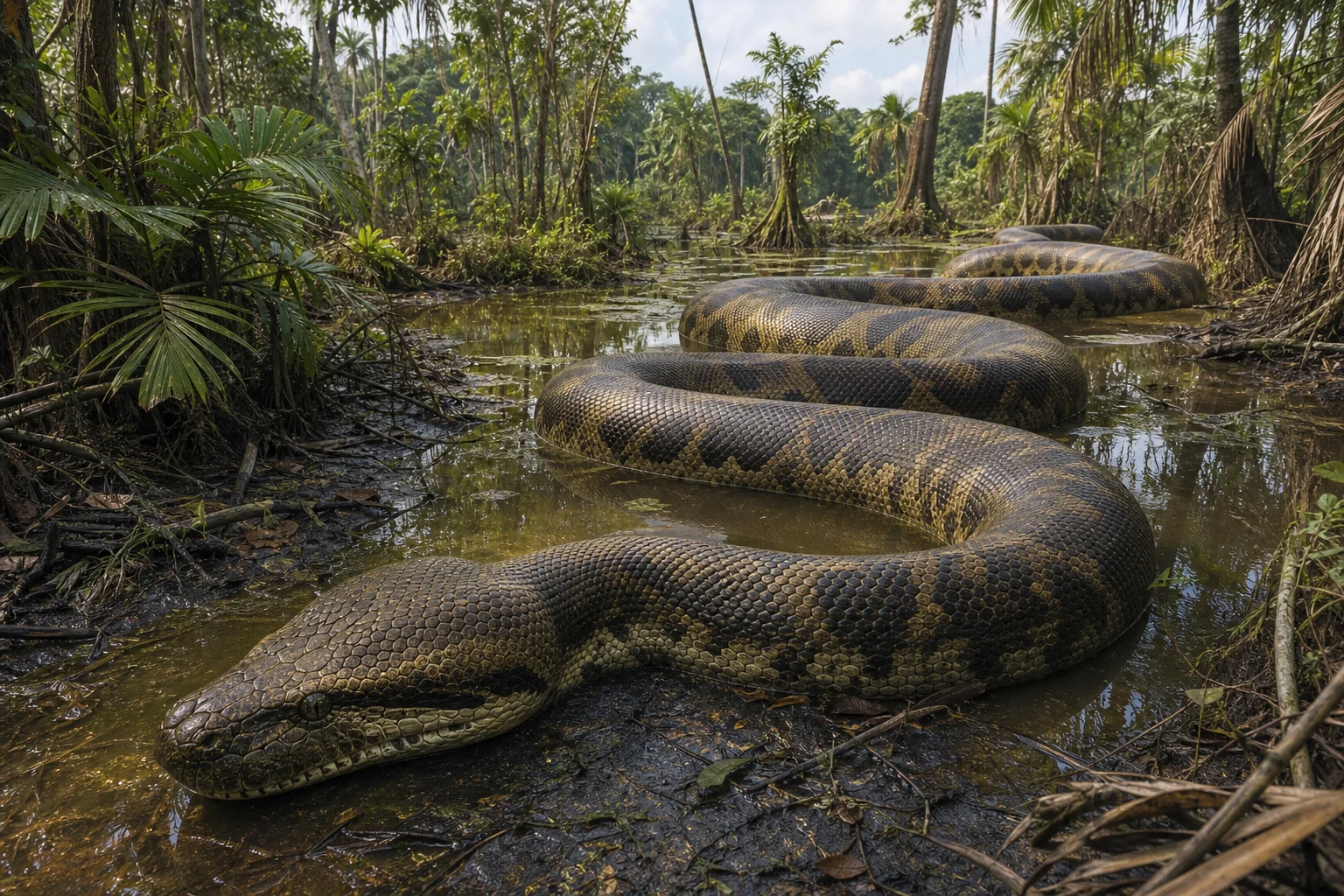 View original image · 1536 × 1024
- Time range
- About 60–58 million years ago
- Final stage
- Paleocene
- Geographic range
- Northern South America · Present-day Colombia
01 / ANSWER FIRST
What was Titanoboa?
Titanoboa was a giant boid snake from Colombia's Paleocene Cerrejón Formation about 60–58 million years ago and is the largest snake securely documented from fossils.
Its original 12.8-metre estimate came from exceptionally large trunk vertebrae compared with living boas and anacondas; later skull material suggested a possible 14.3-metre estimate. Both are proportional reconstructions with broad error ranges, not the measured length of a complete skeleton.
02 / QUICK FACTS
Titanoboa at a glance
- Scientific name
- Titanoboa cerrejonensis
- Age
- About 60–58 million years ago
- Estimated length
- About 12.8 m; later skull scaling up to 14.3 m
- Estimated mass
- Around 1,135 kg in the original model
- Lifestyle
- Large semi-aquatic river predator
- Diet
- Likely fish-rich; other vertebrates possible
- Climate signal
- Supports very warm tropics; exact temperature debated
- Range
- Cerrejón, northern Colombia
03 / CORE QUESTION
Was Titanoboa simply a giant anaconda?
Anacondas provide useful scaling because they are massive aquatic boids, but Titanoboa was not a species of anaconda. Vertebrae and fragmentary skull bones place it within boa relationships while preserving a distinct anatomy.
Its large body, river deposits and fish-associated skull features suggest a semi-aquatic predator. Reconstructions should borrow anaconda-like buoyancy and locomotion cautiously, while avoiding claims about colour, exact coil strength or a single preferred prey that fossils cannot measure.
Read the complete size comparisonHow to read the numbers
This page separates direct evidence, comparative inference and unresolved debate.
04 / LIFE & DISCOVERY TIMELINE
From coal mine vertebrae to a lost rainforest
Cerrejón fieldwork
Teams recovered enormous snake vertebrae from a Colombian coal mine.
Titanoboa named
The original Nature paper estimated 12.8 m and used size to discuss tropical temperature.
Skull material recovered
Partial cranial and jaw bones sharpened estimates and suggested fish-eating adaptations.
Anaconda comparison reviewed
A modern review separated reasonable ecological analogies from unsupported assumptions.
05 / ANATOMY
A giant known vertebra by vertebra
Huge vertebrae
Broad precloacal vertebrae preserve boa-like features and provide the main size proxy.
Long muscular trunk
Hundreds of vertebrae and ribs would support undulatory movement and prey restraint.
Fragmentary skull
Maxilla, palate and jaw elements imply a skull around 40 cm in one reconstruction.
Fish-associated teeth
High tooth counts and relatively weak tooth attachment resemble features associated with piscivory.
06 / DIET & BEHAVIOUR
What did Titanoboa eat?
Skull features and abundant large fish in Cerrejón support a fish-rich diet, unusual among giant living boas. Crocodyliforms, turtles and other river vertebrates were available, but direct gut contents or bite traces are absent.
Read the complete guide07 / DIET & BEHAVIOUR
Was the rainforest hotter?
Ectotherm body size initially implied mean annual temperatures around 30–34°C. Later work notes that physiology, aquatic habits, prey and scaling complicate a precise thermometer, so Titanoboa supports exceptional warmth more securely than one exact temperature.
08 / RANGE & HABITAT
Where did Titanoboa live?
Every confirmed Titanoboa fossil comes from the Cerrejón Formation of northern Colombia, which preserves the oldest well-documented Neotropical rainforest after the K–Pg extinction.
Cerrejón coal mine
Mining exposures revealed mudstones and coal rich in Paleocene plants and vertebrates.
Large rivers
Deposits record broad channels, floodplains and swamp forests suited to a giant aquatic snake.
Warm wet forest
Palms and diverse tropical plants formed a humid low-latitude ecosystem.
Rich river fauna
Large lungfish, osteoglossomorphs, turtles and crocodyliforms shared its waters.
09 / FOSSIL EVIDENCE
How do scientists reconstruct Titanoboa?
Multiple vertebrae
Vertebrae from several individuals establish exceptional size and boa affinities.
Modern snake scaling
Boa and anaconda measurements translate vertebral and skull dimensions into ranges, not exact totals.
Partial cranium
Associated jaw and palate bones test taxonomy, head size and possible feeding ecology.
Whole ecosystem
Plants, sediments and co-occurring vertebrates independently constrain habitat and available prey.
10 / DISAPPEARANCE & DEBATE
Why did Titanoboa disappear?
Titanoboa disappears from the fossil record after the Paleocene; its precise extinction cause is unknown.
Changes in climate, river systems, prey communities and snake lineages could all have mattered. The record is too geographically narrow to identify a single event, and no evidence links its disappearance to one sudden catastrophe.
12 / FREQUENTLY ASKED QUESTIONS
Titanoboa FAQ
How long was Titanoboa?
The original vertebral estimate was about 12.8 m; later skull scaling suggested about 14.3 m, both with wide uncertainty.
How heavy was it?
The original large-individual model estimated roughly 1,135 kg, not a directly weighed mass.
Was it an anaconda?
No. It was a distinct extinct boid; anacondas are useful analogues, not the same lineage.
Did Titanoboa eat crocodiles?
Small crocodyliforms were available and possible prey, but skull evidence currently gives fish a stronger role than popular scenes imply.
Could it live today?
That cannot be tested directly; climate, habitat, prey and physiology all matter beyond air temperature alone.
Is a complete skeleton known?
No. The record consists mainly of vertebrae and ribs plus incomplete skull and jaw elements.
04 / SOURCES & FURTHER READING
Check the source record
Use the scientific name to compare taxonomy, occurrence records and the fossil record. Database coverage and classifications may differ.
05 / REVISION HISTORY
How has this record changed?
- Upgraded to a bilingual S-tier topic hub with size-comparison and ecology-diet guides.
- Verified authoritative entity sources and added three responsive reconstruction sizes.
- Initial bilingual species record published.
06 / CORRECTIONS & ADDITIONS