
TITANOBOA TOPIC HUB · SIZE COMPARISON
Titanoboa Size and Weight vs Anaconda
How large was Titanoboa? Compare vertebral and skull scaling, 12.8- and 14.3-metre estimates, mass, error ranges and valid differences from living anacondas.
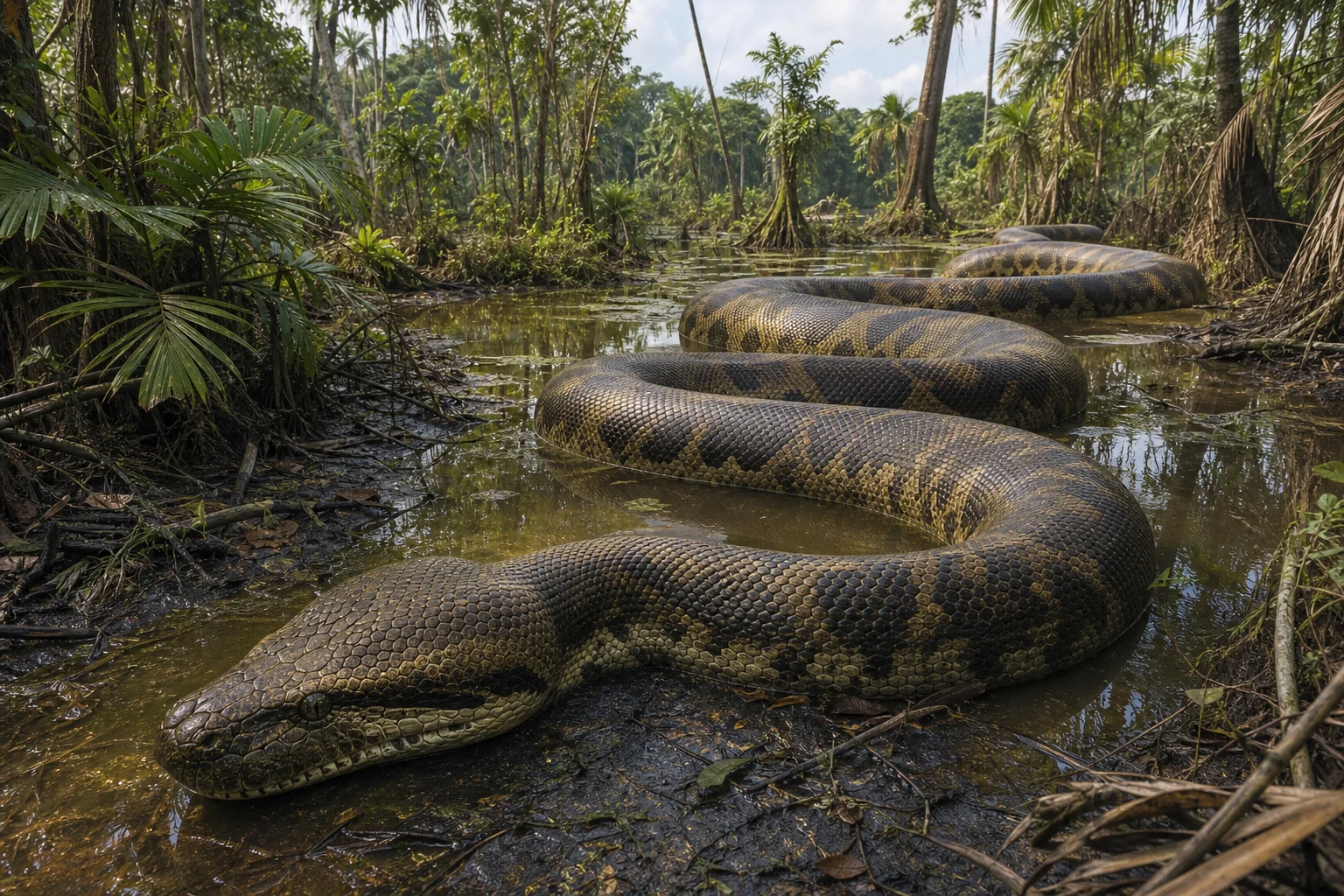 View full-resolution reconstruction ↗
This is an original generative reconstruction, not a photograph or scientific plate. Measurements and interpretations below are tied to named sources.
01 / FOSSILS
What parts of Titanoboa survive?
The sample contains numerous large precloacal vertebrae and ribs from several individuals, plus incomplete maxilla, palate, quadrate and lower-jaw elements. No articulated head-to-tail skeleton exists. Different bones therefore create partly independent estimates but cannot be added into one measured animal.
02 / VERTEBRAL SCALE
How did vertebrae yield 12.8 metres?
Researchers compared the width and shape of Titanoboa trunk vertebrae with corresponding positions in living boas and anacondas. Regression equations translated exceptional vertebral size into about 12.8 metres for the largest sample, with an uncertainty of roughly two metres. Position along the spine and choice of living analogue matter.
03 / SKULL SCALE
Why did a later estimate reach 14.3 metres?
Partial cranial elements suggested an approximately 40-centimetre skull. Scaling head length against the living anaconda produced about 14.3 metres, again with a wide range. Because snake head-to-body proportions vary with ecology, sex and growth, this value is a second model rather than proof that the original was too small.
04 / MASS
Where does one tonne come from?
The original study used length–mass relationships in large living snakes to estimate roughly 1,135 kilograms for a 12.8-metre Titanoboa. Mass grows faster than length because girth contributes strongly to volume, so a modest length change can shift weight substantially. Unknown body condition makes a precise tonne figure misleading.
05 / ANACONDA COMPARISON
How much larger was Titanoboa?
Verified giant green anacondas are much shorter and lighter than Titanoboa's central estimates, even though exaggerated modern snake reports complicate popular comparisons. Anacondas remain useful because they are heavy-bodied aquatic boids. They do not prove identical colour, behaviour, prey choice or physiology in an extinct Paleocene lineage.
06 / RESPONSIBLE SCALE
Which number belongs in a size graphic?
Use 12.8 metres as the peer-reviewed original central estimate, mention the later 14.3-metre skull-based estimate and show uncertainty rather than a hard maximum. Pair any one-tonne label with its scaling basis. A visual comparison should align skeleton-derived lengths, not oversized folklore anacondas.
FREQUENTLY ASKED QUESTIONS
Questions readers ask
How long was Titanoboa?
The original vertebral estimate was about 12.8 m; later skull scaling suggested about 14.3 m, both with wide uncertainty.
How heavy was it?
The original large-individual model estimated roughly 1,135 kg, not a directly weighed mass.
Was it an anaconda?
No. It was a distinct extinct boid; anacondas are useful analogues, not the same lineage.
Did Titanoboa eat crocodiles?
Small crocodyliforms were available and possible prey, but skull evidence currently gives fish a stronger role than popular scenes imply.
Could it live today?
That cannot be tested directly; climate, habitat, prey and physiology all matter beyond air temperature alone.
Is a complete skeleton known?
No. The record consists mainly of vertebrae and ribs plus incomplete skull and jaw elements.
SOURCES & FURTHER READING
Evidence used in this guide
Measurements and interpretations are tied to museum resources or peer-reviewed studies; disputed conclusions include evidence on both sides.
- 01Giant boid snake from the Palaeocene neotropics reveals hotter past equatorial temperatures ↗Nature
Original description, vertebral size estimate and climate inference.
- 02World's Largest Snake Discovered in Fossilized Rainforest ↗Smithsonian Institution
Official discovery context and Cerrejón ecosystem summary.
- 03What can studying anacondas tell us about Titanoboa cerrejonensis? ↗The Herpetological Journal
Peer-reviewed review of size, aquatic ecology, feeding and limits of anaconda analogy.