
TITANOBOA TOPIC HUB · ECOLOGY & DIET
How Did Titanoboa Live and What Did It Eat?
Reconstruct Titanoboa's life from Cerrejón rivers, skull and vertebral anatomy, fish-eating signals, possible crocodilian prey, anaconda comparison and climate uncertainty.
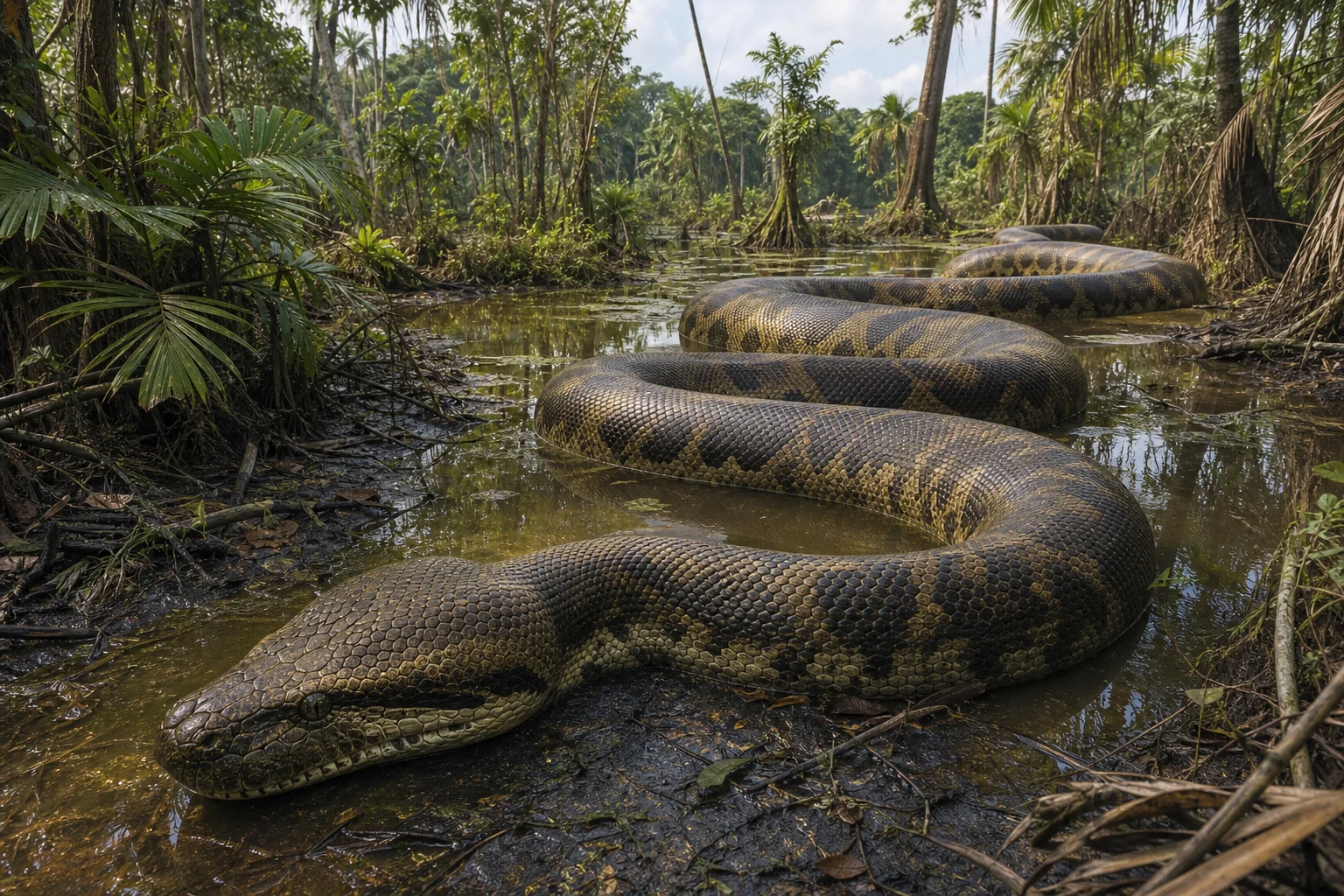 View full-resolution reconstruction ↗
This is an original generative reconstruction, not a photograph or scientific plate. Measurements and interpretations below are tied to named sources.
01 / CERREJÓN
What kind of world surrounded Titanoboa?
Coal, leaves, pollen and river sediments record a hot, humid lowland rainforest only a few million years after the K–Pg extinction. Broad channels and floodplains supported palms, large fish, turtles and several crocodyliforms. This independent ecosystem evidence is as important as snake anatomy when reconstructing daily life.
02 / AQUATIC LIFE
Why reconstruct a semi-aquatic snake?
Its enormous mass would be supported by buoyancy, and the fossils occur in large river deposits alongside aquatic prey. Robust vertebrae and comparison with heavy-bodied boas fit powerful lateral undulation in water. They do not show that Titanoboa never crossed land or spent every hour submerged.
03 / FISH EVIDENCE
Why have fish moved to the centre of its diet?
Partial skull elements show high tooth counts, weakly ankylosed teeth and palate features resembling adaptations associated with fish capture in other snakes. Cerrejón contained large lungfish and osteoglossomorphs. The cranial interpretation is still based on incomplete, briefly described material, so fish-rich is safer than fish-only.
04 / CROCODILIAN CLAIM
Did Titanoboa specialize in crocodiles?
Small crocodyliforms shared the same rivers, and living giant snakes can take crocodilians, so such predation is plausible. No Titanoboa gut contents, bite traces or associated prey skeleton currently demonstrate it. Popular scenes should be labelled as an ecological possibility rather than its defining menu.
05 / CLIMATE
Can a giant snake measure ancient temperature?
Because living ectotherm maximum size correlates with environmental heat, the original study inferred mean annual tropical temperatures around 30–34°C. Critics and later reviews note that water buffers temperature and that food supply, physiology and scaling also constrain size. Titanoboa supports a very warm world more strongly than one exact thermometer reading.
06 / EVIDENCE VERDICT
What is the best current life reconstruction?
Place Titanoboa in warm, slow or broad Cerrejón waters, moving between channel and swamp forest and taking abundant aquatic vertebrates. Give fish a prominent role, leave room for turtles and crocodyliforms, and state that prey proportions are inferred. Avoid assigning a modern anaconda's exact colour, social life or constriction performance.
FREQUENTLY ASKED QUESTIONS
Questions readers ask
How long was Titanoboa?
The original vertebral estimate was about 12.8 m; later skull scaling suggested about 14.3 m, both with wide uncertainty.
How heavy was it?
The original large-individual model estimated roughly 1,135 kg, not a directly weighed mass.
Was it an anaconda?
No. It was a distinct extinct boid; anacondas are useful analogues, not the same lineage.
Did Titanoboa eat crocodiles?
Small crocodyliforms were available and possible prey, but skull evidence currently gives fish a stronger role than popular scenes imply.
Could it live today?
That cannot be tested directly; climate, habitat, prey and physiology all matter beyond air temperature alone.
Is a complete skeleton known?
No. The record consists mainly of vertebrae and ribs plus incomplete skull and jaw elements.
SOURCES & FURTHER READING
Evidence used in this guide
Measurements and interpretations are tied to museum resources or peer-reviewed studies; disputed conclusions include evidence on both sides.
- 01Giant boid snake from the Palaeocene neotropics reveals hotter past equatorial temperatures ↗Nature
Original description, vertebral size estimate and climate inference.
- 02World's Largest Snake Discovered in Fossilized Rainforest ↗Smithsonian Institution
Official discovery context and Cerrejón ecosystem summary.
- 03What can studying anacondas tell us about Titanoboa cerrejonensis? ↗The Herpetological Journal
Peer-reviewed review of size, aquatic ecology, feeding and limits of anaconda analogy.