
Explore this animal in Size of Extinct Animals ↗
217 / Paleozoic
Prionosuchus
Prionosuchus plummeri
A giant Brazilian amphibian with a crocodile-like snout; its famous 9-metre length is a reconstruction from fragmentary fossils.
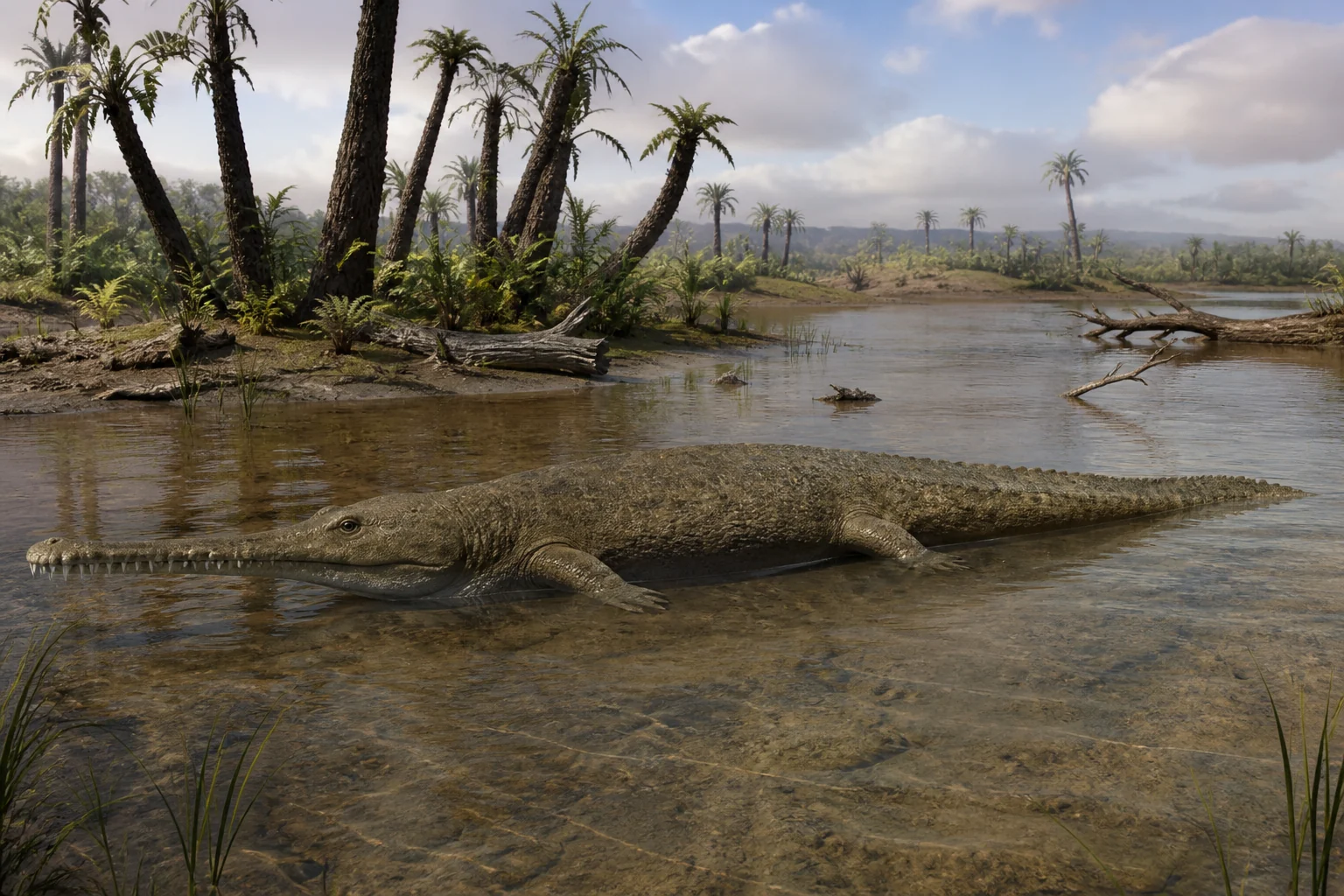 View original image · 1536 × 1024
- Time range
- Early Permian (formation correlation; age revised in 2015)
- Final stage
- Last occurrence uncertain
- Geographic range
- Tropical rivers and lagoons · Northern Brazil
01 / ANSWER FIRST
What was Prionosuchus?
Prionosuchus plummeri was a large aquatic temnospondyl amphibian from Brazil. Its long, narrow, tooth-lined snout resembles a crocodile's, but it belonged to a different branch of vertebrate evolution.
The famous estimate of up to about 9 metres refers to a reconstruction from fragmentary material, not a complete 9-metre skeleton. Its fossils also illustrate a second uncertainty: older papers assigned a younger age to the rock formation than later regional research did.
02 / QUICK FACTS
Prionosuchus at a glance
- Animal group
- Archegosaurid temnospondyl amphibian
- Maximum length claim
- Up to about 9 m (30 ft); extrapolated, not a complete skeleton
- Fossil locality
- Pedra de Fogo Formation, northeastern Brazil
- Age interpretation
- Early Permian in the 2015 formation correlation
- Likely feeding role
- Aquatic predator; exact prey list unknown
Prionosuchus size: how secure is the 9-metre estimate?
A maximum near 9 metres is widely cited, including by Guinness World Records with reference to Cox and Hutchinson's 1991 study. The critical word is estimate: preserved skull material must be scaled to a hypothetical whole animal. Changing the assumed head-to-body proportions changes the result.
For comparison with a human or another extinct animal, treat that number as an approximate upper reconstruction. It is not the average adult size, and it does not establish a measured body weight. A silhouette drawn to that scale should retain the same qualification.
03 / ANATOMY
Why did it look like a crocodile?
A narrow snout
The elongated jaws carried numerous teeth suited to holding prey. A similar outline can evolve independently in unrelated aquatic predators; resemblance alone does not establish crocodilian ancestry.
An amphibian skull
Cox and Hutchinson classified the animal through skull anatomy as an archegosaurid temnospondyl. This anatomical diagnosis is more informative than comparing modern illustrations.
04 / DIET & BEHAVIOUR
What did Prionosuchus eat?
Fish and other aquatic prey are plausible from its jaws and setting. These are feeding inferences, not a preserved menu. The sources here do not establish particular prey species or a quantified bite force.
05 / DIET & BEHAVIOUR
Where did it live?
The fossils come from the Pedra de Fogo Formation in northeastern Brazil. The 2015 regional study describes continental aquatic environments and distinguishes new lower-formation finds from the uppermost beds that yielded Prionosuchus.
06 / RANGE & HABITAT
When did Prionosuchus live?
The age belongs to a geological interpretation, not a date measured directly from an individual animal.
Why older sources say Late Permian
The 1991 paper placed the Pedra de Fogo fauna in the Late Permian using comparisons with other fossil animals. That title remains part of the historical literature even when later correlations change the interpretation.
The Early Permian interpretation
Cisneros and colleagues in 2015 supported a Kungurian assignment through regional biostratigraphic correlations. The approximately 278-million-year dates discussed concern correlated deposits, not a direct radiometric date on a Prionosuchus fossil.
07 / FOSSIL EVIDENCE
What do the Prionosuchus fossils actually establish?
Bones versus whole-body reconstruction
Fossil skull parts establish the distinctive snout and substantial size. Missing body parts introduce uncertainty into length, mass and life appearance. An artwork fills those gaps; it is not additional fossil evidence.
Formation versus species range
Assigning the formation to part of the Permian does not demonstrate that this species lived throughout that entire interval. Its first and last appearances remain constrained by a sparse record.
08 / DISAPPEARANCE & DEBATE
Why did Prionosuchus go extinct?
The cited fossil studies do not establish a species-specific extinction cause.
A change in a fossil assemblage can reflect missing deposits or changing habitats as well as biological extinction. Its Permian age alone is not evidence that it survived until the end-Permian mass extinction.
09 / FREQUENTLY ASKED QUESTIONS
Prionosuchus FAQ
Was Prionosuchus a dinosaur?
No. It was a temnospondyl amphibian from the Permian, before the first dinosaurs appeared in the Triassic.
Was Prionosuchus the largest amphibian?
It is often presented as a record holder because of the roughly 9-metre reconstruction. The comparison depends on scaling fragmentary fossils, so it is not a measured length from a complete animal.
Did Prionosuchus live with Spinosaurus?
No. Prionosuchus was Permian, while Spinosaurus lived much later in the Cretaceous. A size comparison between them is not evidence of an encounter.
04 / SOURCES & FURTHER READING
Check the source record
Use the scientific name to compare taxonomy, occurrence records and the fossil record. Database coverage and classifications may differ.
05 / REVISION HISTORY
How has this record changed?
- Expanded answers to reader questions, clarified the scope of fossil evidence and improved routes to related explanations.
- Added a sourced bilingual topic hub covering size, discovery history, anatomy, diet, habitat, uncertainty and FAQs; updated search metadata.
- Verified authoritative entity sources and added three responsive reconstruction sizes.
- Initial bilingual species record published.
06 / CORRECTIONS & ADDITIONS