
Explore this animal in Size of Extinct Animals ↗
113 / Cenozoic
Sivatherium
Sivatherium giganteum
A massive body, broad feet and four ossicones made this giraffid resemble both deer and cattle.
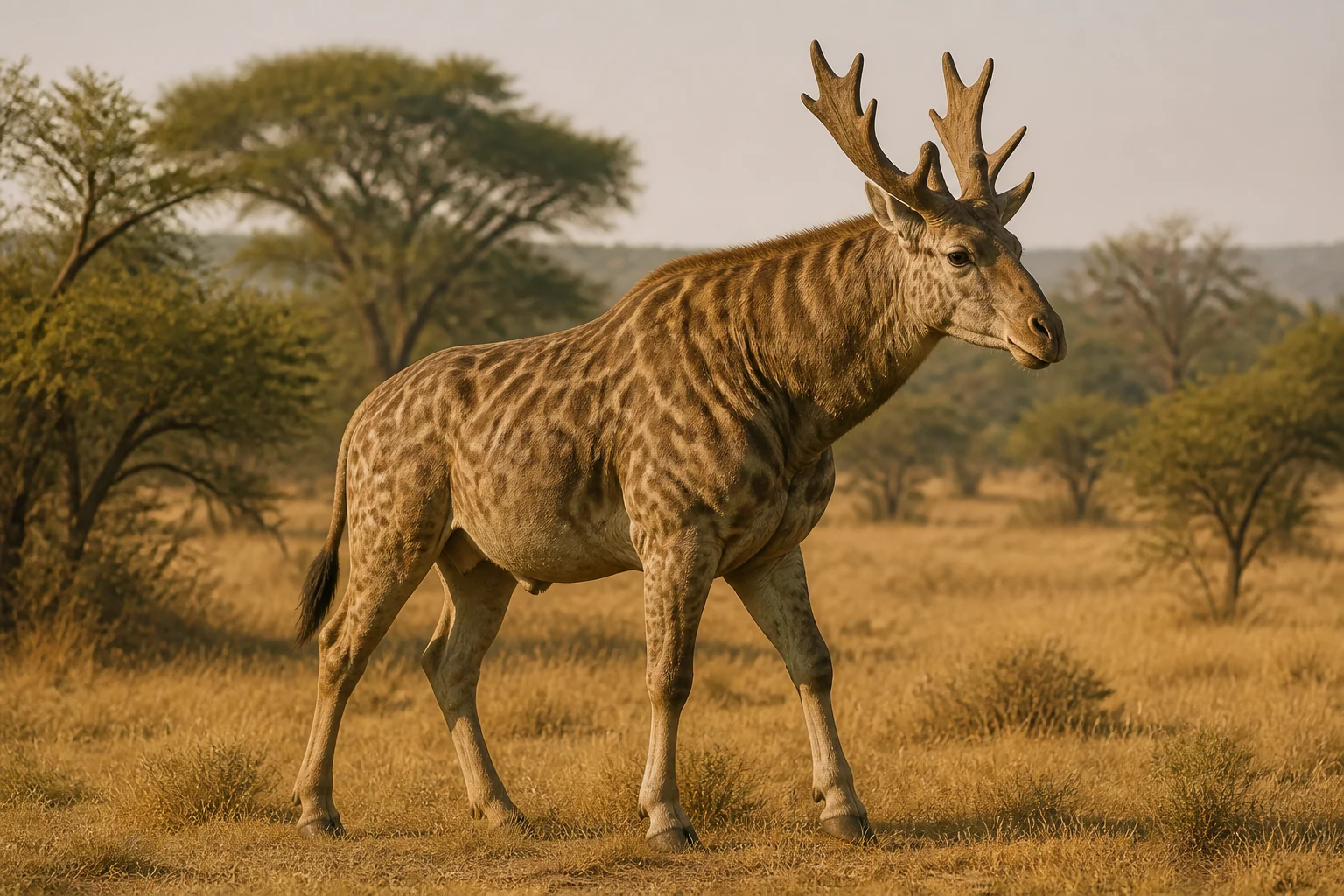 View original image · 1536 × 1024
- Time range
- About 7–1 million years ago
- Final stage
- Early Pleistocene
- Geographic range
- Open woodland in Africa and South Asia
01 / ANSWER FIRST
What was Sivatherium?
Sivatherium was a giant, short-necked member of the giraffe family. S. giganteum is known from the Himalayan foothills near the Pliocene–Pleistocene boundary; the genus also has an African record.
Older accounts compared it with an elephant. A 2016 volumetric reconstruction tested that claim and found a much lower mass—still heavier than an average modern male giraffe.
02 / QUICK FACTS
Sivatherium at a glance
- Animal group
- Giraffid (giraffe family); not a moose or deer
- Body-mass estimate
- About 1,246 kg (range 857–1,812 kg), 2016 volumetric model
- Reference material
- 26 bones at the Natural History Museum, London
- Headgear
- Two pairs of ossicones; large branched rear pair in males
How big was Sivatherium?
Basu, Falkingham and Hutchinson built a three-dimensional composite skeleton from 26 fossil bones in London's Natural History Museum, then estimated body volume. The result was about 1,246 kg, with a plausible range of 857–1,812 kg. A limb-bone formula gave roughly 3,000 kg, showing how strongly the method affects the answer.
The authors note that the bones represent at least three individuals of different sizes. The composite is therefore a scaled model, not one weighed animal. It exceeds the average mass of a modern male giraffe but does not approach an African elephant.
03 / ANATOMY
Why did Sivatherium look so unlike a giraffe?
A short neck
Giraffids are defined by skull and tooth features, not by a long neck. Sivatherium had a relatively short neck and a massive body, closer in outline to a large ox than to a modern giraffe.
Ossicones, not antlers
Its broad, branched rear headgear looks antler-like, but these were ossicones, the skin-covered bony structures of the giraffe family. The 2016 study notes that males carried the ornate cranial appendages, which may help explain robust forelimbs.
04 / DIET & BEHAVIOUR
What did Sivatherium eat?
As a giraffid it was a plant eater. The sources cited here do not establish its exact balance of browsing and grazing, so a precise menu remains open.
05 / DIET & BEHAVIOUR
Where did it live?
S. giganteum comes from the Siwalik region of the Himalayan foothills. The genus first appears in East Africa in the Late Miocene, so African and South Asian records should not be merged into one population.
06 / RANGE & HABITAT
When did Sivatherium live?
The genus spans a long interval across two continents; individual fossils are dated through the rocks they come from.
Plio–Pleistocene South Asia
The London material behind the mass estimate comes from the Himalayan foothills near the Pliocene–Pleistocene boundary.
Rock art is not a fossil date
Claims that Saharan rock art shows a sivathere are interpretations of images. They do not supply a dated Sivatherium bone, so they cannot establish a last surviving date.
07 / FOSSIL EVIDENCE
What does the evidence establish?
Mass depends on method
Volumetric and limb-bone approaches differ by more than a factor of two. Quote the 2016 figure together with its range and method.
Elephant comparisons are outdated
Historical claims that Sivatherium rivalled an African elephant were never tested before 2016; the model rejects them.
08 / DISAPPEARANCE & DEBATE
Why did Sivatherium go extinct?
The sources cited here do not identify a specific extinction cause.
Climate and vegetation change are often proposed for large Pleistocene herbivores, but a general setting is not direct evidence for this genus.
09 / FREQUENTLY ASKED QUESTIONS
Sivatherium FAQ
Was Sivatherium a giraffe?
It belonged to the giraffe family, Giraffidae, but it was not a species of modern Giraffa and had a much shorter neck.
How much did Sivatherium weigh?
A 2016 volumetric model estimated about 1,246 kg, with a range of 857–1,812 kg.
Did Sivatherium have antlers?
No. Its branched headgear consisted of ossicones, which are different from the shed antlers of deer.
04 / SOURCES & FURTHER READING
Check the source record
Use the scientific name to compare taxonomy, occurrence records and the fossil record. Database coverage and classifications may differ.
05 / REVISION HISTORY
How has this record changed?
- Expanded answers to reader questions, clarified the scope of fossil evidence and improved routes to related explanations.
- Added a sourced bilingual topic hub covering size, discovery history, anatomy, diet, habitat, uncertainty and FAQs; updated search metadata.
- Verified authoritative entity sources and added three responsive reconstruction sizes.
- Initial bilingual species record published.
06 / CORRECTIONS & ADDITIONS