
PARACERATHERIUM TOPIC HUB · ECOLOGY
Paraceratherium Neck, Diet, Habitat and Evolution
How did the largest hornless rhinocerotoid feed, move and evolve across Oligocene Asia?
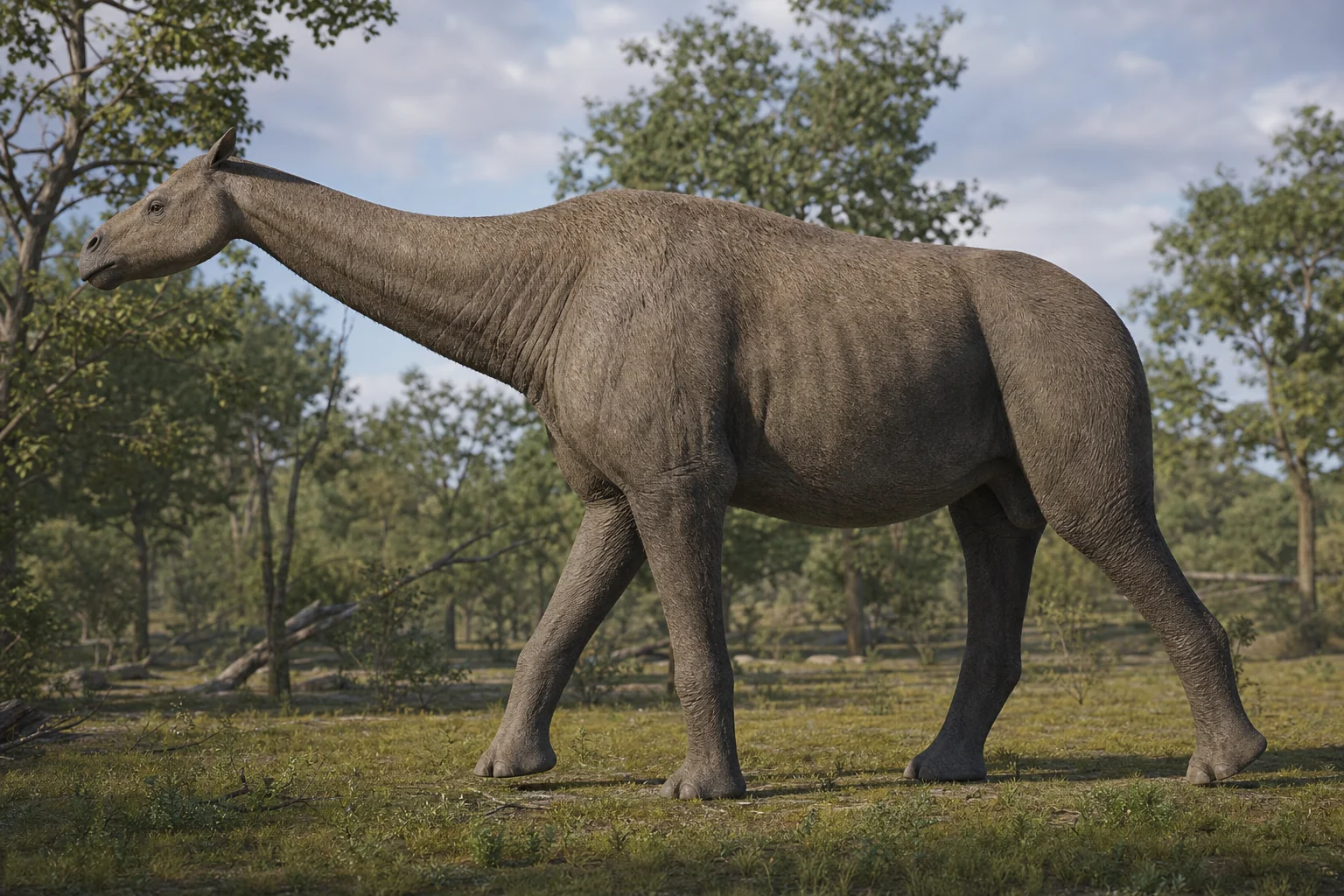 View full-resolution reconstruction ↗
This is an original generative reconstruction, not a photograph or scientific plate. Measurements and interpretations below are tied to named sources.
01 / NECK
How did the neck support the head?
Large vertebrae and strong muscle attachments carried a relatively small hornless skull. The neck increased browsing reach without requiring the extreme vertical posture sometimes shown in art.
02 / TEETH
What did the teeth process?
Low-crowned molars and incisors fit leaves, shoots and woody browse rather than constant abrasive grazing. Wear and local plants refine the menu but do not identify one favourite tree.
03 / BROWSING HEIGHT
Did it feed like a giraffe?
Long limbs and neck enabled high browsing, but skull, lips and locomotion were rhinocerotoid. Similar feeding height is ecological convergence, not close relationship or identical technique.
04 / HABITAT
Where did such a giant live?
Fossils span Oligocene deposits from western to eastern Asia, associated with floodplains, open woodland and seasonally dry environments. It was not confined to dense rainforest.
05 / LOCOMOTION
Could it run?
Long columnar limbs supported efficient walking over broad ranges. Joint loading argues against elephant-speed sprinting claims, while no trackway gives a measured top speed.
06 / EVOLUTION
Was it a true rhinoceros?
It belonged to Rhinocerotoidea and was related to rhinoceroses but lay outside the crown group of living species. Its hornless skull shows that giant rhinocerotoid evolution did not require horns.
FREQUENTLY ASKED QUESTIONS
Questions readers ask
How big was Paraceratherium?
Large individuals may have stood about 4.8 metres at the shoulder and weighed roughly 11–17 tonnes.
Was it a rhinoceros?
It was a giant hornless rhinoceros relative.
Did it have a horn?
No convincing horn attachment is present on the skull.
Did it have a trunk?
A mobile upper lip is plausible; a true elephant-like trunk is unsupported.
What did it eat?
Leaves, twigs and shrubs reached with its tall body and long neck.
Was it the largest land mammal?
It is among the largest reliably sized examples, but fragmentary elephants may rival it.
SOURCES & FURTHER READING
Evidence used in this guide
Measurements and interpretations are tied to museum resources or peer-reviewed studies; disputed conclusions include evidence on both sides.
- 01Why were dinosaurs so big? ↗Natural History Museum, London
Museum comparison giving reliable Paraceratherium scale.
- 02Body mass of proboscideans and giant terrestrial mammals ↗Acta Palaeontologica Polonica
Skeletal scaling and caution around extreme mammal estimates.
- 03Paraceratherium from the Tibetan Plateau ↗Communications Biology
New species and evidence for Asian dispersal routes.