
PARACERATHERIUM TOPIC HUB · SIZE
Paraceratherium Size, Height and Weight: Largest Land Mammal?
How tall and heavy was Paraceratherium, and why do incomplete skeletons produce several defensible mass estimates?
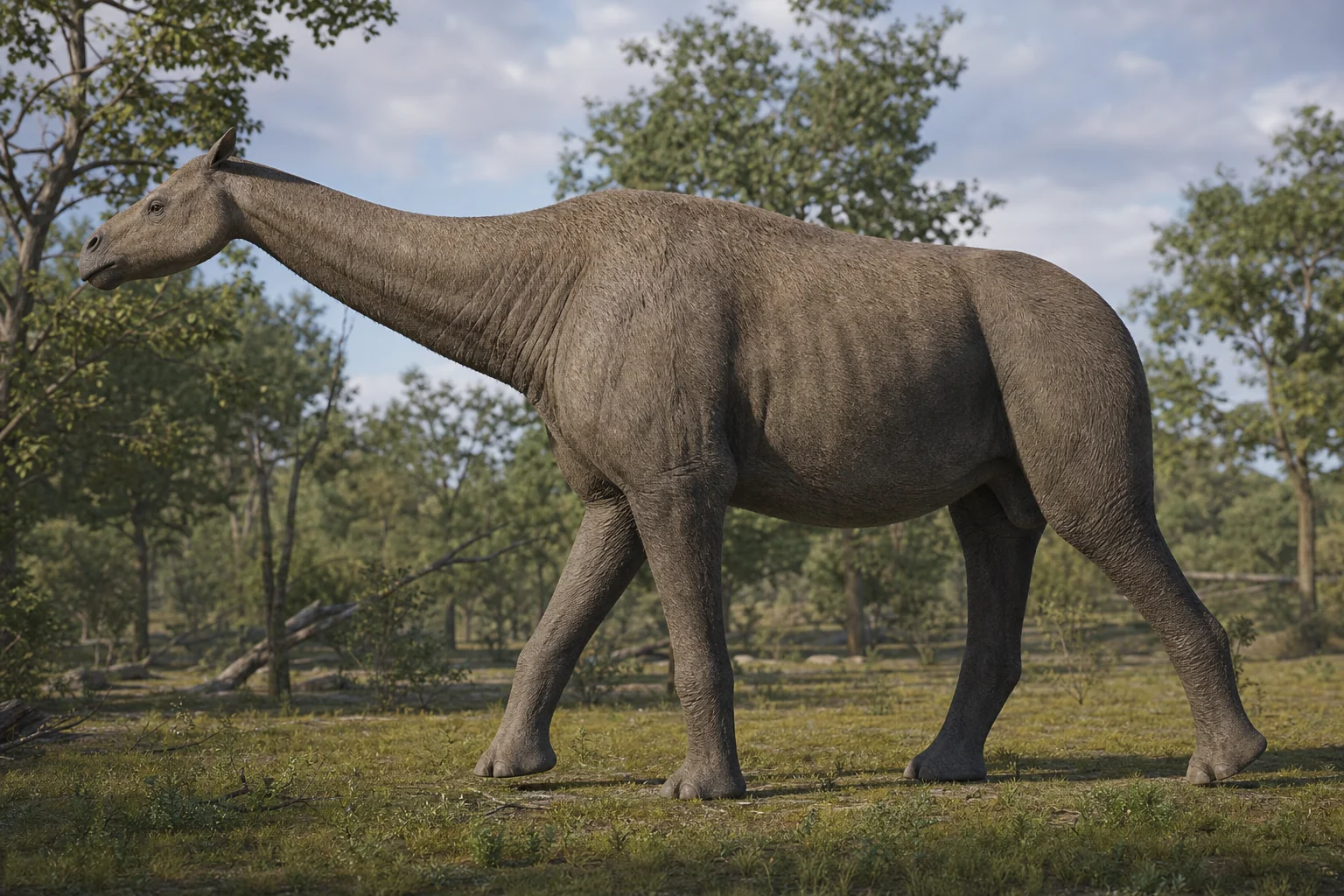 View full-resolution reconstruction ↗
This is an original generative reconstruction, not a photograph or scientific plate. Measurements and interpretations below are tied to named sources.
01 / FOSSIL RECORD
How complete are the skeletons?
Skulls, jaws, vertebrae and limb bones come from multiple individuals and regions. Composite mounts help visualise the animal but must not be mistaken for one complete articulated skeleton.
02 / HEIGHT
How tall was it?
Long limbs place the shoulder around 4.5–5 metres in large adults, with the head reaching higher on the long neck. Shoulder height and browsing reach are different measurements.
03 / LENGTH
How long was Paraceratherium?
Reconstructions often reach roughly 7–8 metres from snout to rump, with a relatively short tail. Posture and missing vertebrae create wider uncertainty than museum captions may suggest.
04 / MASS MODELS
Why do estimates range from 11 to 20 tonnes?
Researchers scale limb circumference, joint size or three-dimensional volume from living mammals. Each method assumes body proportions and density; applying them to different specimens produces different answers.
05 / RECORD CLAIM
Was it definitely the largest land mammal?
It is a leading contender, but other giant rhinocerotoids and proboscideans have overlapping uncertain estimates. 'One of the largest' is more defensible than a precise universal ranking.
06 / COMPARISON
How did it differ from an elephant?
Paraceratherium had a long neck, hornless rhinoceros skull and relatively long limbs, not a trunk-bearing elephant body. Its height exceeded elephants while mass overlap depends on estimate.
FREQUENTLY ASKED QUESTIONS
Questions readers ask
How big was Paraceratherium?
Large individuals may have stood about 4.8 metres at the shoulder and weighed roughly 11–17 tonnes.
Was it a rhinoceros?
It was a giant hornless rhinoceros relative.
Did it have a horn?
No convincing horn attachment is present on the skull.
Did it have a trunk?
A mobile upper lip is plausible; a true elephant-like trunk is unsupported.
What did it eat?
Leaves, twigs and shrubs reached with its tall body and long neck.
Was it the largest land mammal?
It is among the largest reliably sized examples, but fragmentary elephants may rival it.
SOURCES & FURTHER READING
Evidence used in this guide
Measurements and interpretations are tied to museum resources or peer-reviewed studies; disputed conclusions include evidence on both sides.
- 01Why were dinosaurs so big? ↗Natural History Museum, London
Museum comparison giving reliable Paraceratherium scale.
- 02Body mass of proboscideans and giant terrestrial mammals ↗Acta Palaeontologica Polonica
Skeletal scaling and caution around extreme mammal estimates.
- 03Paraceratherium from the Tibetan Plateau ↗Communications Biology
New species and evidence for Asian dispersal routes.