
Explore this animal in Size of Extinct Animals ↗
48 / Mesozoic
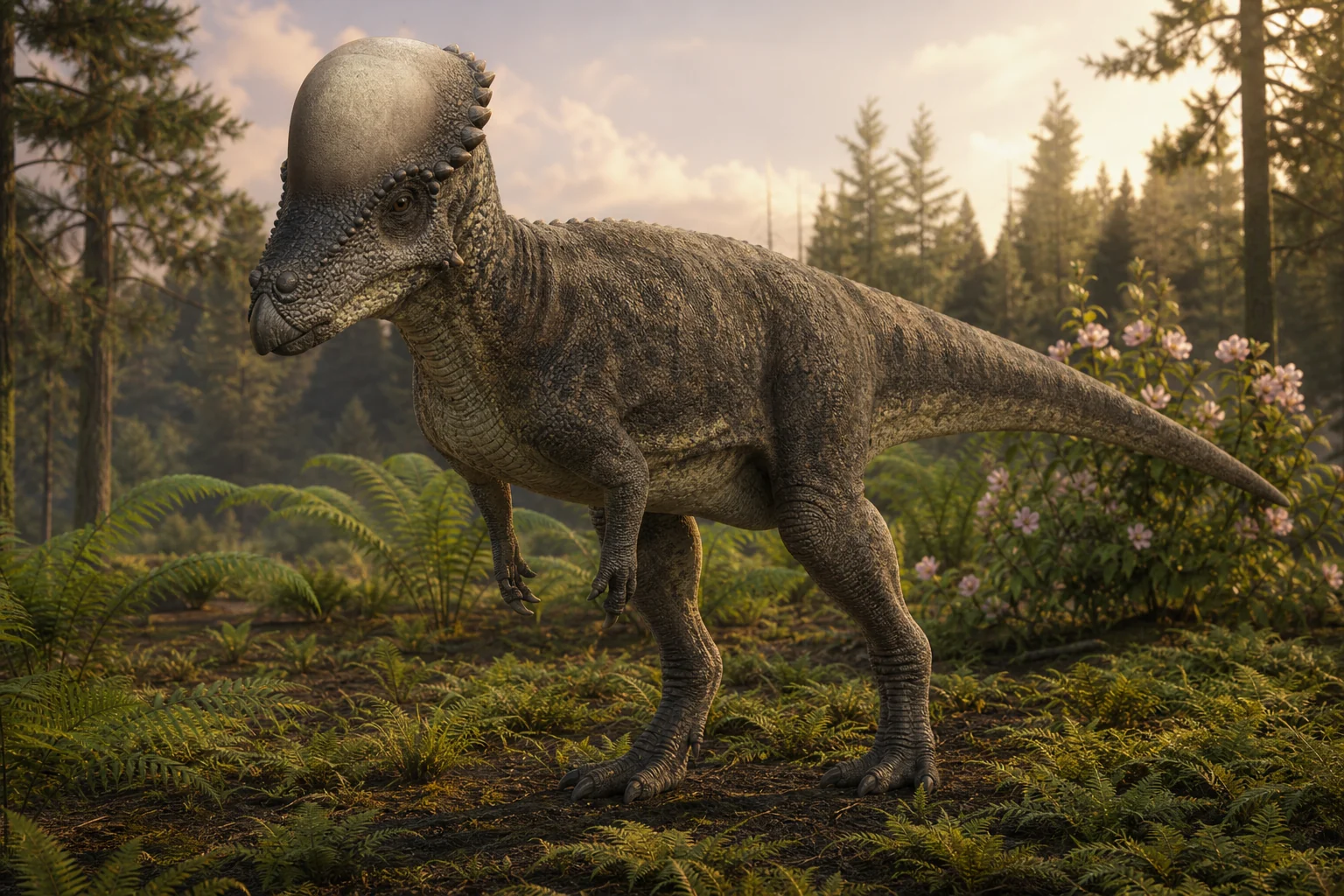
Pachycephalosaurus
Pachycephalosaurus wyomingensis
A thick dome of bone crowned the skull of this two-legged herbivore.
 View original image · 1536 × 1024
- Time range
- About 70–66 million years ago
- Final stage
- End of the Cretaceous
- Geographic range
- Western North America
01 / ANSWER FIRST
What was Pachycephalosaurus?
Pachycephalosaurus was a three-to-five-metre bipedal ornithischian from the latest Cretaceous of North America, famous for a skull roof that could exceed 20 centimetres in thickness.
Domes are common but body skeletons are rare, so posture and mass depend on relatives. Rounded lesions and internal architecture support impact or flank-butting as plausible behaviours, while perfectly aligned ram-like combat remains unobserved.
02 / QUICK FACTS
Pachycephalosaurus at a glance
- Scientific name
- Pachycephalosaurus wyomingensis
- Age
- ~70–66 million years ago
- Length
- About 3–5 m
- Mass
- Roughly 300–500 kg
- Dome
- Up to >20 cm thick
- Diet
- Herbivory with possible omnivory
- Locomotion
- Bipedal
- Range
- Western North America
03 / CORE QUESTION
Did Pachycephalosaurus smash heads?
Dome bone contains structures capable of distributing load, and many domes show healed lesions consistent with repeated trauma. This makes physical contact more likely than a display-only skull.
A rounded dome provides limited alignment in a direct collision, and the neck and body are incompletely known. Flank-butting, shoving or ritualised contact may have reduced risk; fossils cannot specify one universal contest style.
Read the complete headbutting evidence guideHow to read the numbers
This page separates direct evidence, comparative inference and unresolved debate.
04 / LIFE & DISCOVERY TIMELINE
A skull dome that changed radically with age
Hell Creek herbivore
Pachycephalosaurus lives with Triceratops and Tyrannosaurus.
Genus named
A thick skull roof defines the animal.
Combat models tested
Engineers and anatomists debate load paths.
Dracorex debate
Flat and spiked skulls may represent younger stages.
05 / ANATOMY
A thick skull on a lightly built biped
Cranial dome
Fused frontal and parietal bones formed the thick roof.
Nodes and spikes
Bony ornaments changed shape through growth.
Mixed teeth
Small leaf-shaped teeth occur with sharper front teeth.
Fragmentary body
Relatives supply most limb and tail proportions.
06 / DIET & BEHAVIOUR
What did Pachycephalosaurus eat?
Leaf-shaped cheek teeth support plants, while sharper front teeth leave insects or small animals possible.
Read the complete guide07 / DIET & BEHAVIOUR
Were Dracorex and Stygimoloch juveniles?
Growth-series interpretations unite them with Pachycephalosaurus, but taxonomic debate continues because samples are incomplete.
08 / RANGE & HABITAT
Where did Pachycephalosaurus live?
Skulls occur in latest-Cretaceous formations of Montana, South Dakota, Wyoming and Alberta, across wooded river plains.
Hell Creek
Famous domes occur with end-Cretaceous fauna.
Lance Formation
Wyoming material broadens variation.
Scollard
Canadian fossils extend northern range.
River plains
Woodland mosaics supplied low vegetation.
09 / FOSSIL EVIDENCE
How do scientists know about Pachycephalosaurus?
Domes
Many skull roofs document variation and injury.
Histology
Internal growth reveals remodelling and age change.
Pathology
Healed lesions test physical-contact hypotheses.
Relatives
More complete pachycephalosaurs reconstruct the body.
10 / DISAPPEARANCE & DEBATE
What is the safest headbutting conclusion?
The dome probably participated in display and physical contests, but fossils do not require full-speed head-to-head collisions.
Damage frequency, dome architecture and living analogues support contact; incomplete necks and variable dome shapes keep the exact behaviour open.
12 / FREQUENTLY ASKED QUESTIONS
Pachycephalosaurus FAQ
How big was Pachycephalosaurus?
About 3–5 metres long and roughly 300–500 kilograms.
How thick was its skull?
The dome could exceed 20 centimetres.
Did it headbutt?
Physical contact is supported, but exact contest style is uncertain.
Was it a herbivore?
Mostly likely, though sharper front teeth leave some omnivory possible.
Was Stygimoloch the same animal?
It may represent a younger growth stage, but debate continues.
Is the whole skeleton known?
No; skulls dominate and the body is reconstructed from relatives.
04 / SOURCES & FURTHER READING
Check the source record
Use the scientific name to compare taxonomy, occurrence records and the fossil record. Database coverage and classifications may differ.
05 / REVISION HISTORY
How has this record changed?
- Expanded into a bilingual S-tier hub with two evidence-led guides.
- Verified authoritative entity sources and added three responsive reconstruction sizes.
- Initial bilingual species record published.
06 / CORRECTIONS & ADDITIONS