
OPABINIA TOPIC HUB · FIVE EYES & PROBOSCIS
What Animal Had Five Eyes? Opabinia Anatomy
What do rare Burgess Shale specimens reveal about Opabinia's eyes, feeding organ, mouth, flaps, gills, gut and tail?
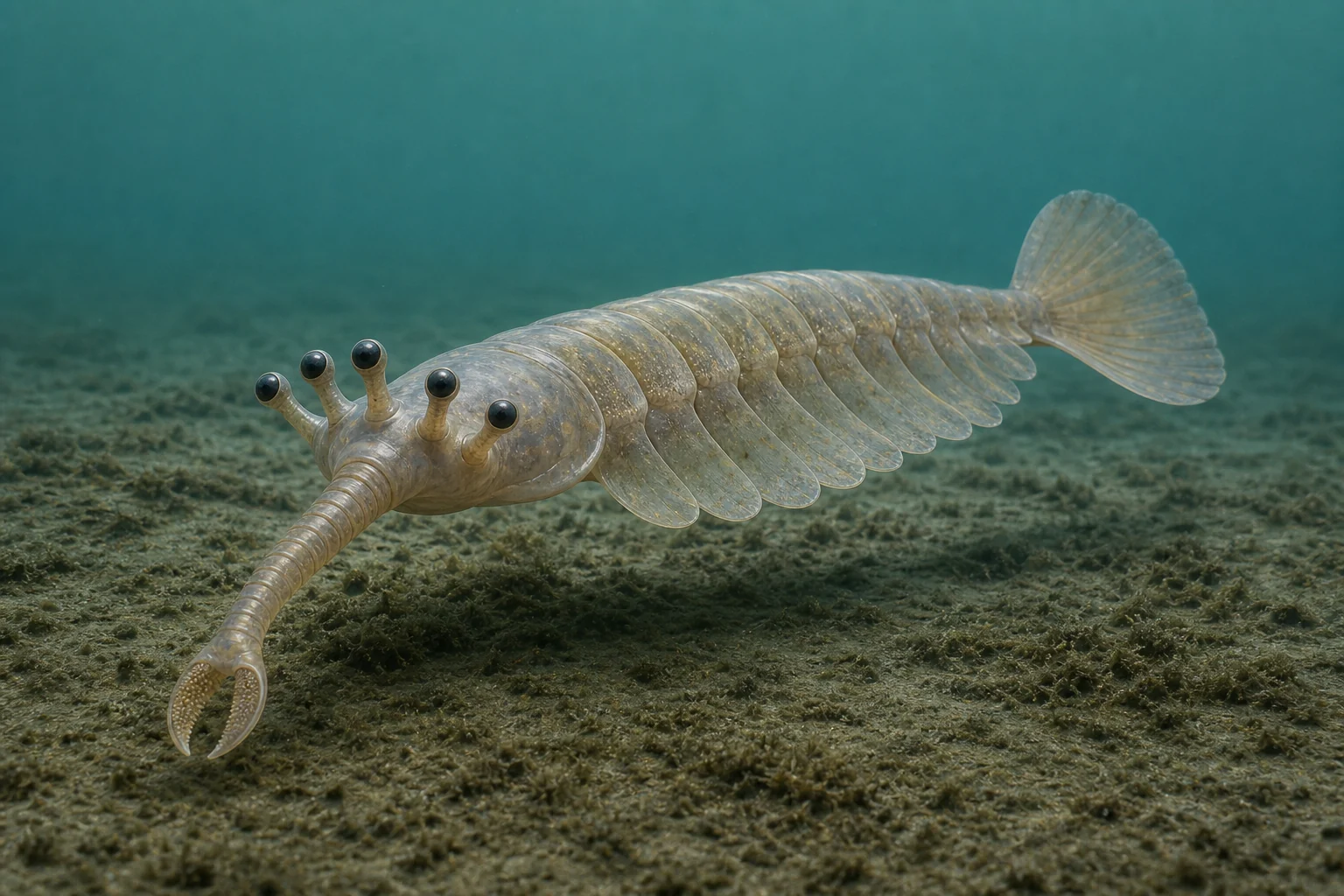 View full-resolution reconstruction ↗
This is an original generative reconstruction, not a photograph or scientific plate. Measurements and interpretations below are tied to named sources.
01 / FIVE EYES
What animal had five eyes?
Opabinia regalis had five eyes: two pairs on short stalks and a larger fifth eye on the dorsal midline. Comparing specimens preserved at different angles separates real anatomy from overlap caused by flattening; the broad field supports active visual behaviour.
02 / PROBOSCIS
Was the nozzle a nose?
No. It was a flexible annulated feeding appendage about four times head length, ending in opposing claws with five or six spines. It is better compared with a grasping limb than a vertebrate nose or elephant trunk.
03 / MOUTH & GUT
Why did the mouth face backward?
The mouth opened beneath the head and toward the rear, requiring food transfer from the proboscis. A U-shaped foregut joined a straight digestive tract with paired glands, supporting active processing without identifying exact prey.
04 / FLAPS & GILLS
How did fifteen segments work together?
Each segment carried a broad lateral flap associated with blade-like gills. Successive flaps passed waves rearward for propulsion while water crossed respiratory surfaces. The precise gill position remains debated because compression shifts tissues.
05 / POSSIBLE LEGS
Did Opabinia have walking limbs?
Triangular trunk structures have been interpreted as lobopod-like legs, gut extensions or body cavities. Their outlines vary among flattened specimens, making walking plausible but less secure than swimming.
06 / TAIL & SCALE
How large was the animal?
Bodies measured 4.3–7.0 centimetres without the proboscis; the largest listed complete specimen is about 10.1 centimetres including it. Three paired upward flaps formed the tail fan, followed by tiny spines.
FREQUENTLY ASKED QUESTIONS
Questions readers ask
Where are Opabinia fossils found?
The Royal Ontario Museum lists the Walcott and Raymond quarries of the Burgess Shale in British Columbia, Canada.
What animal had five eyes?
Opabinia regalis is a Cambrian example: four eyes formed pairs and a fifth sat centrally above them.
Was Opabinia a sea scorpion?
No. It was a soft-bodied stem-arthropod relative; true sea scorpions were later chelicerates.
How large was Opabinia?
Most bodies were 4.3–7.0 centimetres excluding the proboscis; the largest listed specimen reaches about 10.1 centimetres including it.
What was the proboscis for?
It probably grasped food with terminal claws and moved it toward the backward-facing ventral mouth.
Did Opabinia walk?
Possible small lobopod-like limbs are debated; swimming with lateral flaps is better supported.
SOURCES & FURTHER READING
Evidence used in this guide
Measurements and interpretations are tied to museum resources or peer-reviewed studies; disputed conclusions include evidence on both sides.
- 01Opabinia regalis ↗Royal Ontario Museum · Burgess Shale
Specimen-based anatomy, measurements, abundance, ecology and research history.
- 02Extraordinary fossils reveal the nature of Cambrian life ↗Philosophical Transactions B
Peer-reviewed commentary on Whittington's reconstruction and Burgess Shale evidence.
- 03The nature and significance of the appendages of Opabinia ↗Lethaia · DOI 10.1111/j.1502-3931.1996.tb01831.x
Morphological analysis connecting Opabinia to the arthropod stem lineage.