
OPABINIA TOPIC HUB · LIFE & FEEDING
How Did Opabinia Live and What Did It Eat?
Use swimming flaps, eyes, proboscis, digestive glands and Burgess Shale setting to reconstruct Opabinia without turning inference into footage.
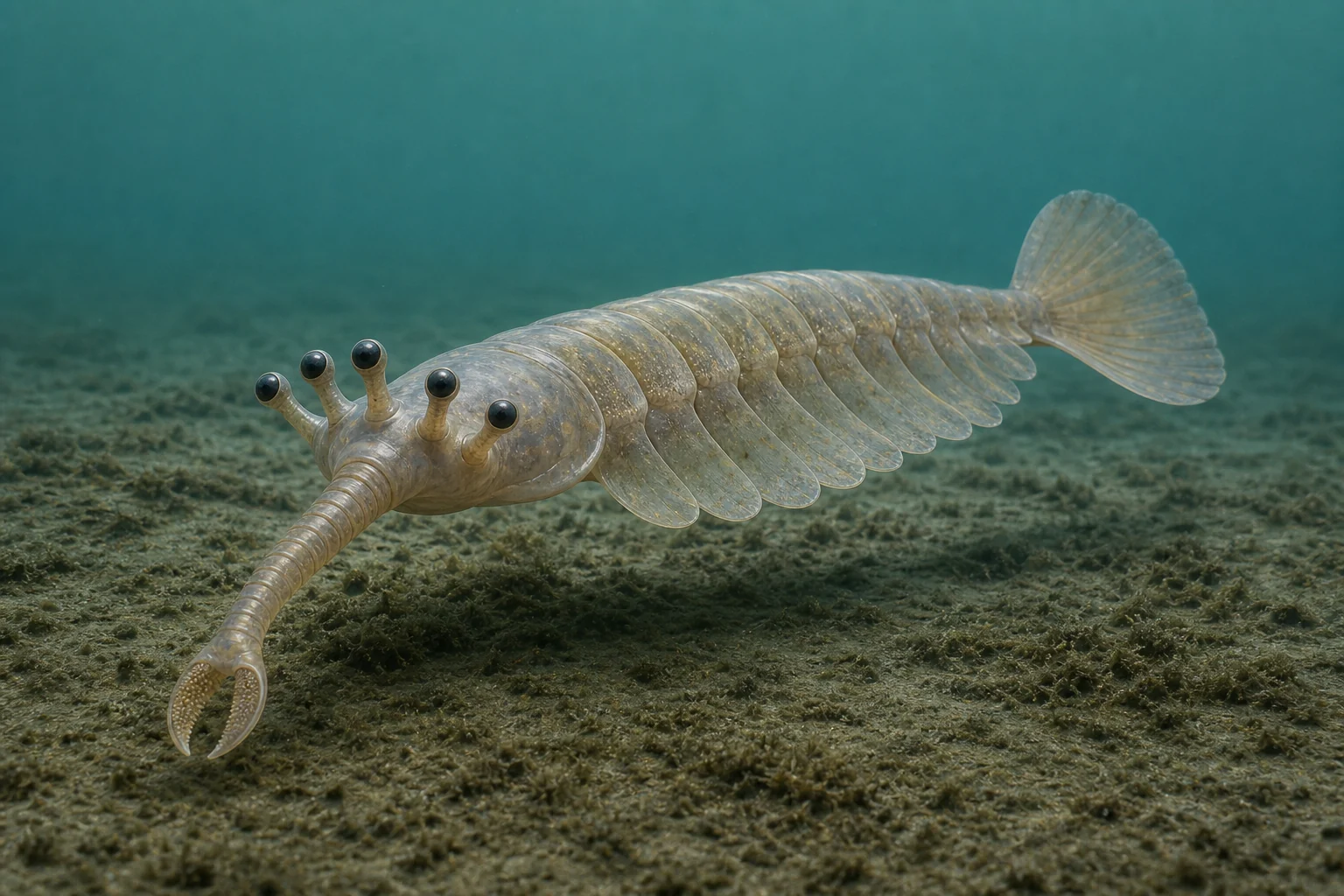 View full-resolution reconstruction ↗
This is an original generative reconstruction, not a photograph or scientific plate. Measurements and interpretations below are tied to named sources.
01 / SETTING
What was its Burgess Shale habitat?
Opabinia lived in a tropical marine basin near a carbonate escarpment. Fine sediment flows rapidly buried soft bodies, but also transported them, so fossil position is not a literal snapshot of normal swimming depth.
02 / LOCOMOTION
Did it crawl or swim?
Overlapping lateral flaps and a tail fan strongly support swimming. Travelling waves propelled the body and the tail stabilised turns. Possible ventral lobopods may have touched bottom, but their identity remains contested.
03 / SENSING
What were five eyes good for?
Eyes spread across the head could detect movement ahead, beside and above while the animal travelled near bottom. They support visual behaviour in lit water, not a claim that each eye produced a unique modern-camera view.
04 / FOOD CAPTURE
How did the proboscis deliver food?
The organ extended claws beyond the head, closed around a small item and bent beneath the body. Because the mouth faced backward, transfer rather than direct biting was necessary; speed and reach remain modelled.
06 / EVIDENCE LIMITS
Why are behaviour scenes uncertain?
Only about forty-two specimens are reported in major collections and compression distorts posture. Anatomy securely supports swimming and grasping; speed, colour, sociality, daily rhythm and exact prey remain open artistic or scientific questions.
FREQUENTLY ASKED QUESTIONS
Questions readers ask
Where are Opabinia fossils found?
The Royal Ontario Museum lists the Walcott and Raymond quarries of the Burgess Shale in British Columbia, Canada.
What animal had five eyes?
Opabinia regalis is a Cambrian example: four eyes formed pairs and a fifth sat centrally above them.
Was Opabinia a sea scorpion?
No. It was a soft-bodied stem-arthropod relative; true sea scorpions were later chelicerates.
How large was Opabinia?
Most bodies were 4.3–7.0 centimetres excluding the proboscis; the largest listed specimen reaches about 10.1 centimetres including it.
What was the proboscis for?
It probably grasped food with terminal claws and moved it toward the backward-facing ventral mouth.
Did Opabinia walk?
Possible small lobopod-like limbs are debated; swimming with lateral flaps is better supported.
SOURCES & FURTHER READING
Evidence used in this guide
Measurements and interpretations are tied to museum resources or peer-reviewed studies; disputed conclusions include evidence on both sides.
- 01Opabinia regalis ↗Royal Ontario Museum · Burgess Shale
Specimen-based anatomy, measurements, abundance, ecology and research history.
- 02Extraordinary fossils reveal the nature of Cambrian life ↗Philosophical Transactions B
Peer-reviewed commentary on Whittington's reconstruction and Burgess Shale evidence.
- 03The nature and significance of the appendages of Opabinia ↗Lethaia · DOI 10.1111/j.1502-3931.1996.tb01831.x
Morphological analysis connecting Opabinia to the arthropod stem lineage.