
MEGATHERIUM TOPIC HUB · SIZE & ANATOMY
Megatherium Size, Weight, Claws and Posture
How big was Megatherium americanum, how did its giant claws work and did this four-tonne ground sloth really walk upright?
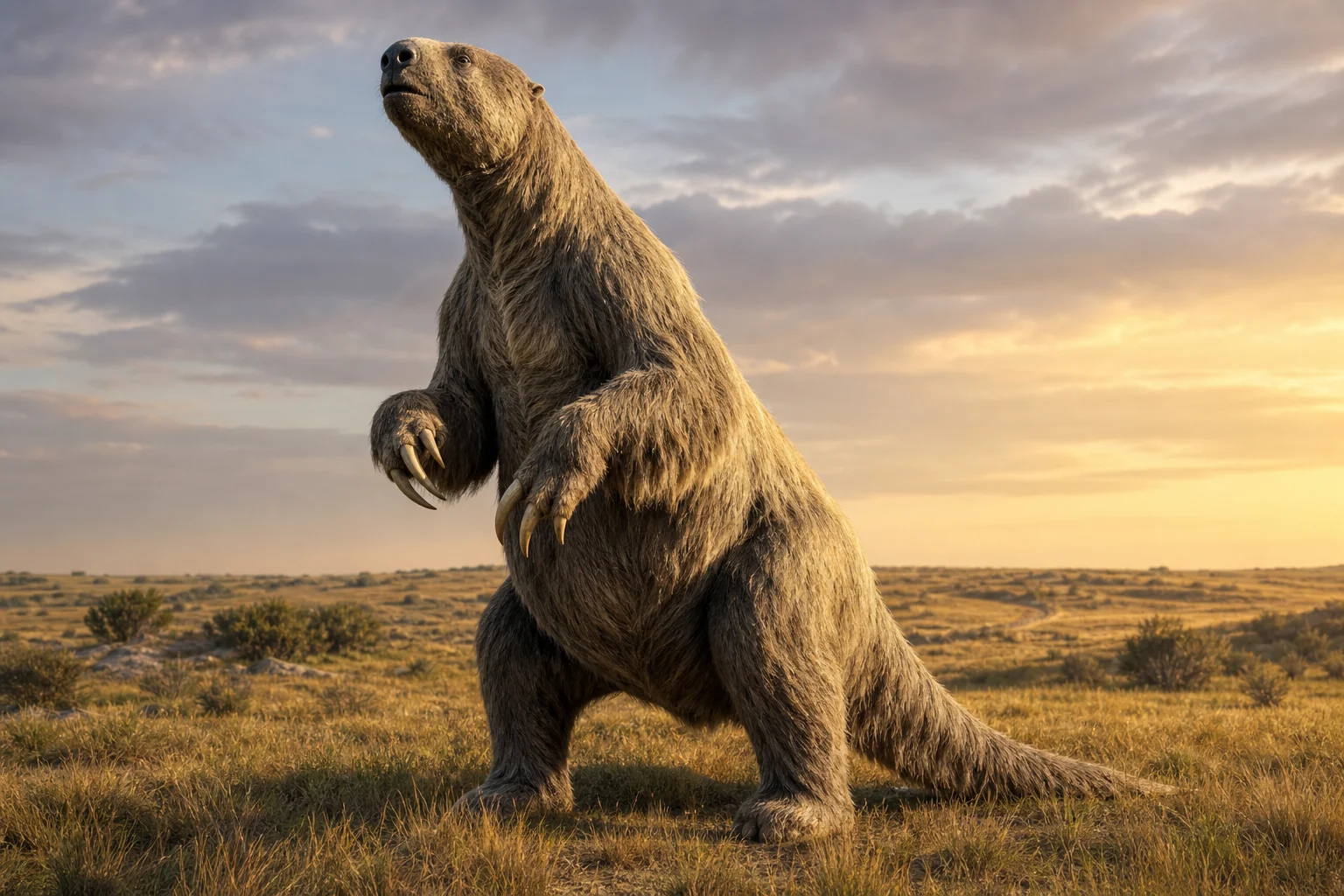 View full-resolution reconstruction ↗
This is an original generative reconstruction, not a photograph or scientific plate. Measurements and interpretations below are tied to named sources.
01 / BODY MASS
How is a four-tonne animal estimated?
Researchers scale limb-bone circumference, skeletal volume and living mammal density. Different specimens and methods yield roughly 2,000–4,000 kilograms, so four tonnes is an upper adult estimate rather than every individual's mass.
02 / HEIGHT
Was Megatherium three and a half metres tall?
About 3.5 metres describes a large animal reared on hind limbs, not shoulder height during normal walking. Quadrupedal body length, hip height and rearing height answer different questions and should not be combined.
03 / CLAWS
How could it walk with curved claws?
The foreclaws turned inward and the hand contacted the ground along its outer edge, protecting the tips. Strong forelimbs could hook branches, dig or defend, but no fossil identifies one exclusive use.
04 / TRIPOD
How did the tail support rearing?
Large tail vertebrae and attachment scars indicate powerful muscles. With two hind feet, the tail made a broad support triangle, bringing the forelimbs to higher vegetation while keeping the centre of mass controlled.
05 / BIPEDAL CLAIM
Did it habitually walk on two legs?
Some skeletal models permit bipedal steps, but footprints interpreted as two-legged can result when hind feet overprint forefeet. Weight-bearing joints and trackways better support quadrupedal travel with occasional rearing.
06 / RECONSTRUCTION
What should an accurate image show?
Show a deep torso, heavy pelvis, long muscular tail, inward foreclaws and columnar hind limbs. Rearing is legitimate when labelled as a momentary posture; a permanently upright, fast-running animal is not supported.
FREQUENTLY ASKED QUESTIONS
Questions readers ask
How large was Megatherium?
Large adults are estimated at roughly 2–4 tonnes and around 3.5 metres high when rearing.
Was Megatherium a giant sloth?
It was a giant ground sloth related to living sloths, but it lived mainly on land.
Did Megatherium walk upright?
It could rear and perhaps take short bipedal steps, but habitual movement was primarily quadrupedal.
What did Megatherium eat?
Teeth, jaws and isotopes best support leaves, shoots and other plant foods.
Did humans hunt Megatherium?
Yes. Campo Laborde preserves secure evidence of butchery around 12,600 calibrated years ago.
When did Megatherium go extinct?
The youngest secure evidence is near 12,600 calibrated years before present.
SOURCES & FURTHER READING
Evidence used in this guide
Measurements and interpretations are tied to museum resources or peer-reviewed studies; disputed conclusions include evidence on both sides.
- 01What was Megatherium? ↗Natural History Museum, London
Museum synthesis of size, anatomy, range, herbivory and human overlap.
- 02Megafauna extinction ↗American Museum of Natural History
Museum context for body mass and late-Pleistocene megafaunal loss.
- 03A human–Megatherium kill/butchery site at Campo Laborde ↗Science Advances · PMC6402857
Radiocarbon, cut-mark and site evidence for interaction around 12,600 cal BP.
- 04Dietary assessment of Megatherium americanum ↗Gondwana Research
Stable-isotope evidence consistent with herbivory.