
MEGATHERIUM TOPIC HUB · DIET & EXTINCTION
What Did Megatherium Eat, and Why Did It Go Extinct?
Use teeth, isotopes, habitat, Campo Laborde butchery and South American climate history to evaluate Megatherium diet and extinction.
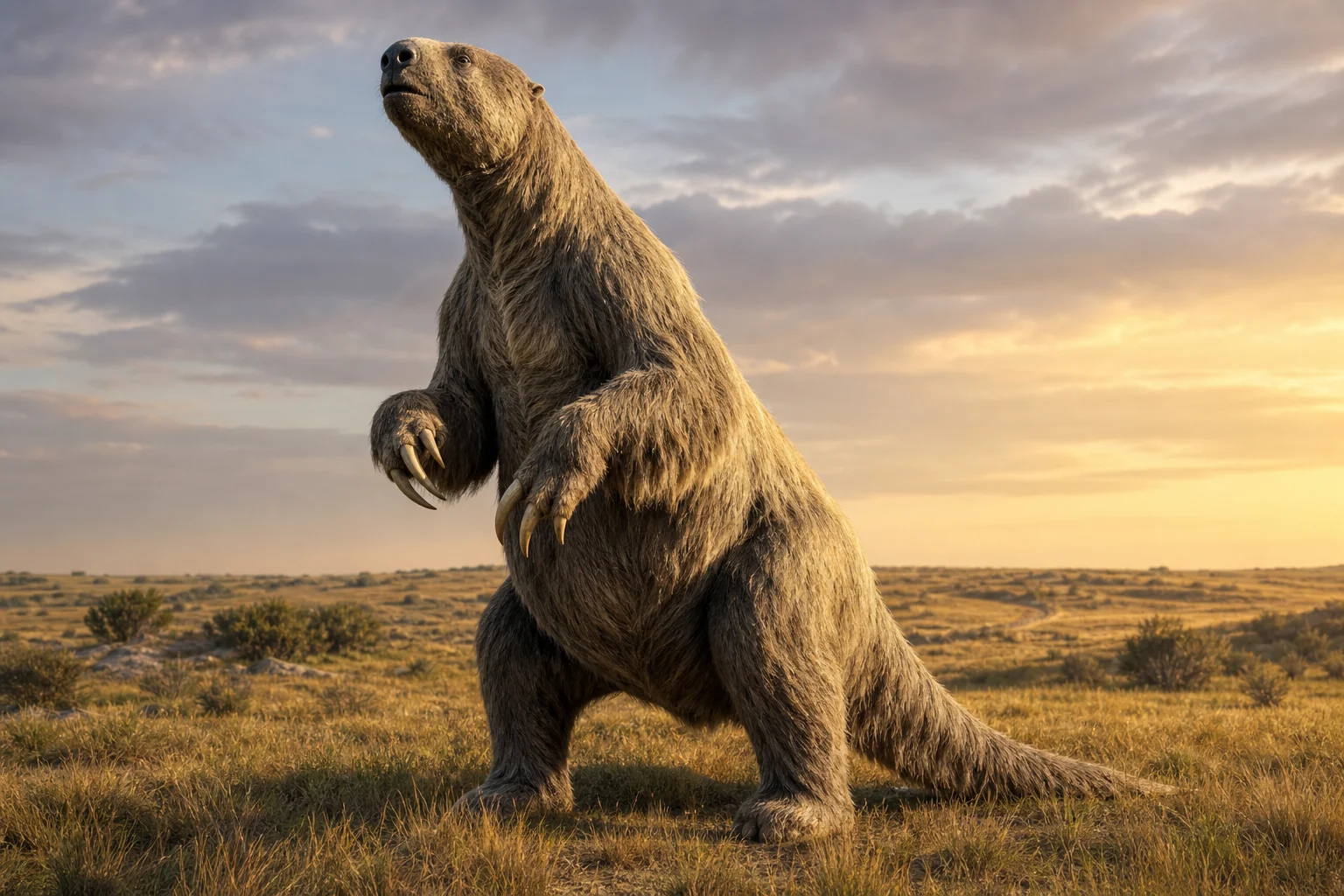 View full-resolution reconstruction ↗
This is an original generative reconstruction, not a photograph or scientific plate. Measurements and interpretations below are tied to named sources.
01 / TEETH & JAWS
What do the teeth reveal?
High-crowned enamel-free teeth grew continuously and met in broad shearing surfaces. Jaw mechanics fit cutting and grinding fibrous vegetation rather than piercing flesh, although tooth form alone cannot name every plant.
02 / ISOTOPES
Was Megatherium a browser or grazer?
Carbon isotopes from teeth and bone support herbivory while recording regional mixtures of plant types. Many populations likely browsed heavily, but habitat and season could shift the balance rather than impose one continent-wide diet.
03 / CARNIVORY CLAIM
Could giant ground sloths eat meat?
Powerful forelimbs inspired scavenger and predator hypotheses, but claws do not identify food and isotopes favour plants. Occasional opportunism is biologically possible; a regular carnivorous ecology is not the best-supported model.
04 / HUMAN EVIDENCE
Did people kill Megatherium?
Campo Laborde preserves cut-marked Megatherium bones, artefacts and dated site context around 12,600 calibrated years ago. This demonstrates butchery and likely hunting, while one site cannot measure total continental pressure.
05 / CLIMATE & HABITAT
What changed at the end of the Ice Age?
Rapid warming and shifts in rainfall reorganised grassland, woodland, water and fire regimes. Megatherium had survived earlier climate cycles, but the final transition acted alongside a new human predator and altered megafaunal food webs.
06 / LAST DATE & VERDICT
Did Megatherium survive thousands of years later?
Redating Campo Laborde places secure survival near 12,600 cal BP and rejects much younger ages once proposed for the site. Current evidence favours extinction near the terminal Pleistocene through interacting hunting and environmental stress.
FREQUENTLY ASKED QUESTIONS
Questions readers ask
How large was Megatherium?
Large adults are estimated at roughly 2–4 tonnes and around 3.5 metres high when rearing.
Was Megatherium a giant sloth?
It was a giant ground sloth related to living sloths, but it lived mainly on land.
Did Megatherium walk upright?
It could rear and perhaps take short bipedal steps, but habitual movement was primarily quadrupedal.
What did Megatherium eat?
Teeth, jaws and isotopes best support leaves, shoots and other plant foods.
Did humans hunt Megatherium?
Yes. Campo Laborde preserves secure evidence of butchery around 12,600 calibrated years ago.
When did Megatherium go extinct?
The youngest secure evidence is near 12,600 calibrated years before present.
SOURCES & FURTHER READING
Evidence used in this guide
Measurements and interpretations are tied to museum resources or peer-reviewed studies; disputed conclusions include evidence on both sides.
- 01What was Megatherium? ↗Natural History Museum, London
Museum synthesis of size, anatomy, range, herbivory and human overlap.
- 02Megafauna extinction ↗American Museum of Natural History
Museum context for body mass and late-Pleistocene megafaunal loss.
- 03A human–Megatherium kill/butchery site at Campo Laborde ↗Science Advances · PMC6402857
Radiocarbon, cut-mark and site evidence for interaction around 12,600 cal BP.
- 04Dietary assessment of Megatherium americanum ↗Gondwana Research
Stable-isotope evidence consistent with herbivory.