
LIVYATAN TOPIC HUB · COMPARISON
Livyatan vs Megalodon: Size, Bite and Fossil Evidence
Compare two Miocene apex predators without turning uncertain ranges and overlapping habitats into a fictional documented battle.
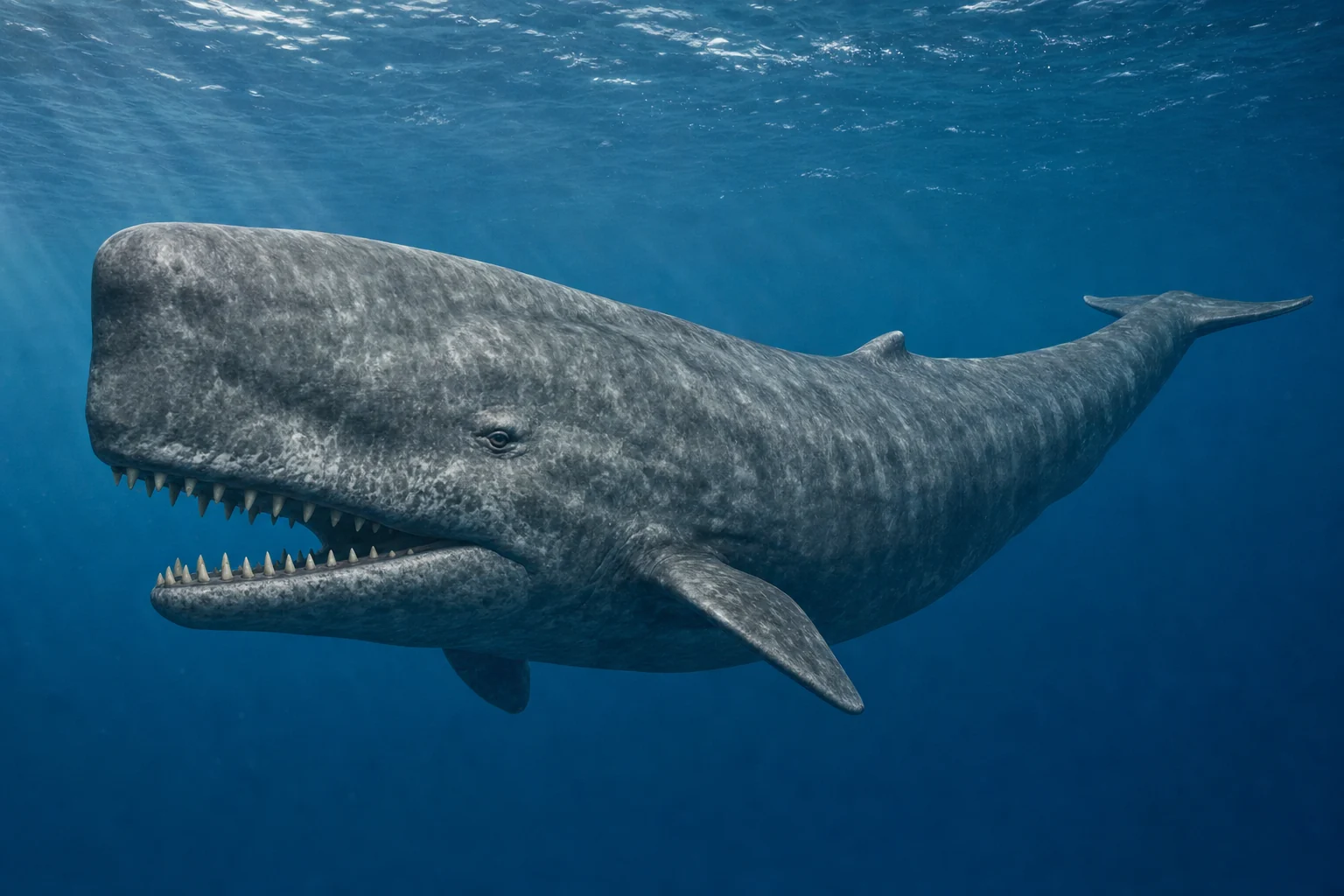 View full-resolution reconstruction ↗
This is an original generative reconstruction, not a photograph or scientific plate. Measurements and interpretations below are tied to named sources.
01 / SIZE
Which animal was larger?
Both length ranges overlap in the mid-teens of metres, while maximum megalodon models extend longer and much heavier. Livyatan estimates rely on one skull; megalodon estimates rely on teeth and vertebrae.
02 / WEAPONS
How did their teeth differ?
Livyatan had conical rooted teeth for gripping and tearing in both jaws. Megalodon had broad serrated triangular teeth replaced continuously, suited to cutting thick flesh and bone.
03 / BITE FORCE
Can bite force decide the comparison?
Megalodon bite forces come from scaled biomechanical models. No equivalent validated Livyatan value exists, so ranking two precise numbers would compare unlike methods rather than measured animals.
04 / PREY
Did they compete for the same food?
Both could consume whales and other large vertebrates, so ecological overlap is plausible. Tooth marks and local faunas show predator–prey relations, not direct Livyatan–megalodon competition at every site.
05 / NO BATTLE FOSSIL
Did they ever fight?
They may have encountered one another, but no associated skeleton or diagnostic reciprocal wounds document combat. A coexistence map is not evidence of a specific event.
06 / RESPONSIBLE VERDICT
Who would win?
Science cannot assign a universal winner. Outcome would depend on individual size, health, position and behaviour, most of which are unknown; the useful comparison is anatomy and evidence quality.
FREQUENTLY ASKED QUESTIONS
Questions readers ask
How big was Livyatan?
Whole-body estimates commonly span roughly 13–18 metres.
How large were its teeth?
The largest exceeded 36 centimetres including the root.
Was it a sperm whale?
It was a stem macroraptorial member of the sperm-whale superfamily.
Did it eat whales?
Medium-sized baleen whales are the strongest prey hypothesis, but stomach contents are absent.
Did Livyatan fight Megalodon?
No direct fossil evidence records a fight.
Why was its name changed?
Leviathan was already used, so the genus became Livyatan.
SOURCES & FURTHER READING
Evidence used in this guide
Measurements and interpretations are tied to museum resources or peer-reviewed studies; disputed conclusions include evidence on both sides.
- 01The giant bite of a new raptorial sperm whale ↗Nature · DOI 10.1038/nature09067
Primary description of skull, teeth, body estimate and prey hypothesis.
- 02Replacement name Livyatan ↗Nature · DOI 10.1038/nature09381
Formal correction replacing the preoccupied genus name.
- 03Macroraptorial sperm whales from Peru ↗Zoological Journal of the Linnean Society
Broader anatomy and evolution of Miocene raptorial physeteroids.