
LIVYATAN TOPIC HUB · SIZE & ANATOMY
Livyatan Size, Teeth, Skull and Predatory Whale Anatomy
How large was Livyatan melvillei and what does its giant toothed skull reveal about macroraptorial sperm whales?
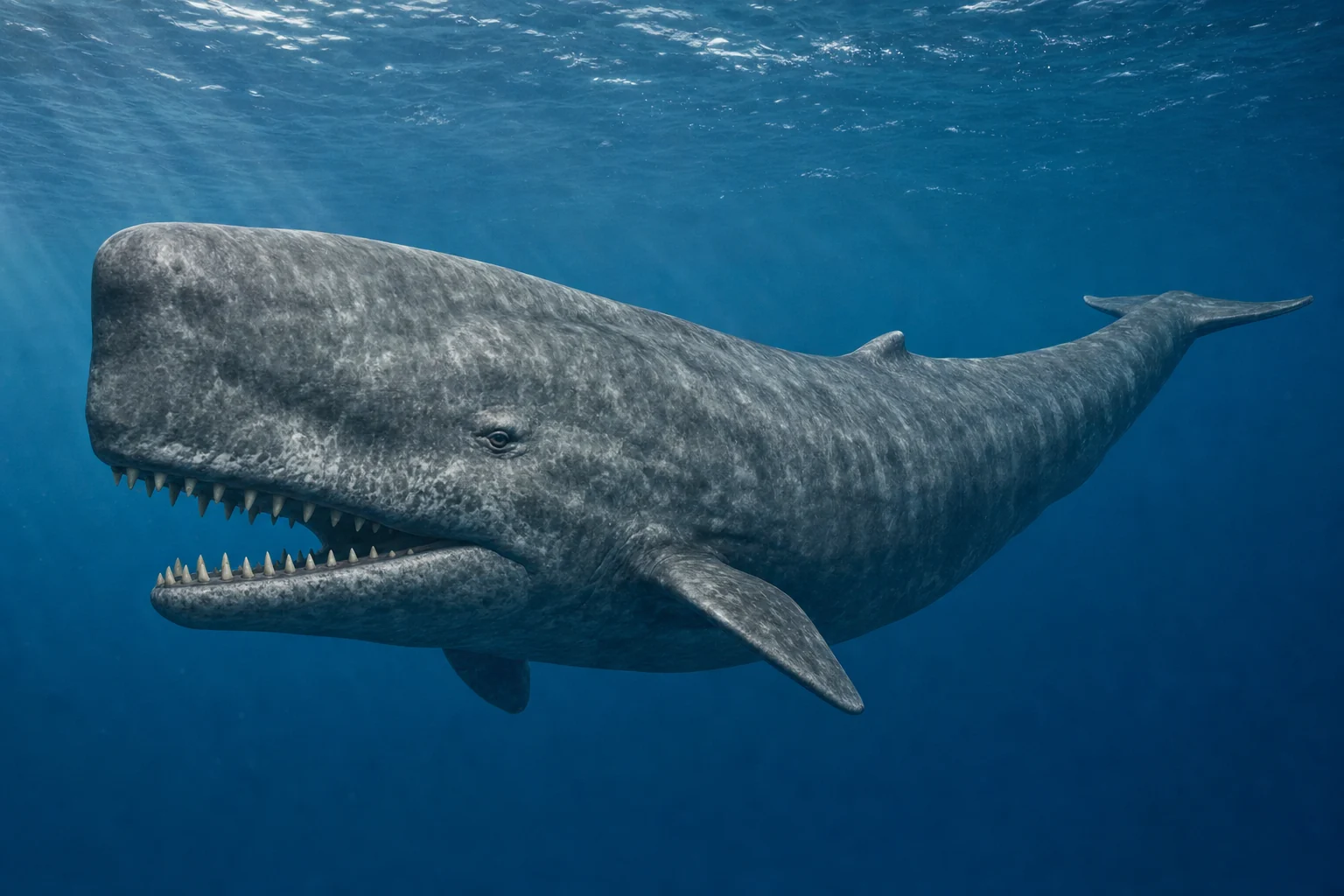 View full-resolution reconstruction ↗
This is an original generative reconstruction, not a photograph or scientific plate. Measurements and interpretations below are tied to named sources.
01 / SKULL
What fossil anchors the reconstruction?
The Peruvian holotype preserves a large skull, mandible and teeth but little postcranial skeleton. Skull measurements are direct; total body length depends on comparison with living and fossil sperm whales.
02 / BODY LENGTH
Why do length estimates vary?
Different sperm whales have different head-to-body proportions. Scaling Livyatan to the living sperm whale or shorter-headed macroraptorial forms yields different ranges, so estimates should remain explicit models.
03 / TEETH
How large were the teeth?
Some teeth exceed 30 centimetres including the root and rank among the largest biting teeth known. Crown length and total tooth length must not be confused.
04 / FUNCTIONAL JAWS
How was it unlike a living sperm whale?
Living sperm whales carry large lower teeth but reduced upper dentition. Livyatan had robust functional teeth in both jaws, forming a seizing and tearing bite for large prey.
05 / HEAD ORGANS
Did it have a spermaceti organ?
A deep supracranial basin on the skull supports enlarged soft tissues comparable to sperm-whale forehead organs. Their exact shape and roles in sound, buoyancy or impact cannot be read directly from bone.
06 / RECONSTRUCTION
What should an evidence-led image show?
Show a sperm-whale-like head with both tooth rows engaged and label body length as estimated. Avoid copying the living sperm whale's narrow lower-jaw-only bite or inventing a complete known skeleton.
FREQUENTLY ASKED QUESTIONS
Questions readers ask
How big was Livyatan?
Whole-body estimates commonly span roughly 13–18 metres.
How large were its teeth?
The largest exceeded 36 centimetres including the root.
Was it a sperm whale?
It was a stem macroraptorial member of the sperm-whale superfamily.
Did it eat whales?
Medium-sized baleen whales are the strongest prey hypothesis, but stomach contents are absent.
Did Livyatan fight Megalodon?
No direct fossil evidence records a fight.
Why was its name changed?
Leviathan was already used, so the genus became Livyatan.
SOURCES & FURTHER READING
Evidence used in this guide
Measurements and interpretations are tied to museum resources or peer-reviewed studies; disputed conclusions include evidence on both sides.
- 01The giant bite of a new raptorial sperm whale ↗Nature · DOI 10.1038/nature09067
Primary description of skull, teeth, body estimate and prey hypothesis.
- 02Replacement name Livyatan ↗Nature · DOI 10.1038/nature09381
Formal correction replacing the preoccupied genus name.
- 03Macroraptorial sperm whales from Peru ↗Zoological Journal of the Linnean Society
Broader anatomy and evolution of Miocene raptorial physeteroids.