
Explore this animal in Size of Extinct Animals ↗
565 / Mesozoic
Jobaria
Jobaria tiguidensis
A relatively short neck, strong limbs and primitive vertebrae belonged to a large non-neosauropod herbivore.
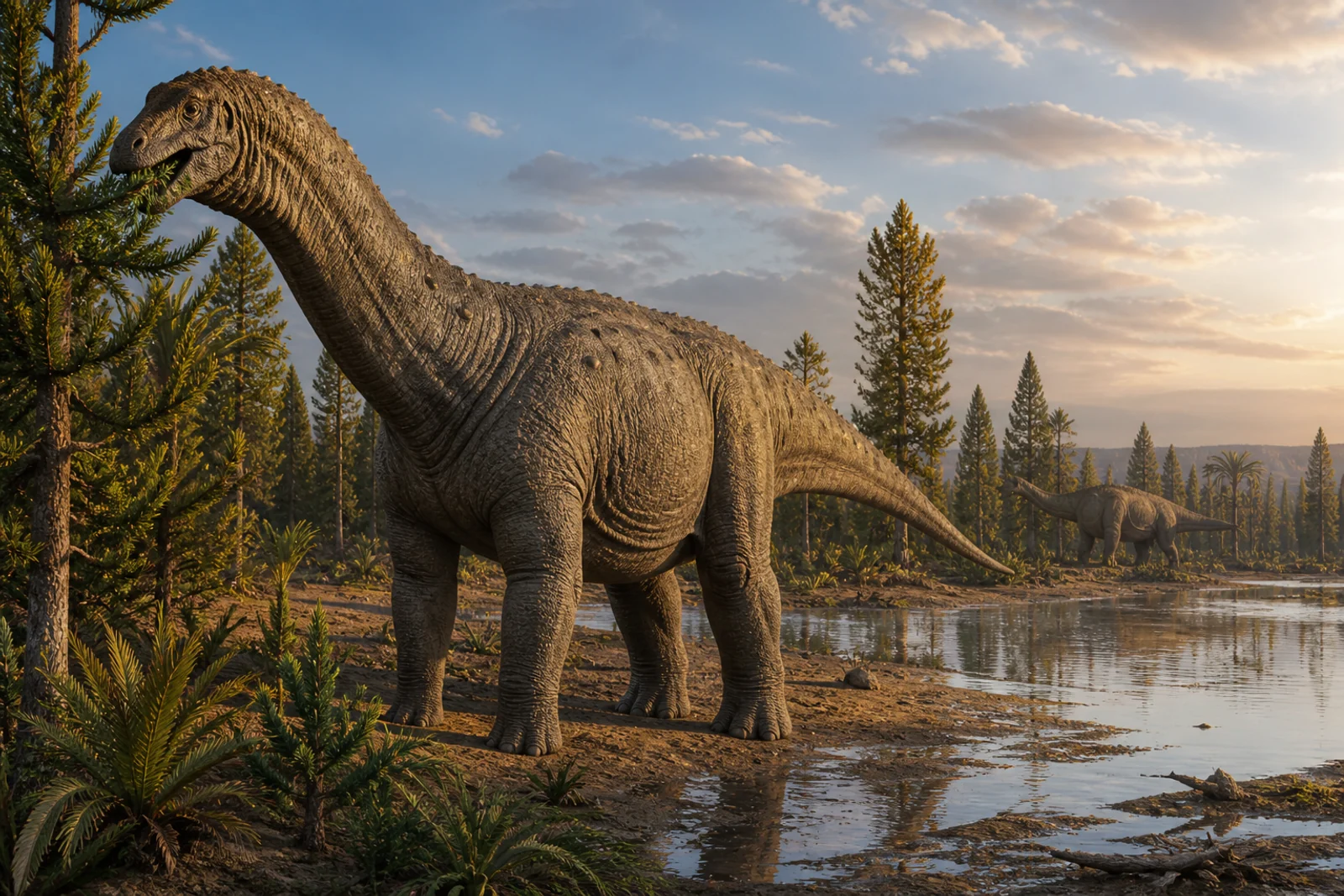 View original image · 1600 × 1067
- Time range
- About 170–164 million years ago
- Final stage
- Middle Jurassic
- Geographic range
- River floodplain · Niger
01 / ANSWER FIRST
What was Jobaria?
Jobaria tiguidensis was a large, four-legged sauropod from Niger, with a long neck, a small head and broad, spoon-shaped teeth. Its fossils come from the Tiourarén Formation, now generally placed in the Jurassic.
The discovery matters because associated skeletons preserve much more anatomy than an isolated giant bone can reveal. It also shows how changing the age of a rock unit changes the evolutionary story told about an animal.
02 / QUICK FACTS
Jobaria at a glance
- Scientific name
- Jobaria tiguidensis
- Length
- About 21 m; museum reference estimate
- Diet
- Herbivorous
- Formation
- Tiourarén Formation, Niger
- Age
- Jurassic; formation age remains debated
- Named
- 1999, Sereno and colleagues
Jobaria size: how big was it?
The Natural History Museum lists a reference length of about 21 metres. Length includes the neck and tail; it is not shoulder height. A reconstructed skeleton combines preserved bones with estimates for gaps, so the number should be read as approximate.
Jobaria was a substantial sauropod, but not a contender for the largest known dinosaur. Body mass requires a separate calculation: length alone cannot distinguish a slender animal from one with a heavier trunk and limbs.
Life and discovery timeline
Life in ancient Niger
The Tiourarén ecosystem supported Jobaria; the exact age should not be reduced to a single secure date.
Scientific description
Sereno and colleagues named Jobaria in a paper that interpreted the formation as Early Cretaceous.
Reassessing the rock age
Rauhut and López-Arbarello argued for a late Middle Jurassic to early Late Jurassic age using the fauna and stratigraphic context.
03 / ANATOMY
Neck, teeth and weight-bearing limbs
Spoon-shaped teeth
Broad tooth crowns suited gathering vegetation. They differ from the narrow, pencil-like teeth of Diplodocus; this is an anatomical comparison, not proof of an exact plant menu.
A relatively short sauropod neck
Jobaria had a long neck compared with most animals, but a less elongated one than some later sauropods. Neck posture and feeding height require more than simply lining up the vertebrae.
Four supporting limbs
Robust limbs supported a large trunk. The possibility of rearing is a biomechanical question; a dramatic museum pose does not demonstrate routine behaviour.
04 / DIET & BEHAVIOUR
What did Jobaria eat?
It was a plant eater. Teeth and comparison with other sauropods support browsing, but do not identify every plant it consumed. Lists of ferns, conifers or cycads describe plausible foods, not verified stomach contents.
05 / DIET & BEHAVIOUR
Did Jobaria live in herds?
Several individuals occur in the fossil assemblage. Such associations can inform population studies, but shared burial alone cannot establish permanent herds, social roles or coordinated defence.
06 / RANGE & HABITAT
Where did Jobaria live?
Known material comes from the Tiourarén Formation in Niger. The modern Sahara is a discovery location, not a direct picture of the Jurassic habitat.
Deposits and environment
Sedimentary context is used to reconstruct ancient river and floodplain settings; vegetation and water availability changed across that landscape.
A regional fossil record
Finding Jobaria in Niger establishes its presence there. It does not map the full geographic range of the living animal or prove its absence elsewhere.
07 / FOSSIL EVIDENCE
What do the fossils actually establish?
Associated skeletal material
Skull and postcranial material allow comparisons across the skeleton. Association matters because isolated bones at a mixed site need not belong to one individual.
Age is an independent question
The original Early Cretaceous interpretation made Jobaria appear unusually conservative. A Jurassic assignment changes that comparison without changing the preserved bones.
08 / DISAPPEARANCE & DEBATE
Why did Jobaria disappear?
Its specific extinction cause is unknown. It lived long before the end-Cretaceous asteroid impact.
The end of a sampled fossil range is not an observed final population. Claims that later sauropods directly replaced it need evidence beyond succession in the rock record.
09 / FREQUENTLY ASKED QUESTIONS
Jobaria FAQ
How long was Jobaria?
About 21 metres in the Natural History Museum reference; this is an approximate reconstruction.
Was Jobaria Jurassic or Cretaceous?
Originally described as Early Cretaceous, its formation was later argued to be Jurassic. The exact age remains a subject of stratigraphic interpretation.
Was Jobaria a carnivore?
No. Its teeth and sauropod anatomy support a plant-based diet.
04 / SOURCES & FURTHER READING
Check the source record
Use the scientific name to compare taxonomy, occurrence records and the fossil record. Database coverage and classifications may differ.
05 / REVISION HISTORY
How has this record changed?
- Rewrote an extinction cause that presented environmental or faunal turnover as established; it is now given as context the record does not prove.
- Added a sourced bilingual topic hub covering size, discovery history, anatomy, diet, habitat, uncertainty and FAQs; updated search metadata.
- Verified authoritative entity sources and added three responsive reconstruction sizes.
- Initial bilingual species record published.
06 / CORRECTIONS & ADDITIONS