
HALLUCIGENIA TOPIC HUB · RECONSTRUCTION HISTORY
Why Was Hallucigenia Reconstructed Upside Down?
Follow the specimens and preparation work that turned Hallucigenia from a spine-walking oddity into a clawed lobopodian with a recognisable head.
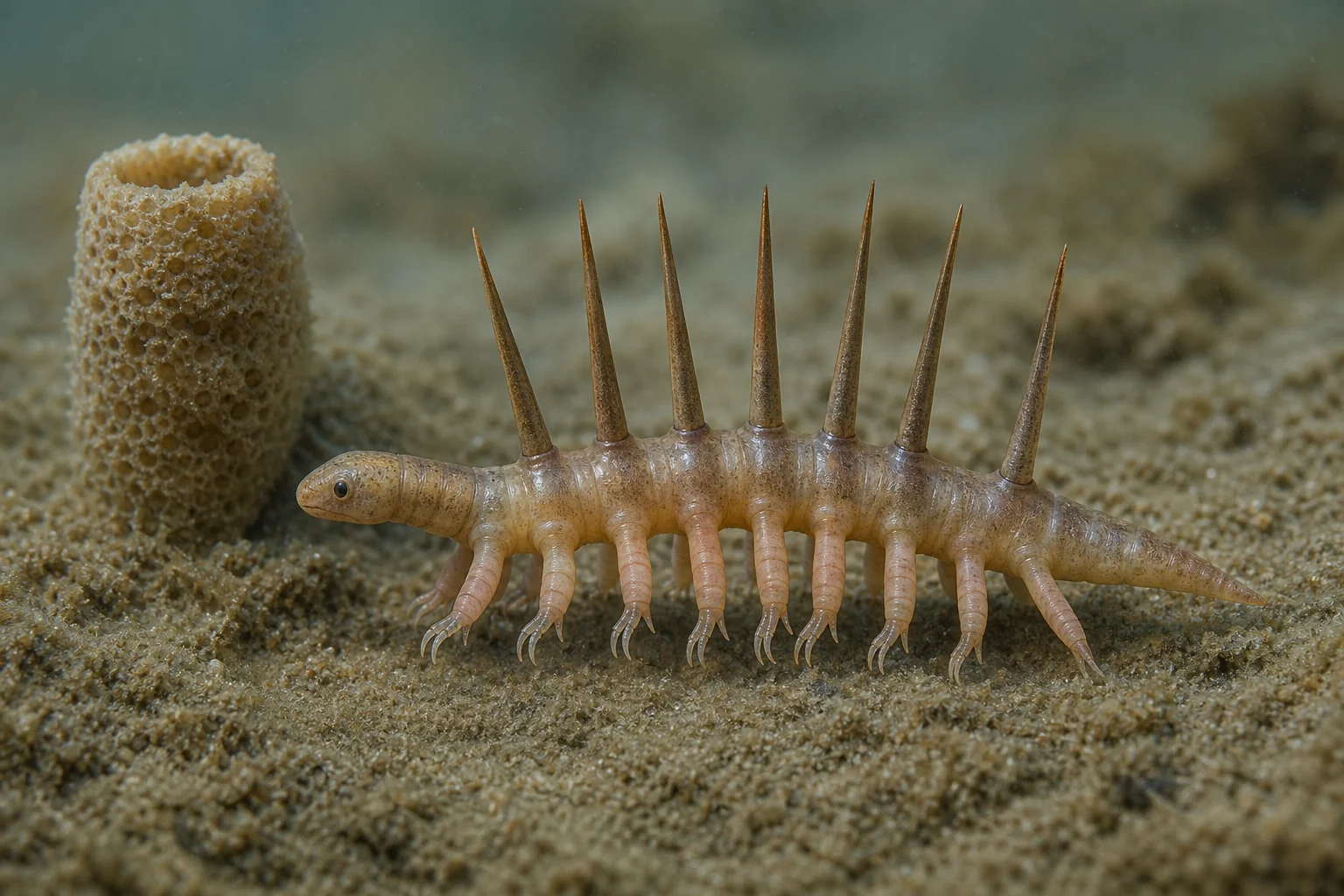 View full-resolution reconstruction ↗
This is an original generative reconstruction, not a photograph or scientific plate. Measurements and interpretations below are tied to named sources.
01 / FLATTENED FOSSILS
Why was the fossil so hard to read?
Soft tissues survived as films in shale while rigid spines remained sharply outlined. Burial flattened left, right, top and bottom into one plane, and decay fluids produced stains that could imitate anatomy.
02 / FIRST FULL MODEL
What did the 1977 reconstruction show?
Simon Conway Morris placed seven pairs of spines beneath the body as walking supports and a single row of soft appendages above as feeding tentacles. With no obvious head, Hallucigenia seemed unlike any known animal.
03 / LOBOPODIAN COMPARISON
How did Chinese fossils change the picture?
Well-preserved Cambrian lobopodians showed paired soft legs below and defensive spines above. This comparative body plan supplied the missing orientation and made the Burgess fossils readable as relatives rather than isolated oddities.
04 / PAIRED STRUCTURES
What proved the 'tentacles' were legs?
Specimens buried at different angles exposed left and right appendages and terminal claws. Structures that looked like one dorsal row in a side-on fossil were paired ventral legs overlapped by compression.
05 / HEAD REVERSAL
How was the front end identified?
Preparing rock from the supposedly blunt tail revealed paired eyes and a mouth. The bulb at the opposite end lacked organised anatomy and is interpreted as decay material extruded from the body.
06 / SCIENTIFIC LESSON
Was the early error bad science?
It was a testable reconstruction made from limited evidence. Science advanced because later fossils and methods exposed its weaknesses. Keeping obsolete models visible shows how interpretations change rather than implying that every new image is final.
FREQUENTLY ASKED QUESTIONS
Questions readers ask
How large was Hallucigenia?
Most specimens are only about 10–35 millimetres long.
Did Hallucigenia walk on its spines?
No. It walked on soft paired legs; the rigid spines projected from its back.
How many eyes did Hallucigenia have?
The head is reconstructed with one simple eye on each side.
Was Hallucigenia an arthropod?
It was a panarthropod lobopodian near the lineage linking velvet worms and arthropods, not a crown-group arthropod.
What did Hallucigenia eat?
The exact diet is unknown; small soft or particulate food is plausible.
Why is Hallucigenia famous?
Its radically revised reconstruction became a classic example of how new fossils correct scientific interpretations.
SOURCES & FURTHER READING
Evidence used in this guide
Measurements and interpretations are tied to museum resources or peer-reviewed studies; disputed conclusions include evidence on both sides.
- 01Hallucigenia claws reveal the ancestry of onychophoran jaws ↗Nature · DOI 10.1038/nature13576
Microscopic claw structure connects Hallucigenia with velvet-worm anatomy.
- 02Hallucigenia's head and the pharyngeal armature of early ecdysozoans ↗Nature · PMID 26106857
Head preparation revealed eyes, mouth and pharyngeal teeth.
- 03Researchers discover nightmarish Burgess Shale creature had teeth ↗Royal Ontario Museum
Museum account of anatomy, scale, locality and the velvet-worm relationship.