
HALLUCIGENIA TOPIC HUB · ANATOMY & IDENTITY
Hallucigenia Anatomy: Spines, Legs, Claws and Head
How large was Hallucigenia, what protected it and how do microscopic claws and head structures connect it with velvet worms?
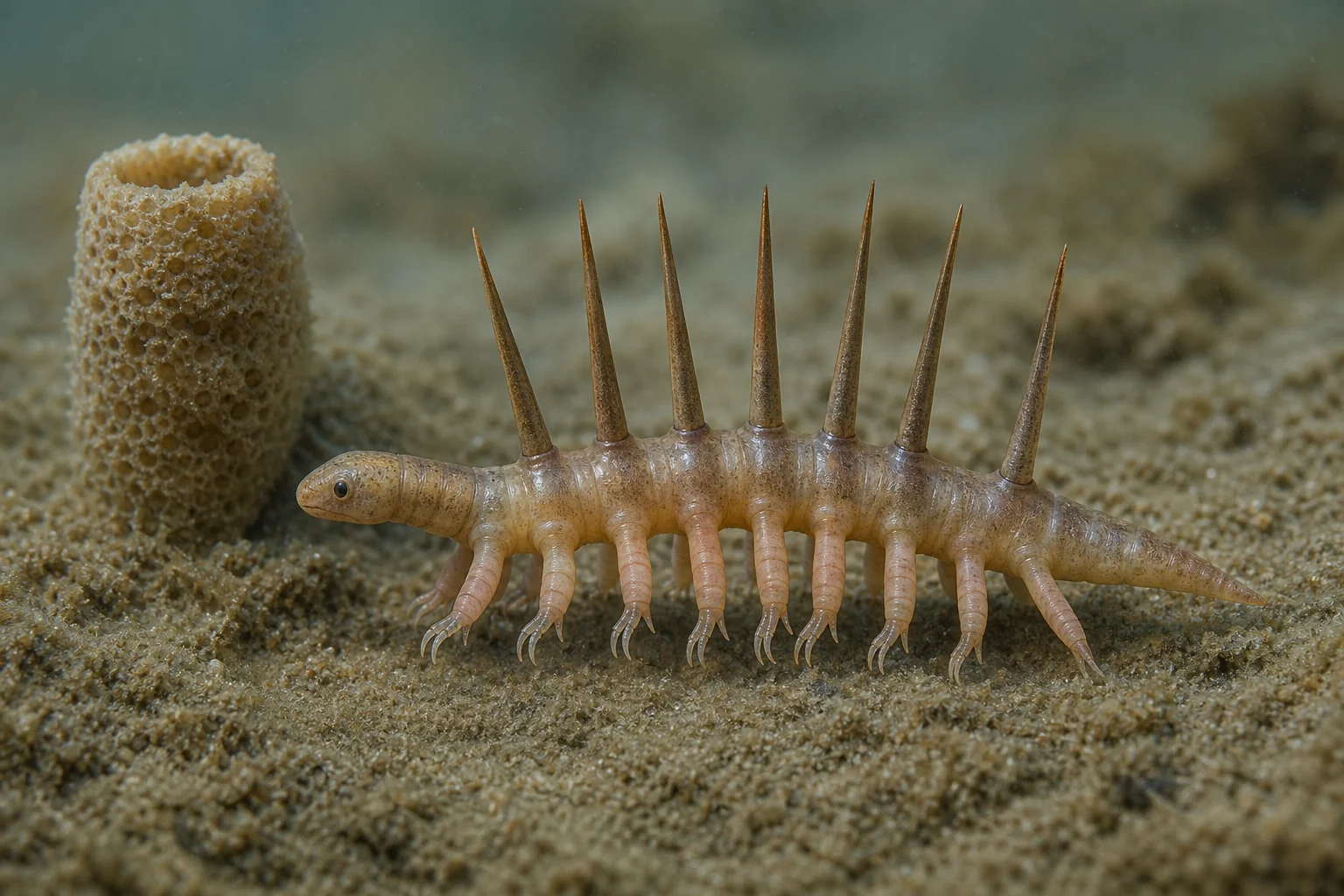 View full-resolution reconstruction ↗
This is an original generative reconstruction, not a photograph or scientific plate. Measurements and interpretations below are tied to named sources.
01 / SCALE
How small was Hallucigenia?
Most specimens measure only one to three and a half centimetres. Enlarged museum images make the animal look monstrous, so responsible art includes scale and keeps the fine legs, eyes and claws proportionate.
02 / DORSAL ARMOUR
What were the paired spines for?
Seven pairs of rigid mineralised spines rose from the trunk. Defence against predators is the strongest functional inference, but no fossil captures an attack and colour, flexibility of any covering and display use remain unknown.
03 / WALKING LEGS
How were the soft legs arranged?
Longer paired lobopods occupied the trunk beneath the spines, while smaller posterior appendages differed in form. Compression can overlap left and right legs, so counts and gait come from comparing many specimens rather than one silhouette.
04 / LAYERED CLAWS
Why are the claws evolutionarily important?
Electron microscopy showed each claw was built from nested elements. The same construction occurs in velvet-worm claws and jaws, supporting a shared ancestry and showing that mouthparts can evolve from limb-like structures.
05 / HEAD
What did the true head contain?
Rock preparation exposed a rounded head with one simple eye on each side, a terminal mouth and an internal ring of teeth followed by needle-like pharyngeal armature. The dark bulb once labelled the head was decay fluid at the opposite end.
06 / EVOLUTIONARY POSITION
Was Hallucigenia an ancestor of velvet worms?
It is safer to call Hallucigenia a close stem relative rather than a direct ancestor. Claws, lobopods and pharyngeal structures link it to panarthropods, while exact branching among Cambrian lobopodians remains under study.
FREQUENTLY ASKED QUESTIONS
Questions readers ask
How large was Hallucigenia?
Most specimens are only about 10–35 millimetres long.
Did Hallucigenia walk on its spines?
No. It walked on soft paired legs; the rigid spines projected from its back.
How many eyes did Hallucigenia have?
The head is reconstructed with one simple eye on each side.
Was Hallucigenia an arthropod?
It was a panarthropod lobopodian near the lineage linking velvet worms and arthropods, not a crown-group arthropod.
What did Hallucigenia eat?
The exact diet is unknown; small soft or particulate food is plausible.
Why is Hallucigenia famous?
Its radically revised reconstruction became a classic example of how new fossils correct scientific interpretations.
SOURCES & FURTHER READING
Evidence used in this guide
Measurements and interpretations are tied to museum resources or peer-reviewed studies; disputed conclusions include evidence on both sides.
- 01Hallucigenia claws reveal the ancestry of onychophoran jaws ↗Nature · DOI 10.1038/nature13576
Microscopic claw structure connects Hallucigenia with velvet-worm anatomy.
- 02Hallucigenia's head and the pharyngeal armature of early ecdysozoans ↗Nature · PMID 26106857
Head preparation revealed eyes, mouth and pharyngeal teeth.
- 03Researchers discover nightmarish Burgess Shale creature had teeth ↗Royal Ontario Museum
Museum account of anatomy, scale, locality and the velvet-worm relationship.