
GREAT AUK TOPIC HUB · EXTINCTION
Why Did the Great Auk Go Extinct?
Trace harvest, egg collecting and the 1844 endpoint.
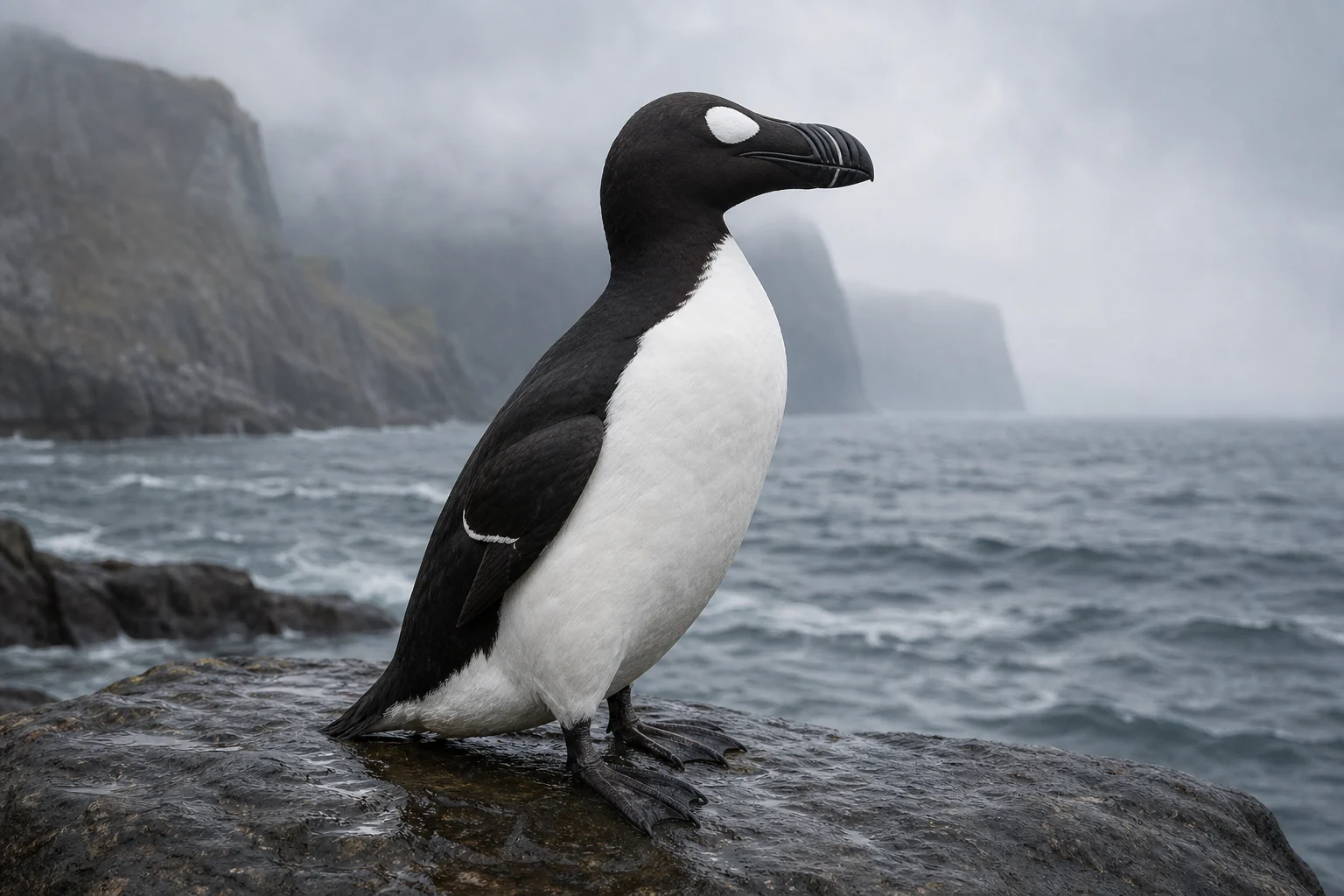 View full-resolution reconstruction ↗
This is an original generative reconstruction, not a photograph or scientific plate. Measurements and interpretations below are tied to named sources.
01 / SHORT ANSWER
Why did the Great Auk go extinct?
People killed adults for meat, bait, oil and feathers and collected their single eggs. Because the birds could not fly and nested in dense coastal groups, harvest removed breeding adults faster than colonies could replace them.
As numbers fell, museums and private collectors increased demand for skins and eggs. The last widely accepted breeding pair was killed on Eldey, Iceland, in 1844; later sightings are unverified.
02 / ECOLOGY
What did Great Auk eat and how did it live?
How did the Great Auk live?: It fed at sea and returned to isolated rocks to breed in dense seasonal colonies, laying one large egg without a built nest.
Was it related to penguins?: No. Auks and penguins independently evolved black-and-white, wing-propelled diving bodies in opposite hemispheres.
03 / PLACE & TIME
Where did the Great Auk live?
It ranged across cold North Atlantic waters from eastern North America and Greenland to Iceland, Britain and northern Europe, but bred only on suitable predator-free rocks.
Newfoundland: Funk Island once held immense colonies.
Iceland: Geirfuglasker and Eldey held last breeders.
British Isles: Bones and historical records mark former range.
Open Atlantic: Adults migrated and foraged widely outside breeding.
04 / SOURCE RECORD
How do scientists know about the Great Auk?
Museum skins: Dozens preserve plumage, bill and body proportions.
Eggs: Surviving eggs record unique pattern variation.
Bones: Archaeological and natural deposits map range and use.
Historical testimony: Sailors and collectors document colonies and final killings.
05 / SCIENTIFIC DEBATE
What remains uncertain?
Reliability of post-1844 sightings.
Original colony sizes.
Relative regional harvest intensity.
Seasonal migration routes.
06 / EVIDENCE VERDICT
Could the Great Auk have been saved?
Yes in principle: protecting its few breeding islands and ending commercial and collecting harvest before colonies collapsed could have removed the direct cause.
Its loss shows how rarity can raise specimen value and accelerate a preventable extinction.
FREQUENTLY ASKED QUESTIONS
Questions readers ask
When did the Great Auk go extinct?
The last accepted breeding pair was killed in 1844.
Could it fly?
No, its short wings were adapted for diving.
Was it a penguin?
No, it was a North Atlantic auk.
How tall was it?
About 75–85 centimetres.
Why was it hunted?
For meat, bait, oil, feathers, skins and eggs.
Are specimens preserved?
Yes, skins, skeletons and eggs remain in museums.
SOURCES & FURTHER READING
Evidence used in this guide
Measurements and interpretations are tied to museum resources or peer-reviewed studies; disputed conclusions include evidence on both sides.
- 01Research Case: The Great Auk ↗Smithsonian Institution
Museum evidence from specimens and extinction history.
- 02Pinguinus impennis ↗Paleobiology Database
Taxonomic and fossil-occurrence record.
- 03Pinguinus impennis ↗GBIF
Stable biodiversity record.