
GREAT AUK TOPIC HUB · BODY & DIVING
Great Auk Size, Wings and Diving
Compare bones, skins and convergent penguin form.
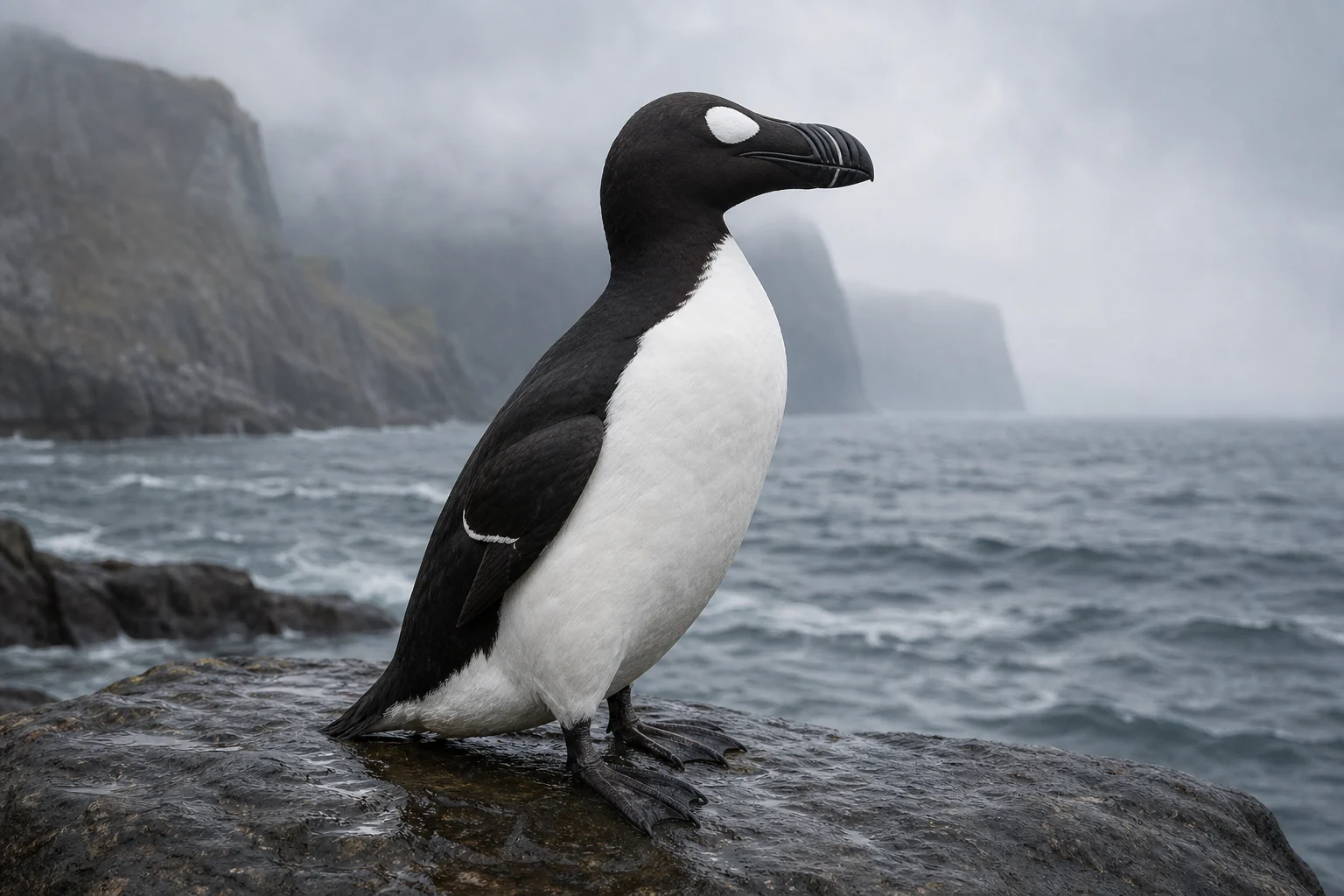 View full-resolution reconstruction ↗
This is an original generative reconstruction, not a photograph or scientific plate. Measurements and interpretations below are tied to named sources.
01 / QUICK ANSWER
What was the Great Auk?
The Great Auk was a large flightless seabird of the North Atlantic, about 75–85 centimetres tall, whose short wings powered pursuit dives rather than flight.
It was the original bird called a penguin, though unrelated to Southern Hemisphere penguins. Dense colonies on a small number of exposed islands made adults, eggs and down easy to harvest.
02 / MEASUREMENTS
How large was Great Auk?
Scientific name: Pinguinus impennis · Extinction: 1844 · Height: About 75–85 cm · Mass: About 5 kg · Flight: Flightless · Diet: Fish and marine invertebrates · Breeding: One large egg on rocky islands · Range: North Atlantic
03 / ANATOMY
A seabird whose wings became underwater propellers
Short wings: Reduced flight feathers and robust bones powered diving.
Deep body: Dense insulation and fat protected against cold water.
Grooved bill: A large laterally compressed bill gripped fish.
Webbed feet: Feet steered underwater and supported an upright land stance.
04 / FUNCTION
Why did the Great Auk go extinct?
People killed adults for meat, bait, oil and feathers and collected their single eggs. Because the birds could not fly and nested in dense coastal groups, harvest removed breeding adults faster than colonies could replace them.
As numbers fell, museums and private collectors increased demand for skins and eggs. The last widely accepted breeding pair was killed on Eldey, Iceland, in 1844; later sightings are unverified.
05 / FOSSIL EVIDENCE
How do scientists know about the Great Auk?
Museum skins: Dozens preserve plumage, bill and body proportions.
Eggs: Surviving eggs record unique pattern variation.
Bones: Archaeological and natural deposits map range and use.
Historical testimony: Sailors and collectors document colonies and final killings.
06 / EVIDENCE VERDICT
Could the Great Auk have been saved?
Yes in principle: protecting its few breeding islands and ending commercial and collecting harvest before colonies collapsed could have removed the direct cause.
Its loss shows how rarity can raise specimen value and accelerate a preventable extinction.
FREQUENTLY ASKED QUESTIONS
Questions readers ask
When did the Great Auk go extinct?
The last accepted breeding pair was killed in 1844.
Could it fly?
No, its short wings were adapted for diving.
Was it a penguin?
No, it was a North Atlantic auk.
How tall was it?
About 75–85 centimetres.
Why was it hunted?
For meat, bait, oil, feathers, skins and eggs.
Are specimens preserved?
Yes, skins, skeletons and eggs remain in museums.
SOURCES & FURTHER READING
Evidence used in this guide
Measurements and interpretations are tied to museum resources or peer-reviewed studies; disputed conclusions include evidence on both sides.
- 01Research Case: The Great Auk ↗Smithsonian Institution
Museum evidence from specimens and extinction history.
- 02Pinguinus impennis ↗Paleobiology Database
Taxonomic and fossil-occurrence record.
- 03Pinguinus impennis ↗GBIF
Stable biodiversity record.