
GLYPTODON TOPIC HUB · ARMOUR & ANATOMY
Glyptodon Size, Armour, Tail and Anatomy
How large was Glyptodon, how was its shell built and why was its tail different from the club of Doedicurus?
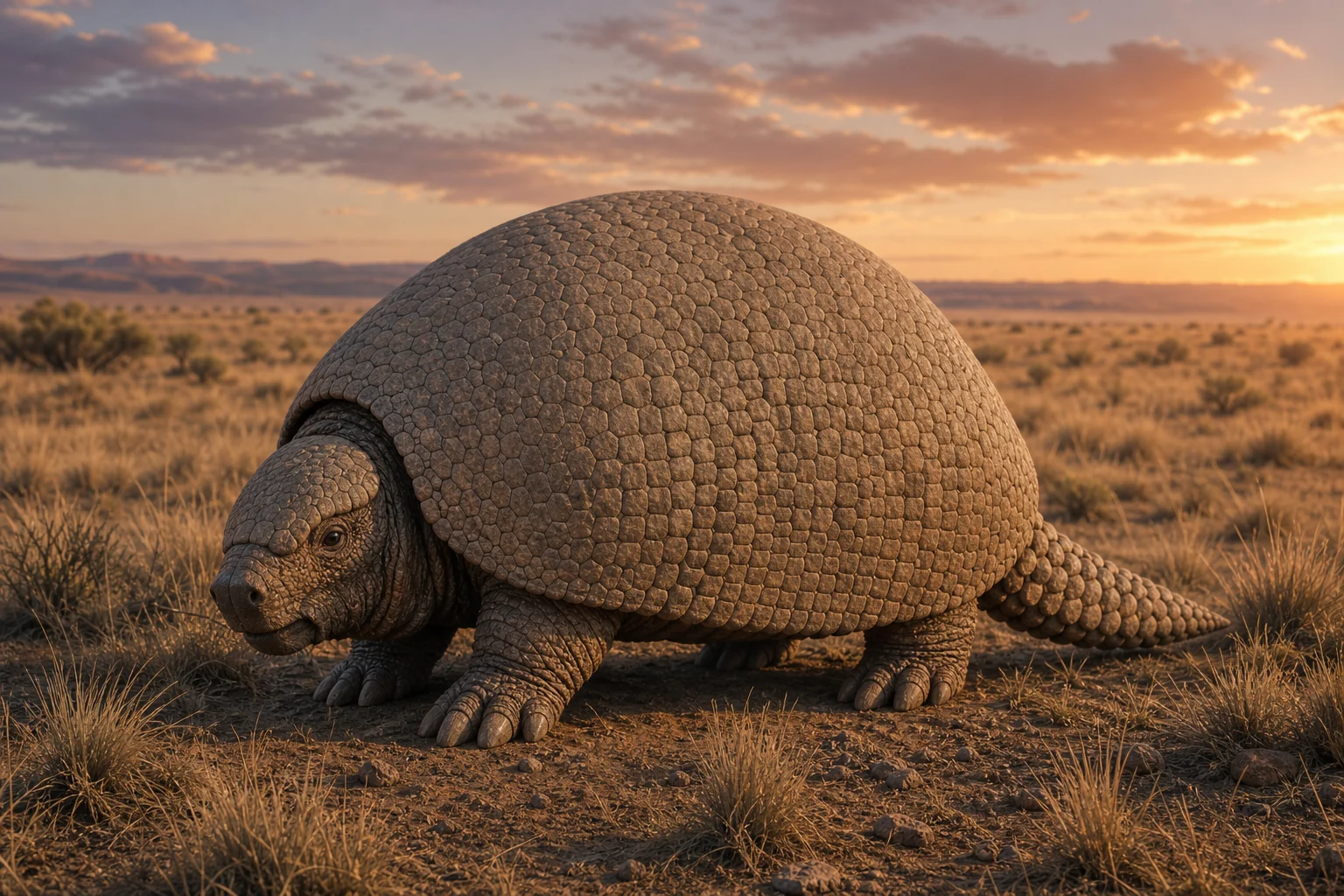 View full-resolution reconstruction ↗
This is an original generative reconstruction, not a photograph or scientific plate. Measurements and interpretations below are tied to named sources.
01 / SIZE
How big was Glyptodon?
Adult estimates cluster around 3–3.5 metres in length and one to two tonnes. Shells vary among specimens, so a single maximum should not be presented as the average.
02 / CARAPACE
How was the armour constructed?
Hundreds of polygonal skin bones fused into a continuous dome over the trunk. Sutures, surface patterns and repaired injuries are direct evidence; colour and keratin covering are reconstructed.
03 / ARMADILLO, NOT TURTLE
Was the shell a turtle shell?
No. Glyptodont armour developed within the armadillo lineage from osteoderms in the skin. Turtle shells incorporate ribs and vertebrae and arose through a different developmental history.
04 / HEAD & LIMBS
How did the skeleton support the shell?
A deep skull, short robust limb bones and broad feet carried the heavy trunk close to the ground. A separate bony cap guarded the skull without sealing the neck opening.
05 / TAIL
Did Glyptodon have a tail club?
Its tail was strong and enclosed by bony rings, but the genus lacked the enlarged mace-like terminal structure of Doedicurus. Defensive sweeping is plausible, yet no fossil records the motion itself.
06 / RECONSTRUCTION
What should an accurate reconstruction show?
Show a rigid domed shell, low heavy body, armoured head and ringed tail. Avoid a flexible armadillo band, turtle-like rib shell or invented Doedicurus club.
FREQUENTLY ASKED QUESTIONS
Questions readers ask
How big was Glyptodon?
About 3–3.5 metres long and roughly 1–2 tonnes.
Was Glyptodon an armadillo?
It was an extinct glyptodont nested within the armadillo branch.
Was its shell like a turtle shell?
No. It formed from fused skin bones and did not incorporate the ribs like a turtle shell.
Did Glyptodon have a tail club?
Its tail was armoured, but not specialised into the large club seen in Doedicurus.
What did it eat?
Mostly grasses and low vegetation, with regional flexibility.
Did humans encounter Glyptodon?
Yes; archaeological remains document overlap and processing.
SOURCES & FURTHER READING
Evidence used in this guide
Measurements and interpretations are tied to museum resources or peer-reviewed studies; disputed conclusions include evidence on both sides.
- 01Glyptodon collection and armour ↗Natural History Museum, London
Museum context for glyptodont armour and historical specimens.
- 02Ancient DNA reveals glyptodont relationships ↗Current Biology · DOI 10.1016/j.cub.2016.01.039
Genomic evidence places glyptodonts within the armadillo lineage.
- 03Extinct megafauna dominated human subsistence ↗Science Advances · PMC12487880
Regional archaeological context for South American megafaunal exploitation.