
GLYPTODON TOPIC HUB · DIET & EXTINCTION
What Did Glyptodon Eat, and Why Did It Go Extinct?
Use teeth, isotopes, archaeology and environmental change to reconstruct Glyptodon ecology and its terminal-Pleistocene loss.
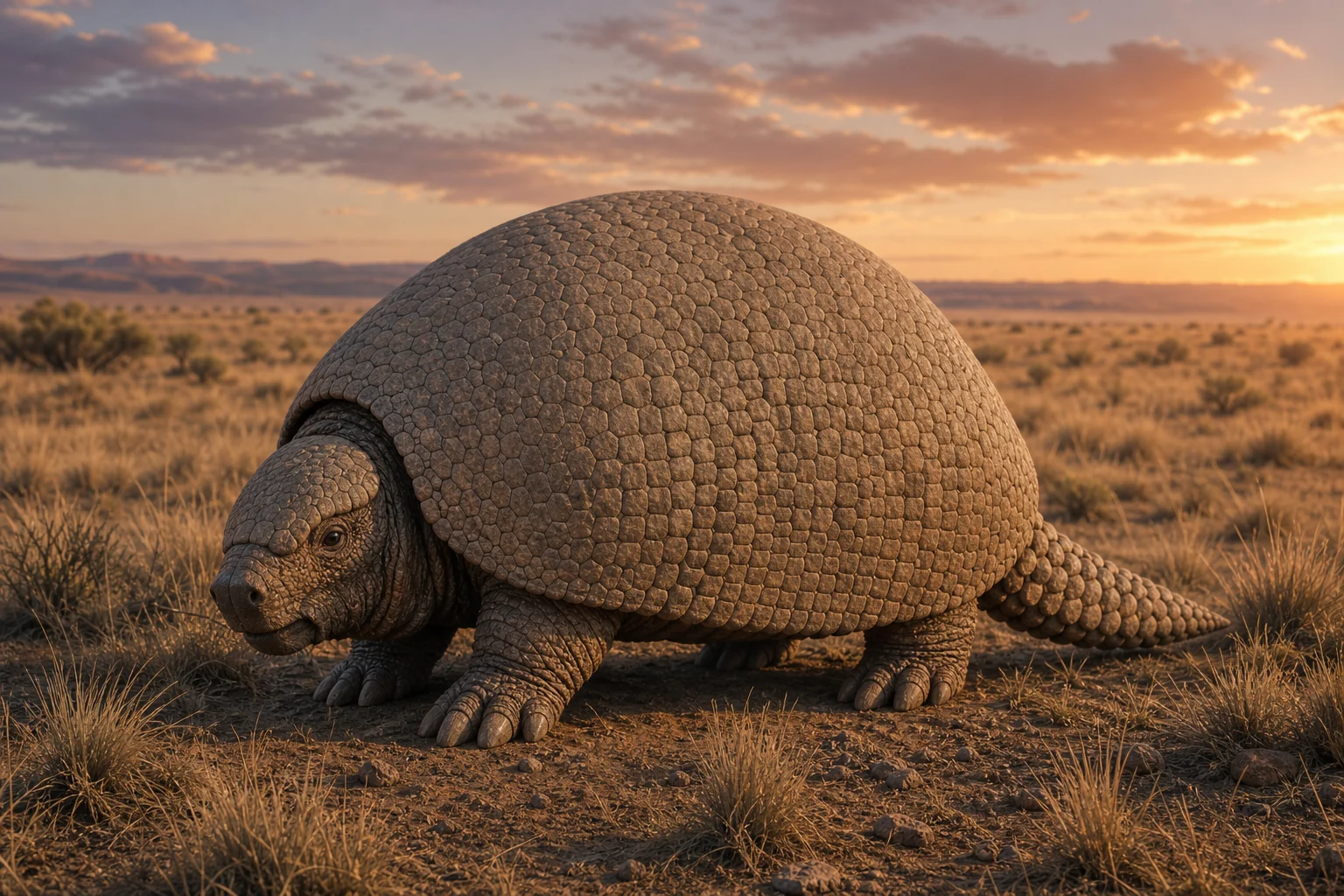 View full-resolution reconstruction ↗
This is an original generative reconstruction, not a photograph or scientific plate. Measurements and interpretations below are tied to named sources.
01 / TEETH
What do the teeth reveal?
Tall ridged teeth formed repeated grinding surfaces suitable for abrasive plants. Tooth form establishes herbivory but does not identify one plant species or a continent-wide menu.
02 / ISOTOPES
Did it graze or browse?
Carbon isotopes support substantial grass consumption in open habitats, with regional mixtures of C3 and C4 plants. Diet shifted with latitude, climate and available vegetation.
03 / HUMAN CONTACT
Did people use Glyptodon?
Cut or modified remains and archaeological associations document overlap and processing in southern South America. Each site requires careful dating; association alone does not prove a kill.
04 / CLIMATE
What changed at the Ice Age's end?
Warming and rainfall shifts reorganised grassland, woodland, fire and water. Large slow-breeding herbivores faced altered forage while many other megafaunal species declined at the same time.
05 / NOT ONE CAUSE
Was hunting the only cause?
Direct human use makes hunting relevant, but geography, timing and broad ecosystem turnover resist a single-cause claim. Climate-only explanations also fail to explain every local pattern.
06 / VERDICT
What is the best-supported explanation?
A multi-factor model fits current evidence: human pressure reduced vulnerable populations while rapid environmental change altered habitat and recovery. Exact contributions probably differed among regions.
FREQUENTLY ASKED QUESTIONS
Questions readers ask
How big was Glyptodon?
About 3–3.5 metres long and roughly 1–2 tonnes.
Was Glyptodon an armadillo?
It was an extinct glyptodont nested within the armadillo branch.
Was its shell like a turtle shell?
No. It formed from fused skin bones and did not incorporate the ribs like a turtle shell.
Did Glyptodon have a tail club?
Its tail was armoured, but not specialised into the large club seen in Doedicurus.
What did it eat?
Mostly grasses and low vegetation, with regional flexibility.
Did humans encounter Glyptodon?
Yes; archaeological remains document overlap and processing.
SOURCES & FURTHER READING
Evidence used in this guide
Measurements and interpretations are tied to museum resources or peer-reviewed studies; disputed conclusions include evidence on both sides.
- 01Glyptodon collection and armour ↗Natural History Museum, London
Museum context for glyptodont armour and historical specimens.
- 02Ancient DNA reveals glyptodont relationships ↗Current Biology · DOI 10.1016/j.cub.2016.01.039
Genomic evidence places glyptodonts within the armadillo lineage.
- 03Extinct megafauna dominated human subsistence ↗Science Advances · PMC12487880
Regional archaeological context for South American megafaunal exploitation.