
DIRE WOLF TOPIC HUB · ECOLOGY & EXTINCTION
Dire Wolf Diet, Pack Hunting and Extinction
What dire wolves ate, whether they hunted in packs, how La Brea biases the record and why they disappeared at the end of the Pleistocene.
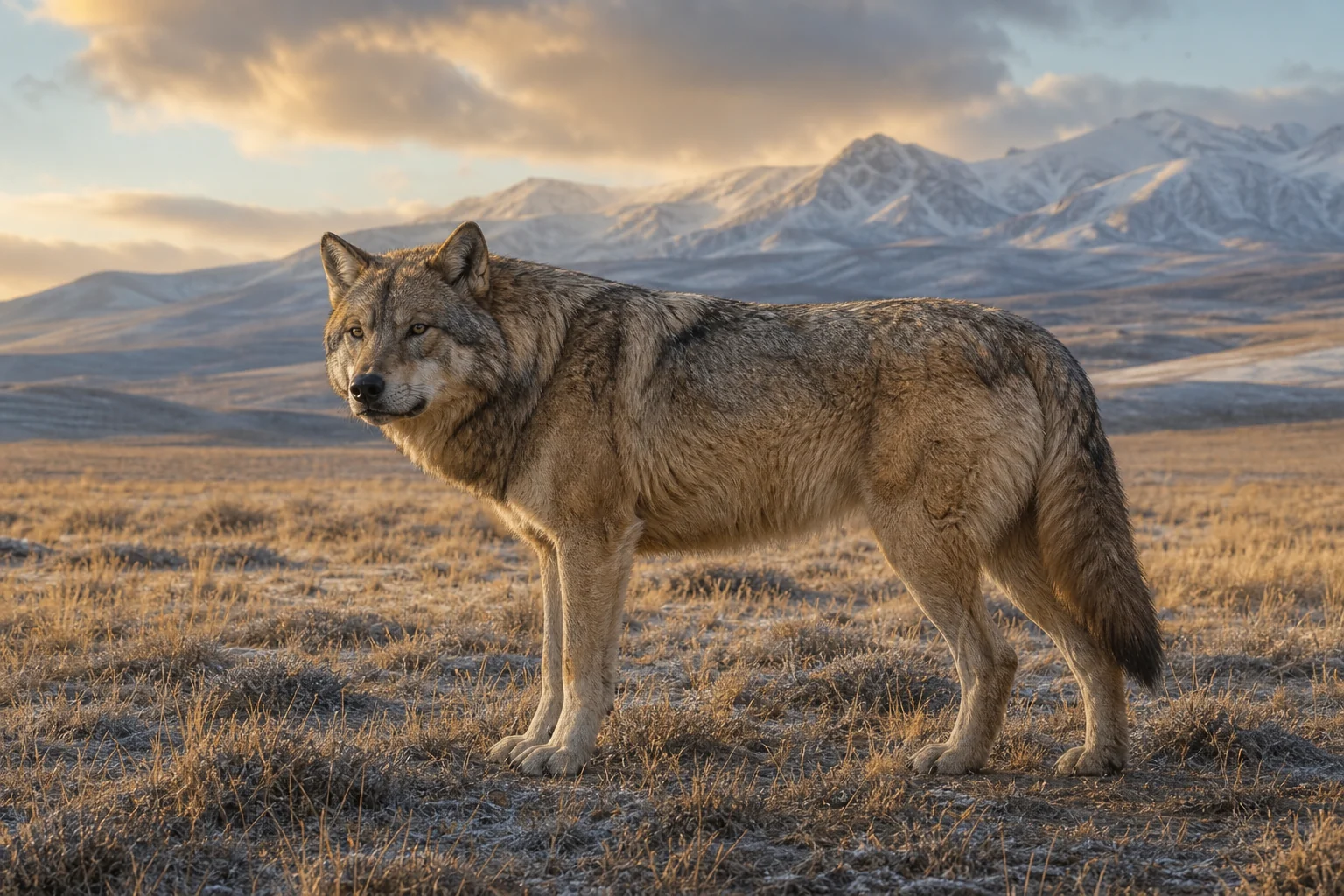 View full-resolution reconstruction ↗
This is an original generative reconstruction, not a photograph or scientific plate. Measurements and interpretations below are tied to named sources.
01 / DIET
What did dire wolves eat?
Stable isotopes and tooth wear identify horses, bison, camels and other large herbivores as major prey. Local menus shifted as animal communities and climates changed.
02 / PACKS
Did dire wolves hunt in packs?
Large prey, repeated predator remains and canid comparisons make cooperation plausible. Yet asphalt traps attracted multiple individuals over time, so abundance at La Brea does not directly record one coordinated pack.
03 / FEEDING DAMAGE
Were dire wolves bone crushers?
Heavy wear and fractures show frequent hard-object contact, especially during food stress. Their teeth could process carcasses effectively, but were less specialised than those of hyenas.
04 / FOSSIL BIAS
What does La Brea overrepresent?
Predators drawn to trapped herbivores accumulated disproportionately. The site is exceptional for anatomy and population studies but cannot by itself establish ordinary predator density or group size.
05 / EXTINCTION
Why did dire wolves disappear?
Many large prey populations collapsed around the end of the Pleistocene while habitats changed rapidly and humans spread. More flexible coyotes and gray wolves survived, but direct competitive replacement is not demonstrated.
06 / EVIDENCE VERDICT
What is the best ecological model?
Dire wolves were robust social-capable predators tied strongly to large-prey food webs. That strategy succeeded for millennia but became vulnerable when prey, climate and competitors changed together.
FREQUENTLY ASKED QUESTIONS
Questions readers ask
Was the dire wolf a gray wolf?
No. Ancient DNA supports a separate, deeply divergent American canid lineage.
How big was it?
Typical estimates are around 60–68 kg: robust and large, but not a fantasy giant.
Did it hunt in packs?
Plausible but not directly demonstrated; La Brea abundance alone cannot prove cooperation.
What did it eat?
Horses, bison, camels and other large mammals, plus carrion when available.
Could it interbreed with gray wolves?
The 2021 genomes found no evidence of recent gene flow despite overlapping ranges.
Why did it vanish?
Large-prey loss, climate and ecological competition probably interacted.
SOURCES & FURTHER READING
Evidence used in this guide
Measurements and interpretations are tied to museum resources or peer-reviewed studies; disputed conclusions include evidence on both sides.
- 01Dire wolves were the last of an ancient New World canid lineage ↗Nature
Ancient genomes establishing deep divergence and long isolation.
- 02Mammal Collections ↗La Brea Tar Pits
Official context for the exceptionally abundant dire-wolf collection.
- 03Sample Tar Pits’ Paleo Diets ↗La Brea Tar Pits
Dental evidence and food-web interpretation at La Brea.