
DIRE WOLF TOPIC HUB · SIZE & GENETICS
Dire Wolf Size, DNA and Comparison with Gray Wolves
How large was the dire wolf, how did it compare with gray wolves, and what ancient genomes reveal about its deep American lineage?
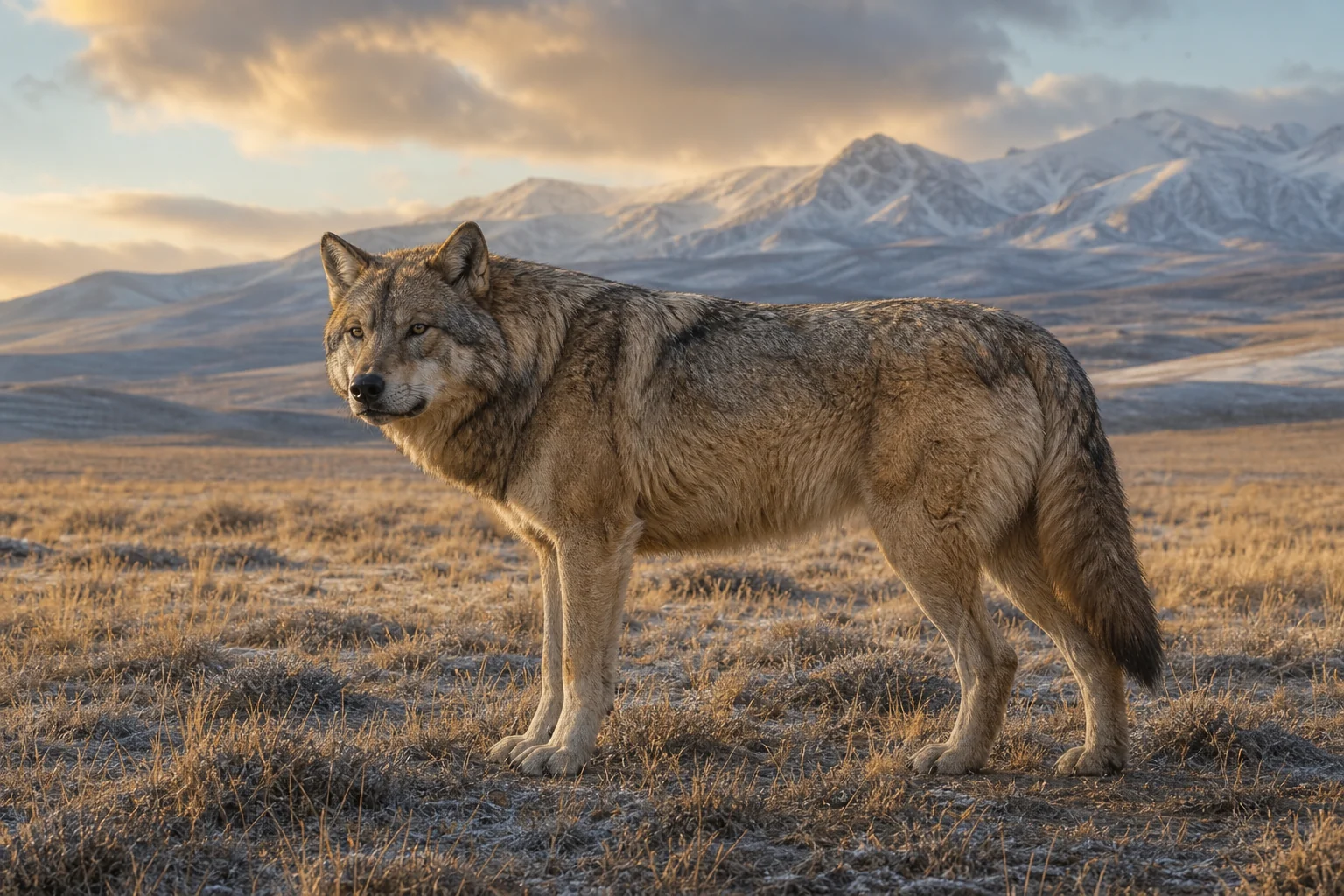 View full-resolution reconstruction ↗
This is an original generative reconstruction, not a photograph or scientific plate. Measurements and interpretations below are tied to named sources.
01 / IDENTITY
Was the dire wolf a gray wolf?
No. Genome sequences place dire wolves outside the crown group containing gray wolves, coyotes and jackals. Their similar skull and body proportions reflect convergent adaptation to large-prey hunting.
02 / SIZE
How large was a dire wolf?
Most reconstructions put adults above many modern gray wolves in average mass, with a broad head and heavy teeth. Population and sex variation mean there is no single species-wide weight.
03 / ANCIENT DNA
How was its genome recovered?
DNA survived in a small number of bones and teeth from cooler sites. Researchers compared genome-wide sequences with living and extinct canids, while testing contamination and dating each specimen.
04 / LINEAGE
Why use the name Aenocyon dirus?
The deep genetic split supports recognising a distinct genus, Aenocyon, rather than placing the animal inside Canis. Taxonomic usage is still being standardised across museums and databases.
05 / GENE FLOW
Could dire wolves breed with gray wolves?
The initial genomes found no evidence of recent gene flow despite geographic overlap, unlike the frequent hybridisation among many Canis species. That isolation may have limited access to useful incoming adaptations.
06 / EVIDENCE VERDICT
What changed after the DNA study?
The dire wolf changed from a heavy gray-wolf relative into the last known member of a long-isolated New World lineage. Precise deeper ancestry continues to be refined as more genomes become available.
FREQUENTLY ASKED QUESTIONS
Questions readers ask
Was the dire wolf a gray wolf?
No. Ancient DNA supports a separate, deeply divergent American canid lineage.
How big was it?
Typical estimates are around 60–68 kg: robust and large, but not a fantasy giant.
Did it hunt in packs?
Plausible but not directly demonstrated; La Brea abundance alone cannot prove cooperation.
What did it eat?
Horses, bison, camels and other large mammals, plus carrion when available.
Could it interbreed with gray wolves?
The 2021 genomes found no evidence of recent gene flow despite overlapping ranges.
Why did it vanish?
Large-prey loss, climate and ecological competition probably interacted.
SOURCES & FURTHER READING
Evidence used in this guide
Measurements and interpretations are tied to museum resources or peer-reviewed studies; disputed conclusions include evidence on both sides.
- 01Dire wolves were the last of an ancient New World canid lineage ↗Nature
Ancient genomes establishing deep divergence and long isolation.
- 02Mammal Collections ↗La Brea Tar Pits
Official context for the exceptionally abundant dire-wolf collection.
- 03Sample Tar Pits’ Paleo Diets ↗La Brea Tar Pits
Dental evidence and food-web interpretation at La Brea.