
DEINONYCHUS TOPIC HUB · PACK EVIDENCE
Did Deinonychus Hunt in Packs?
Separate Tenontosaurus associations from coordinated social behaviour.
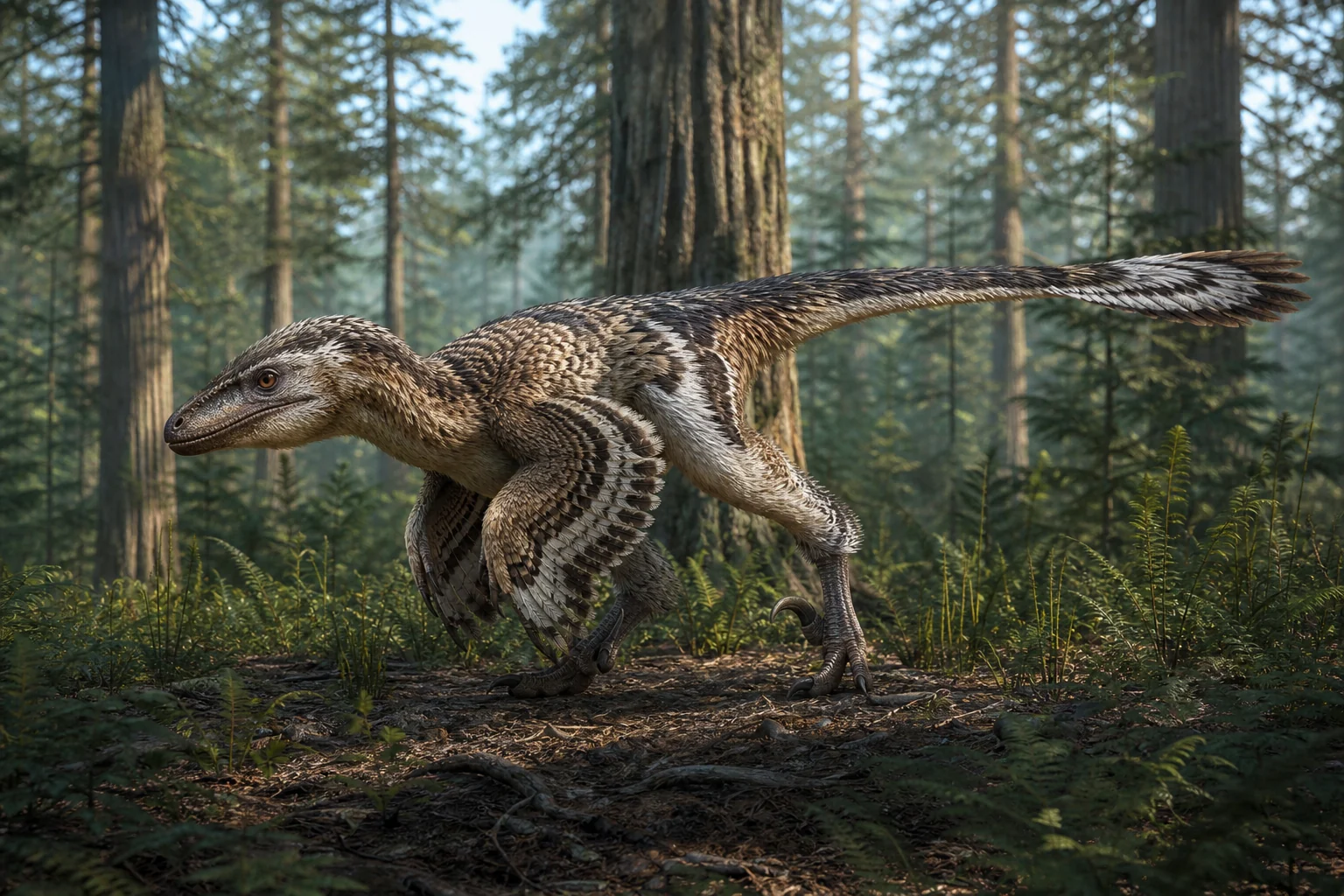 View full-resolution reconstruction ↗
This is an original generative reconstruction, not a photograph or scientific plate. Measurements and interpretations below are tied to named sources.
01 / SHORT ANSWER
Did Deinonychus hunt in coordinated packs?
At several Tenontosaurus sites, shed Deinonychus teeth and sometimes multiple individuals occur around one herbivore. This establishes feeding and repeated contact, but drought, carcass attraction or mobbing can also assemble predators.
Modern archosaurs do not require mammal-like social packs to exploit a large carcass. Cooperative hunting remains possible, yet claims about permanent hierarchy, assigned roles or family packs exceed the fossils.
02 / ECOLOGY
What did Deinonychus eat and how did it live?
What did Deinonychus eat?: Tenontosaurus is directly associated, while smaller vertebrates and carrion were also available.
How did the claw work?: Curvature supports puncturing, hooking and prey restraint more strongly than a long disembowelling slash.
03 / PLACE & TIME
Where did Deinonychus live?
Fossils come mainly from the Cloverly Formation of Montana and Wyoming and equivalent rocks in the western United States.
Montana: Type localities preserve skeletons and prey associations.
Wyoming: Additional material expands individual variation.
Floodplains: Rivers supported conifers, cycads and diverse herbivores.
Seasonal habitats: Drought and carcass concentration may explain bonebeds.
04 / SOURCE RECORD
How do scientists know about Deinonychus?
Associated skeletons: Multiple individuals preserve much of the body.
Toe claws: Joint surfaces constrain posture and motion.
Tenontosaurus sites: Teeth and bones record feeding associations.
Bird comparison: Related feathers and wing anatomy guide soft-tissue reconstruction.
05 / SCIENTIFIC DEBATE
What remains uncertain?
Degree of cooperation.
Primary sickle-claw function.
Adult body mass.
Feather shape and colour.
06 / EVIDENCE VERDICT
What did Deinonychus prove?
It showed that non-avian dinosaurs could be active, balanced and bird-like, but it did not prove cinematic pack tactics or a single use for the sickle claw.
The best reconstruction combines direct skeletal mechanics with feather evidence from close relatives and keeps social behaviour conditional.
FREQUENTLY ASKED QUESTIONS
Questions readers ask
How big was Deinonychus?
About 3–4 metres long and roughly 60–100 kilograms.
Did it have feathers?
No direct skin is known, but feathered close relatives make feathers strongly supported.
Was it Velociraptor?
No. Deinonychus was a larger North American relative.
Did it slash prey open?
Hooking and restraint fit the claw better than a long slicing stroke.
Did it hunt in packs?
Possible, but coordinated packs are not directly demonstrated.
Why is it important?
Its anatomy helped launch the dinosaur renaissance and renew the dinosaur–bird link.
SOURCES & FURTHER READING
Evidence used in this guide
Measurements and interpretations are tied to museum resources or peer-reviewed studies; disputed conclusions include evidence on both sides.
- 01Deinonychus ↗Yale Peabody Museum
Museum account of discovery, feathers and dinosaur renaissance significance.
- 02Life among Dinosaurs ↗Yale Peabody Museum
Specimen and locomotor context for Deinonychus.
- 03Deinonychus antirrhopus ↗Paleobiology Database
Taxonomic and occurrence record.