
WOOLLY RHINOCEROS TOPIC HUB · EXTINCTION
Why Did the Woolly Rhinoceros Go Extinct?
Combine chronology, climate modelling, ancient DNA, diet and human overlap to explain the woolly rhinoceros's late survival and loss.
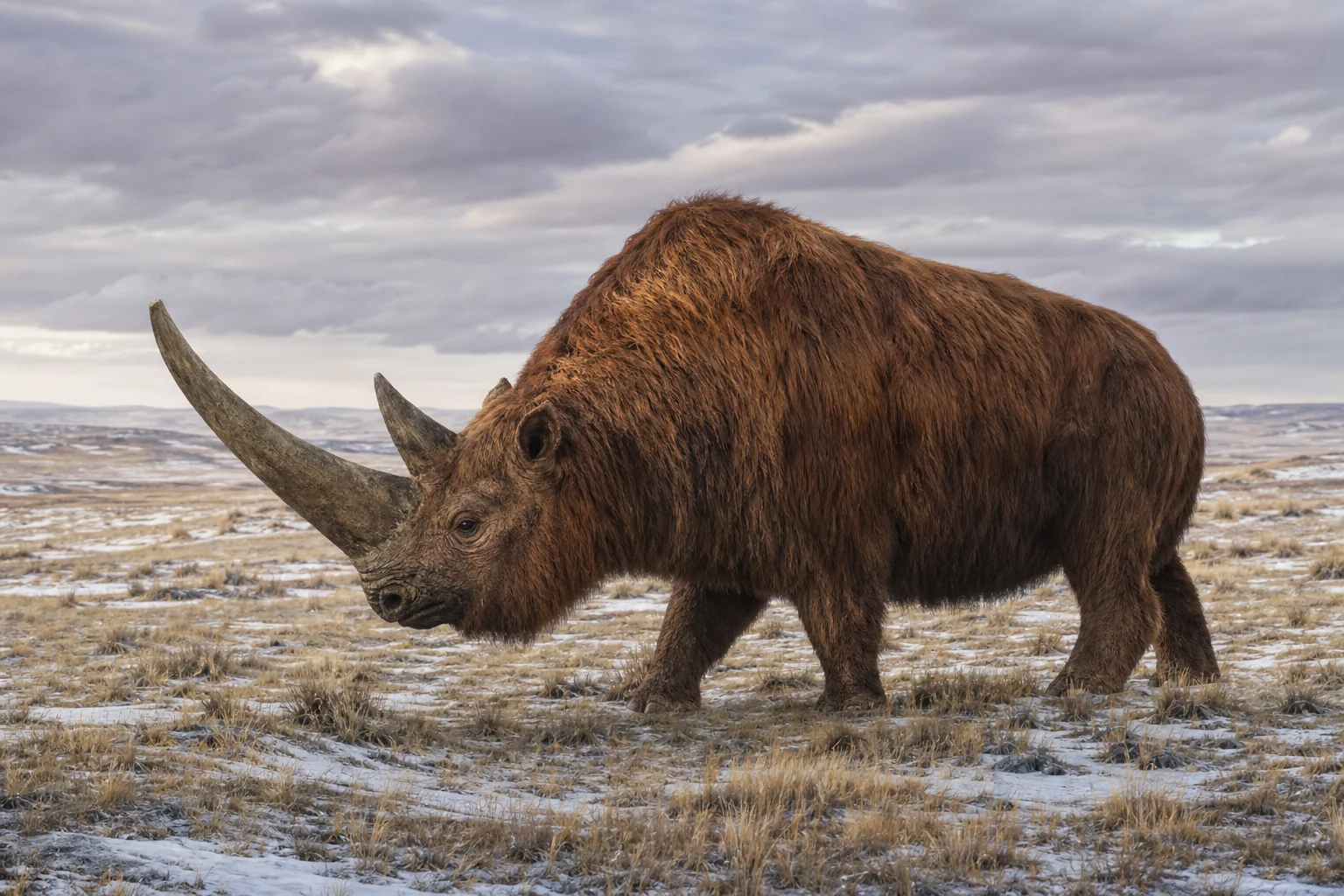 View full-resolution reconstruction ↗
This is an original generative reconstruction, not a photograph or scientific plate. Measurements and interpretations below are tied to named sources.
01 / CHRONOLOGY
When did the last populations disappear?
Radiocarbon syntheses place terminal survival around 14,000 years ago in northeastern Siberia, with regional retreat occurring earlier elsewhere. Dates must be screened for contamination and redeposition.
02 / ANCIENT DNA
Did inbreeding cause the extinction?
A pre-extinction genome and population history show long-term demographic stability and substantial diversity until near the end. That weakens a prolonged genetic-collapse model, though final small groups could still be vulnerable.
03 / WARMING
Why did abrupt warming matter?
The Bølling–Allerød transition brought fast temperature and moisture changes. Shrubs, trees and snow conditions altered the open herb-rich steppe on which the rhinoceros was specialised.
04 / HUMAN PRESSURE
Were people the main cause?
Humans overlapped woolly rhinoceroses and used Ice Age megafauna, but direct kill evidence is sparse. Modelling suggests hunting can amplify climate-driven range loss without requiring continent-wide intensive pursuit.
05 / SPECIALISATION
Why could a cold-adapted survivor fail?
Its grazing teeth, body and distribution fit cold dry open habitat. Rapidly fragmented forage reduced carrying capacity and connections among populations, making recovery from extra mortality harder.
06 / VERDICT
What explanation fits all evidence?
Rapid climate and vegetation change is the strongest continent-scale driver, with human pressure and demographic fragmentation as plausible multipliers. Ancient DNA argues against a simple long genetic decline.
FREQUENTLY ASKED QUESTIONS
Questions readers ask
How big was a woolly rhinoceros?
About 3.2–3.8 metres long and roughly 1.8–2.7 tonnes.
Did it have two horns?
Yes, with a very large flattened front horn.
Was it covered in wool?
Yes. Mummies preserve dense underfur and long guard hair.
Did it live on glaciers?
No. It lived on cold, dry, largely snow-light steppe.
What did it eat?
Mostly low grasses and herbaceous plants.
When did it go extinct?
About 14,000 years ago in northeastern Siberia.
SOURCES & FURTHER READING
Evidence used in this guide
Measurements and interpretations are tied to museum resources or peer-reviewed studies; disputed conclusions include evidence on both sides.
- 01Extinction chronology of the woolly rhinoceros ↗Quaternary Science Reviews
Direct radiocarbon review and dry-steppe ecology.
- 02Pre-extinction demographic stability ↗Current Biology
Nuclear and mitochondrial genomes test diversity before extinction.
- 0352,000 years of population dynamics ↗PNAS
Integrated fossil, DNA and simulation model of habitat and hunting.