
WOOLLY RHINOCEROS TOPIC HUB · ANATOMY
Woolly Rhinoceros Size, Horns, Coat and Ice Age Adaptations
How large was Coelodonta antiquitatis and what evidence supports its flattened horn, thick coat and mammoth-steppe life?
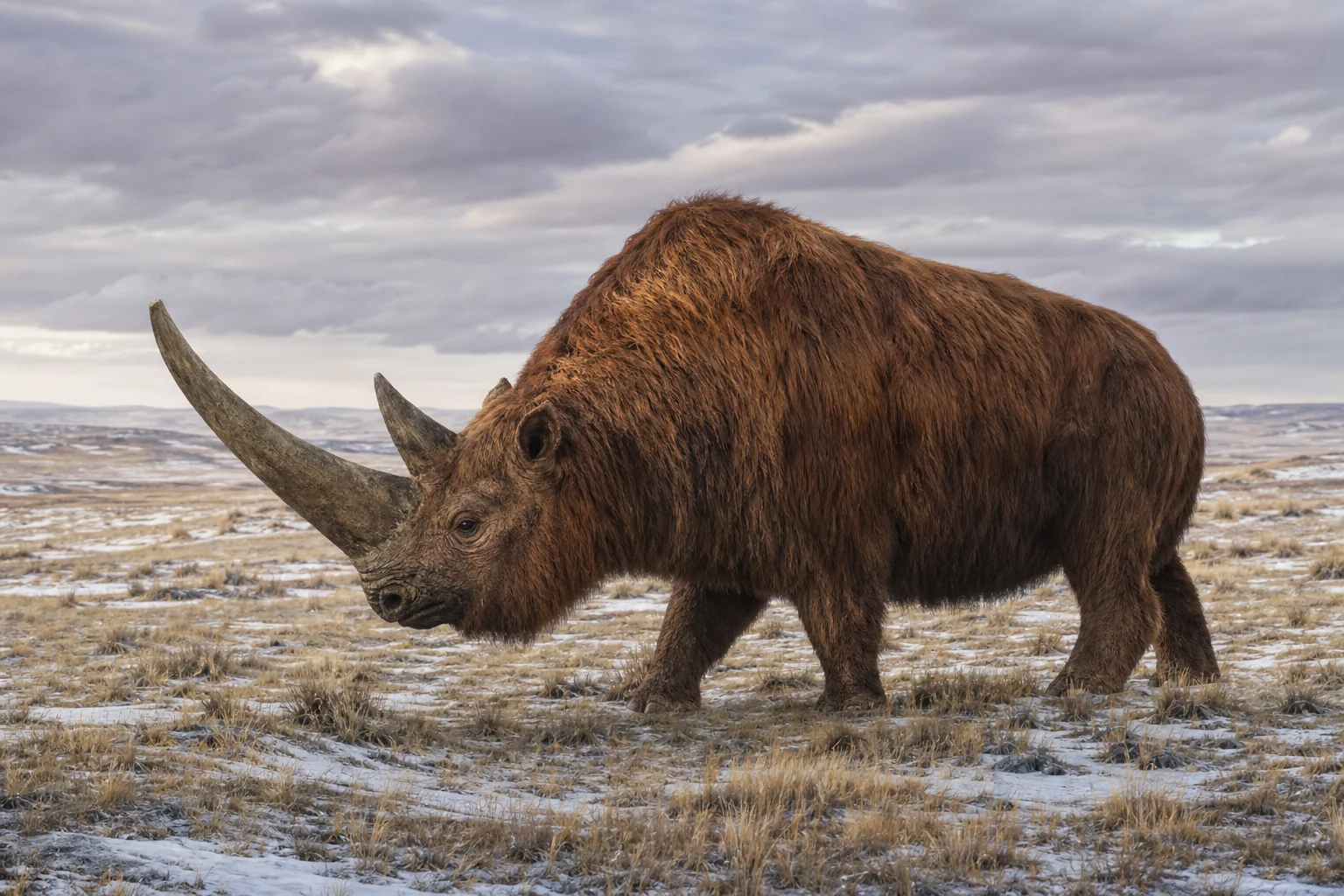 View full-resolution reconstruction ↗
This is an original generative reconstruction, not a photograph or scientific plate. Measurements and interpretations below are tied to named sources.
01 / SIZE
How big was the woolly rhinoceros?
Adults varied by sex and region; large skeletons reach about 3.8 metres while mass estimates overlap living large rhinoceroses. Report ranges, not one exact species weight.
02 / HORNS
What was unusual about the front horn?
Preserved keratin horns are long, laterally flattened and show wear bands. Abrasion supports contact with vegetation or snow, but it does not prove systematic snow-ploughing everywhere.
03 / COAT
Do we know it was woolly?
Frozen carcasses preserve dense underfur beneath long guard hairs. Cave art also outlines shaggy bodies, while exact seasonal colour and pattern varied or remain uncertain.
04 / COLD ADAPTATION
How did its body conserve heat?
Compact ears and tail, a thick skin-and-fur layer and a massive torso reduced exposed surface. Nasal anatomy conditioned cold dry air, while a high shoulder supported the head and horn.
05 / FEEDING
How did it eat steppe plants?
A broad squared lip and high-crowned cheek teeth fit grazing abrasive grasses and herbs. Isotopes and stomach contents support open dry habitats rather than a forest-browsing ecology.
06 / RECONSTRUCTION
What should a reconstruction avoid?
Avoid a modern rhinoceros with decorative fur. Show a deep compact body, high shoulder, small ears, flattened paired horns and low grazing posture, while labelling colour as reconstructed.
FREQUENTLY ASKED QUESTIONS
Questions readers ask
How big was a woolly rhinoceros?
About 3.2–3.8 metres long and roughly 1.8–2.7 tonnes.
Did it have two horns?
Yes, with a very large flattened front horn.
Was it covered in wool?
Yes. Mummies preserve dense underfur and long guard hair.
Did it live on glaciers?
No. It lived on cold, dry, largely snow-light steppe.
What did it eat?
Mostly low grasses and herbaceous plants.
When did it go extinct?
About 14,000 years ago in northeastern Siberia.
SOURCES & FURTHER READING
Evidence used in this guide
Measurements and interpretations are tied to museum resources or peer-reviewed studies; disputed conclusions include evidence on both sides.
- 01Extinction chronology of the woolly rhinoceros ↗Quaternary Science Reviews
Direct radiocarbon review and dry-steppe ecology.
- 02Pre-extinction demographic stability ↗Current Biology
Nuclear and mitochondrial genomes test diversity before extinction.
- 0352,000 years of population dynamics ↗PNAS
Integrated fossil, DNA and simulation model of habitat and hunting.