
Explore this animal in Size of Extinct Animals ↗
176 / Cenozoic
Ambulocetus
Ambulocetus natans
Strong limbs could still bear weight, yet long feet paddled through water and the ear region was adapting to underwater sound.
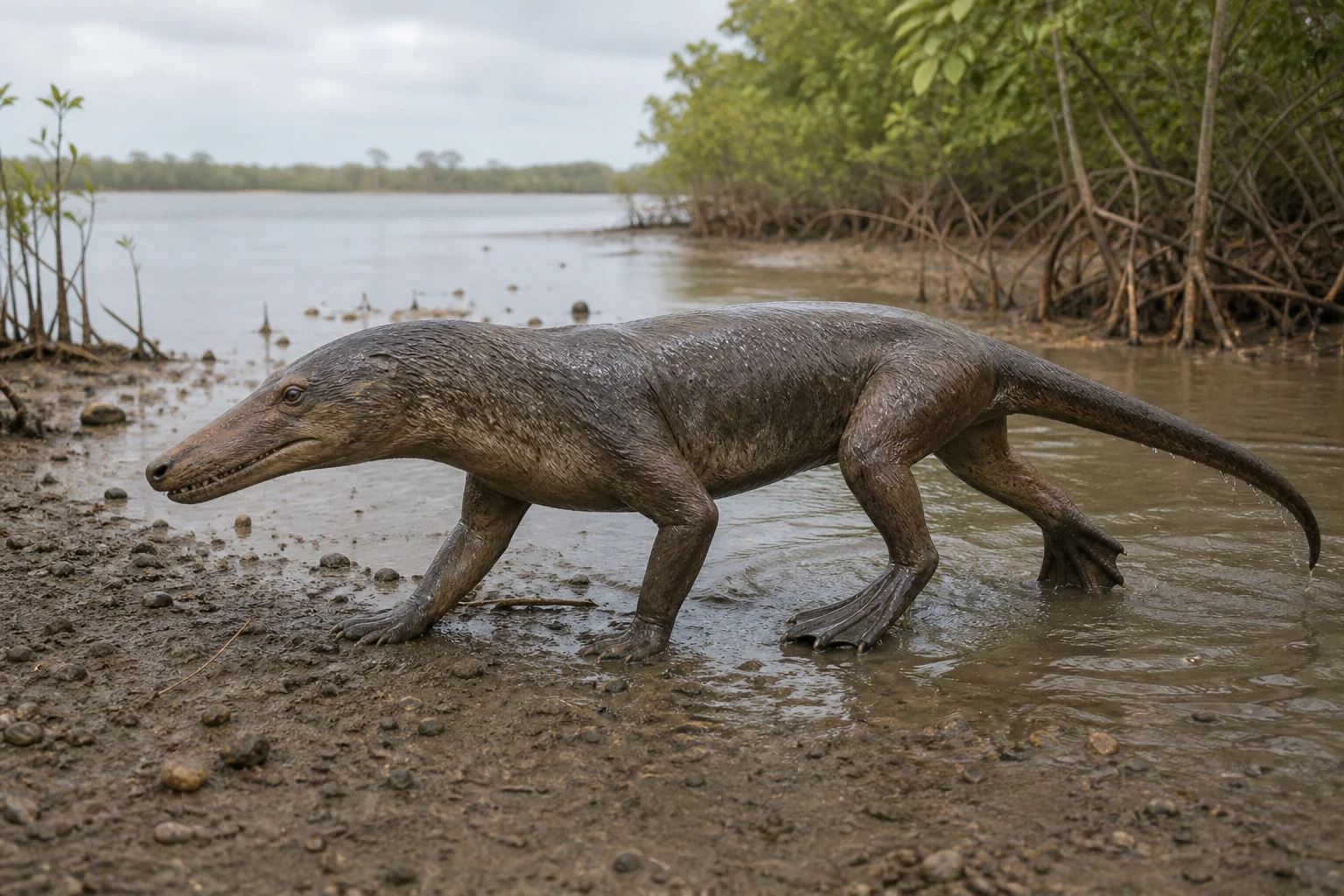 View original image · 1536 × 1024
- Time range
- About 49–47 million years ago
- Final stage
- Early Eocene
- Geographic range
- Estuaries and shallows on the northern Tethys · Present-day Pakistan
01 / ANSWER FIRST
What was Ambulocetus?
Ambulocetus natans was an early amphibious whale from the Eocene of Pakistan. Its name means walking and swimming whale.
It is known from a nearly complete skeleton of one individual, about 3 metres long, described in 1994 from the Kuldana Formation.
02 / QUICK FACTS
Ambulocetus at a glance
- Length
- About 3 m (10 ft), from a nearly complete skeleton
- Age
- About 48 million years ago, Eocene
- Locality
- Kuldana Formation, Pakistan
- Water use
- Isotopes suggest both fresh and salt water
How did Ambulocetus swim and walk?
Thewissen, Hussain and Arif proposed in 1994 that it swam by flexing its spine up and down, driving large hind feet in a way similar to modern otters. An alternative model describes alternate paddling with the legs, using the tail as a rudder.
Most researchers think it could also walk on land, probably slowly and awkwardly. Another hypothesis has it walking along river or lake bottoms like a hippopotamus. How often it came ashore cannot be read directly from the bones.
03 / ANATOMY
What makes Ambulocetus a whale?
Hearing through the jaw
Its large lower-jaw opening suggests a fat pad that carried sound to the ear, as in modern toothed whales. It may still have heard airborne sound as well.
Huge feet, weight-bearing legs
Strong limbs could still support the body, while very large feet suited paddling. Unlike later whales, it had no tail fluke.
04 / DIET & BEHAVIOUR
What did Ambulocetus eat?
Tall, sharp molars suggest fish were part of its diet. Ambushing land animals at the water's edge has been suggested, but lacks direct evidence.
05 / DIET & BEHAVIOUR
Fresh or salt water?
Oxygen isotopes in its teeth suggest it drank both fresh and salt water, consistent with estuaries or bays between rivers and the sea.
06 / RANGE & HABITAT
Where did Ambulocetus live?
Its fossil comes from coastal sediments of the ancient Tethys Sea in present-day Pakistan.
Tethys shores
The Kuldana Formation records nearshore settings where early whales moved between land and water.
07 / FOSSIL EVIDENCE
What Ambulocetus adds to whale evolution
A transitional body
It combines whale ear and jaw features with legs that could bear weight, filling a stage between earlier Pakicetus and fully aquatic later whales.
A branch, not a proven ancestor
Its place in the sequence illustrates a stage of adaptation. That does not prove it was the direct ancestor of modern whales.
08 / DISAPPEARANCE & DEBATE
Why did Ambulocetus disappear?
No specific extinction cause is established by its fossil record.
Later whales became increasingly aquatic, but a later fossil does not by itself show that they replaced Ambulocetus.
09 / FREQUENTLY ASKED QUESTIONS
Ambulocetus FAQ
Could Ambulocetus walk on land?
Probably, though slowly and awkwardly; some researchers suggest it mainly walked along the bottom of rivers or lakes.
How big was Ambulocetus?
About 3 metres long, based on a nearly complete skeleton.
Did Ambulocetus live in the ocean?
Its tooth isotopes suggest it used both fresh and salt water, such as estuaries and bays.
04 / SOURCES & FURTHER READING
Check the source record
Use the scientific name to compare taxonomy, occurrence records and the fossil record. Database coverage and classifications may differ.
05 / REVISION HISTORY
How has this record changed?
- Expanded answers to reader questions, clarified the scope of fossil evidence and improved routes to related explanations.
- Added a sourced bilingual topic hub covering size, discovery history, anatomy, diet, habitat, uncertainty and FAQs; updated search metadata.
- Verified authoritative entity sources and added three responsive reconstruction sizes.
- Initial bilingual species record published.
06 / CORRECTIONS & ADDITIONS