
BASILOSAURUS TOPIC HUB · DIET & PREDATION
What Did Basilosaurus Eat? Evidence for an Eocene Apex Predator
Use teeth, stomach contents and bite-marked juvenile whales to reconstruct Basilosaurus hunting without exaggerating its speed or prey.
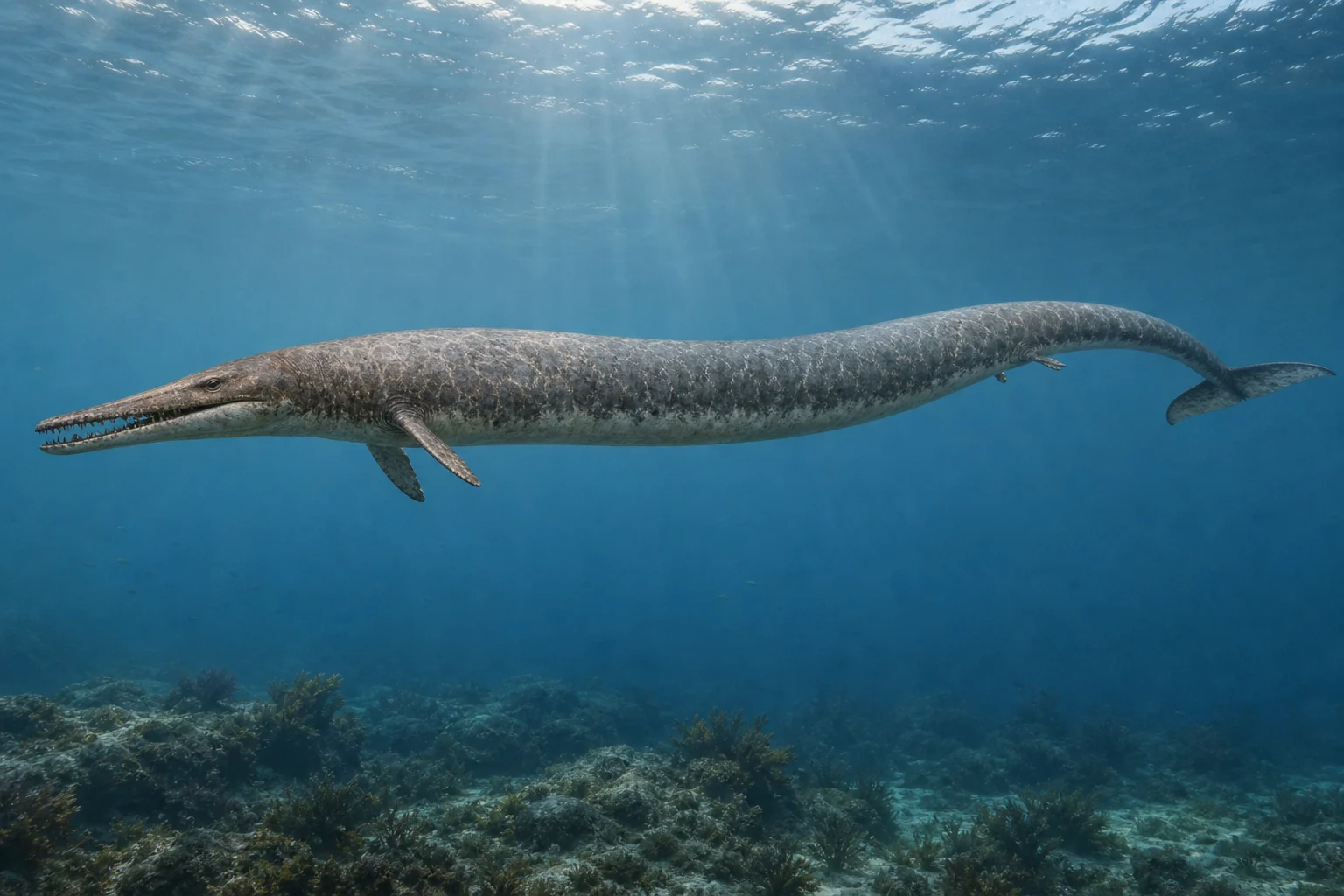 View full-resolution reconstruction ↗
This is an original generative reconstruction, not a photograph or scientific plate. Measurements and interpretations below are tied to named sources.
01 / TEETH
What could its jaws do?
Front teeth gripped while double-rooted cheek teeth carried cutting edges. Heavy wear and breakage fit repeated processing of large struggling prey rather than suction or filter feeding.
02 / STOMACH CONTENTS
Is any meal preserved directly?
A Basilosaurus isis skeleton from Wadi Al Hitan contains remains of large fish and juvenile Dorudon in the abdominal region. Association and damage patterns support consumption rather than simple burial together.
03 / WHALE PREY
Did it hunt young whales?
Dorudon calf skulls carry large bite marks matching Basilosaurus tooth spacing and damage. Nursery-like concentrations suggest predators targeted vulnerable young, though not every calf was killed the same way.
04 / FISH PREY
Were fish also important?
Yes. Large fish occur among stomach remains, showing a broad macropredatory diet. Relative proportions cannot be inferred from one meal or one locality.
05 / HUNTING
How might the long whale attack?
A powerful tail and flexible trunk could close distance and orient the head, while jaws seized and sliced. Exact attack speed, social hunting and ambush behaviour are not preserved.
06 / FOOD WEB
Why call it an apex predator?
Its great size, cutting dentition and direct consumption of other marine vertebrates place adults high in the Eocene food web. 'Apex' describes trophic position, not invulnerability or one exclusive prey.
FREQUENTLY ASKED QUESTIONS
Questions readers ask
Was Basilosaurus a dinosaur?
No. It was a fully aquatic early whale.
How long was Basilosaurus?
B. isis reached roughly 15–18 metres.
Could it walk on land?
No. Its tiny hind limbs could not bear weight and its pelvis was detached from the spine.
Why did it have feet?
They were evolutionary remnants, possibly retained for mating.
What did it eat?
Fish and smaller whales, including juvenile Dorudon.
Did it have a whale tail?
Tail anatomy supports a small horizontal fluke and up-down propulsion.
SOURCES & FURTHER READING
Evidence used in this guide
Measurements and interpretations are tied to museum resources or peer-reviewed studies; disputed conclusions include evidence on both sides.
- 01Basilosaurus isis ↗University of Michigan Museum of Paleontology
Museum synthesis of anatomy, age and hind-limb function.
- 02Hind limbs of Eocene Basilosaurus ↗Science · DOI 10.1126/science.249.4965.154
Primary description of complete pelvic limb and foot bones.
- 03Stomach contents of Basilosaurus isis ↗PLOS ONE · PMC6326415
Direct evidence for fish and juvenile-whale prey.