
BASILOSAURUS TOPIC HUB · ANATOMY & EVOLUTION
Basilosaurus Hind Legs, Body Shape and Whale Evolution
Why did a fully aquatic whale retain tiny hind limbs, and how do its spine, skull and pelvis reconstruct Eocene swimming?
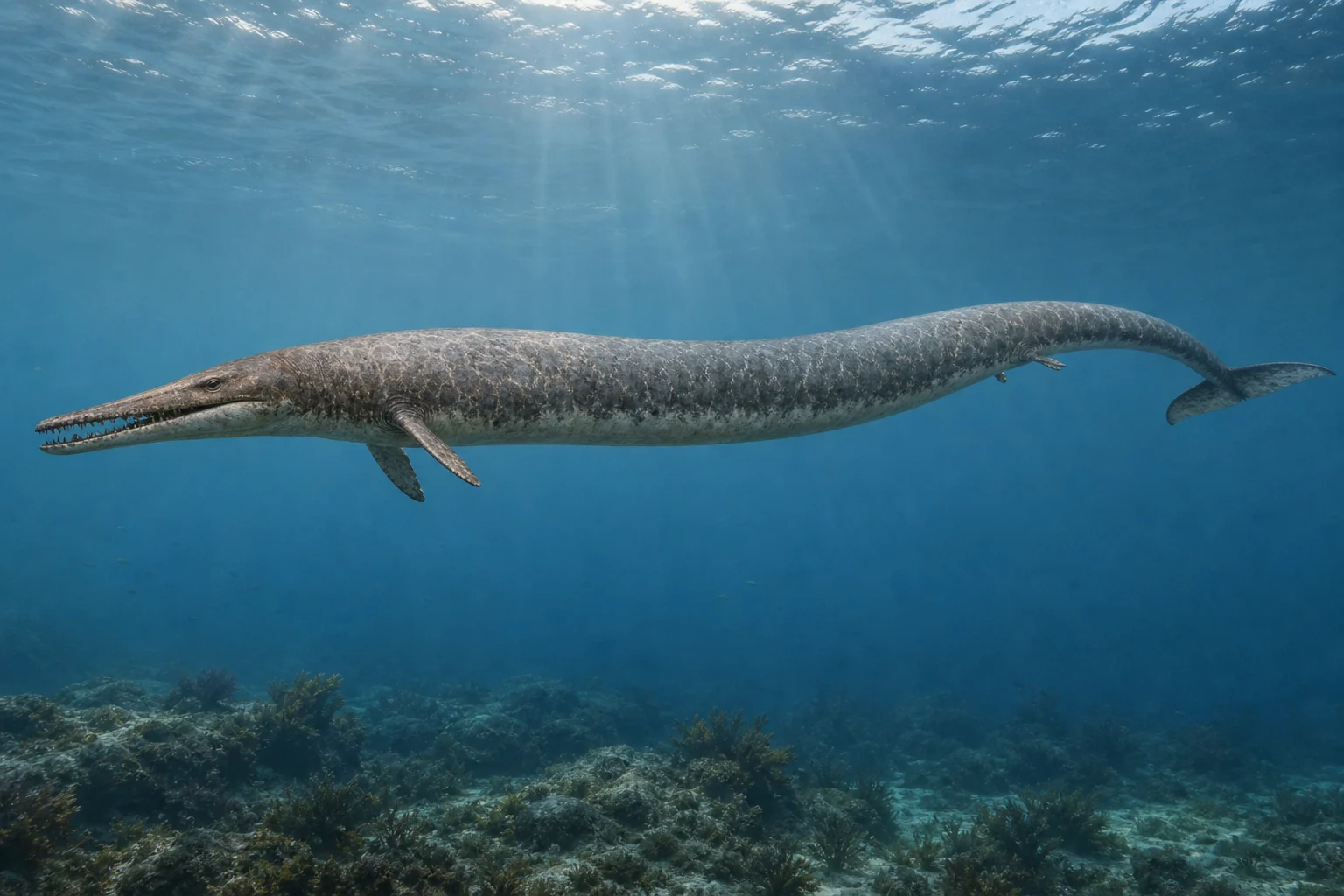 View full-resolution reconstruction ↗
This is an original generative reconstruction, not a photograph or scientific plate. Measurements and interpretations below are tied to named sources.
01 / SIZE
How long was Basilosaurus?
Large Basilosaurus isis skeletons support lengths around 15–18 metres. The long series of elongated vertebrae makes the animal appear snake-like, but body mass was lower than an equally long modern whale.
02 / IDENTITY
Why is it named like a reptile?
Early workers mistook the huge fossils for a marine reptile and named 'king lizard'. Teeth, ear bones and the rest of the skeleton establish an early whale.
03 / HIND LIMBS
Could the hind legs walk?
No. The pelvis was detached from the spine and the limbs were far too small to carry the body. Joint form allowed useful movement, supporting a role in positioning during copulation.
04 / SPINE
How did the long body move?
Elongated lumbar and tail vertebrae permitted vertical flexion. Muscles transmitted force to a tail fluke, while the trunk undulated more than in many modern whales.
05 / FORELIMBS
Were the front limbs already flippers?
Yes. Broad forelimbs steered and stabilised the body but no longer supported land movement. The elbow remained mobile within a wholly marine locomotor system.
06 / EVOLUTION
Was Basilosaurus the ancestor of modern whales?
It is a close stem whale within Basilosauridae, not necessarily the direct ancestor of every living species. Its mosaic shows that full aquatic life preceded complete external hind-limb loss.
FREQUENTLY ASKED QUESTIONS
Questions readers ask
Was Basilosaurus a dinosaur?
No. It was a fully aquatic early whale.
How long was Basilosaurus?
B. isis reached roughly 15–18 metres.
Could it walk on land?
No. Its tiny hind limbs could not bear weight and its pelvis was detached from the spine.
Why did it have feet?
They were evolutionary remnants, possibly retained for mating.
What did it eat?
Fish and smaller whales, including juvenile Dorudon.
Did it have a whale tail?
Tail anatomy supports a small horizontal fluke and up-down propulsion.
SOURCES & FURTHER READING
Evidence used in this guide
Measurements and interpretations are tied to museum resources or peer-reviewed studies; disputed conclusions include evidence on both sides.
- 01Basilosaurus isis ↗University of Michigan Museum of Paleontology
Museum synthesis of anatomy, age and hind-limb function.
- 02Hind limbs of Eocene Basilosaurus ↗Science · DOI 10.1126/science.249.4965.154
Primary description of complete pelvic limb and foot bones.
- 03Stomach contents of Basilosaurus isis ↗PLOS ONE · PMC6326415
Direct evidence for fish and juvenile-whale prey.