
ANOMALOCARIS TOPIC HUB · FEEDING EVIDENCE
What Did Anomalocaris Eat and How Did It Hunt?
Test the famous trilobite-crusher story using frontal-appendage mechanics, oral-cone closure, swimming models and fossil limits.
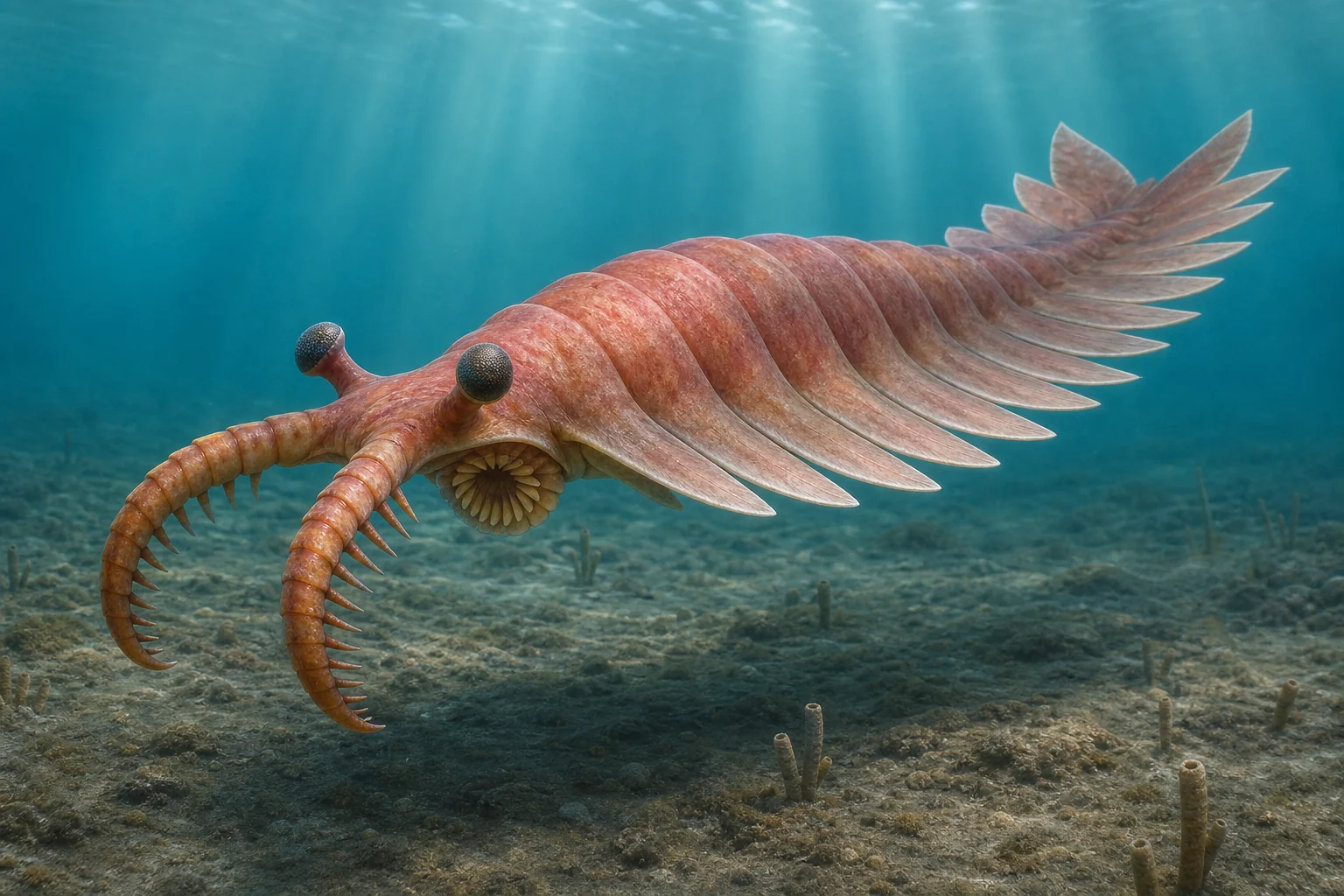 View full-resolution reconstruction ↗
This is an original generative reconstruction, not a photograph or scientific plate. Measurements and interpretations below are tied to named sources.
01 / OLD IMAGE
Why was it called a trilobite crusher?
Large size, spiny limbs, a circular mouth and damaged trilobite shells formed a persuasive story. Yet association is not attribution: predators, scavengers, burial forces and failed molts can all damage shells.
02 / ORAL CONE
Could the mouth crush shell?
Overlapping plates formed a flexible opening but did not converge into a tight vertebrate-like bite. Plate geometry and wear are inconsistent with repeatedly applying high crushing forces; the cone could process food without acting as a nutcracker.
03 / APPENDAGE MECHANICS
What do digital models reveal?
Three-dimensional models found the limbs flexible and fast but highly stressed against resistant hard prey. Ventral spines formed a capture basket better suited to enveloping soft animals than hammering mineralised shells.
04 / WATER-COLUMN HUNTING
How could it catch swimmers?
Large eyes located targets while flap swimming closed distance. The frontal limbs could extend, sweep inward and retain prey before transfer to the mouth. Models support the sequence, though no fossil freezes a complete strike.
05 / LIKELY PREY
Which animals fit the evidence?
Soft-bodied arthropods, worms and other small swimmers fit the mechanics and Burgess community. Freshly molted trilobites might have been vulnerable, but possible prey is not a specialised diet; confirmed gut contents are absent.
06 / VERDICT
Was it still a major predator?
Yes. Rejecting shell crushing replaces one hunting style, not predation. A visually guided, fast radiodont catching soft agile prey was a sophisticated Cambrian hunter; exact prey species remain open.
FREQUENTLY ASKED QUESTIONS
Questions readers ask
How big was Anomalocaris?
A. canadensis is commonly reconstructed around 50–60 centimetres; larger radiodont estimates may belong to other taxa.
Was Anomalocaris a shrimp?
No. It was a radiodont on the arthropod stem lineage.
Did it eat trilobites?
Possible encounters cannot be excluded, but current biomechanics favours softer mobile prey over specialised shell crushing.
How did it swim?
Successive waves along overlapping lateral flaps generated thrust and the tail helped steer.
Why was it reconstructed incorrectly?
Soft bodies often disarticulated, so mouth, limbs and torso were originally named separately.
Was it an apex predator?
It was a major predator, but exact food-web rank varies with community and prey assumptions.
SOURCES & FURTHER READING
Evidence used in this guide
Measurements and interpretations are tied to museum resources or peer-reviewed studies; disputed conclusions include evidence on both sides.
- 01Anomalocaris canadensis ↗Royal Ontario Museum · Burgess Shale
Museum specimen account and history of the composite reconstruction.
- 02Anomalocaris canadensis fed on soft prey with speed ↗Proceedings B · PMID 37403497
2023 appendage biomechanics supporting soft, mobile prey in the water column.
- 03The three-dimensional disparity and ecology of radiodonts ↗Proceedings B
Digital comparisons of radiodont appendages and ecological niche partitioning.