
ANOMALOCARIS TOPIC HUB · BODY & SWIMMING
Anomalocaris Size, Anatomy, Eyes and Swimming
Reassemble Anomalocaris from mouth, appendage and body fossils, then test its size, vision and swimming performance.
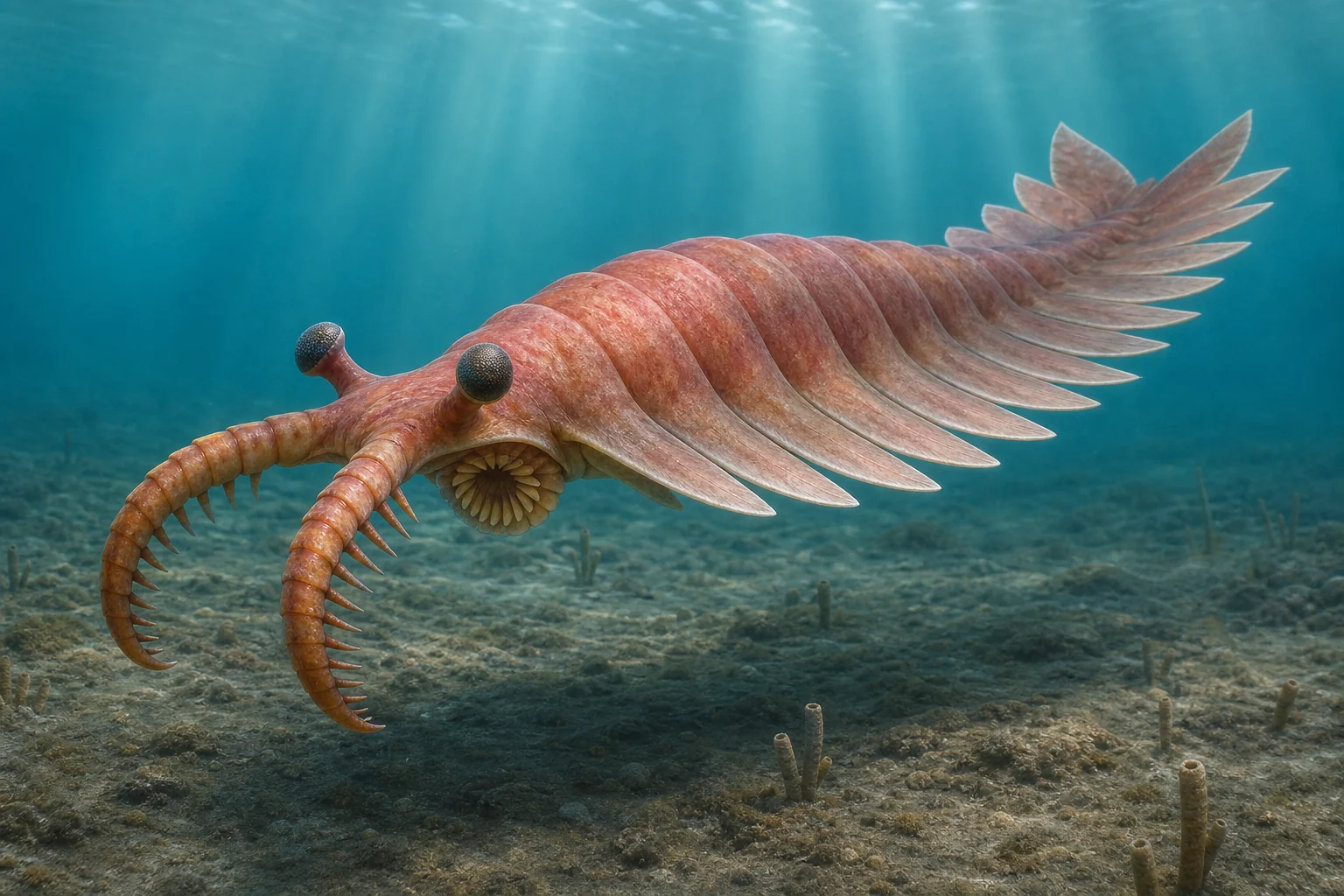 View full-resolution reconstruction ↗
This is an original generative reconstruction, not a photograph or scientific plate. Measurements and interpretations below are tied to named sources.
01 / FOSSIL PUZZLE
Why was one animal given several names?
The soft body readily separated after death: a frontal appendage looked like a shrimp abdomen, the mouth like a jellyfish and the torso like another swimmer. Articulated fossils and matching attachment points eventually united them.
02 / SIZE
How large was A. canadensis?
Well-supported bodies are commonly reconstructed around 50–60 centimetres. Popular metre-scale claims often mix incomplete material, historic restorations and other radiodont species. Estimates must state species and whether appendages are included.
03 / VISION
What could the compound eyes do?
Stalked eyes carried dense lens arrays and produced a broad field sensitive to movement. Lens counts support sophisticated visual hunting, but they do not yield modern-camera resolution, colour perception or a recorded behaviour sequence.
04 / SWIMMING
How did the lateral flaps produce thrust?
Broad overlapping flaps passed travelling waves from front to rear, generating continuous thrust while maintaining stability. Changes in wave phase and amplitude enabled turns, and dorsal blade-like gills remained exposed to flowing water.
05 / HEAD
How were appendages and mouth arranged?
Two segmented appendages projected ahead and curved inward around prey. A ventral oral cone received food behind them. Neither maps neatly onto modern antennae or vertebrate jaws because radiodont head organisation was evolutionarily different.
06 / RECONSTRUCTION
What should modern art avoid?
Avoid a giant hard-shelled shrimp, rigid paddles and a camera-iris mouth. Show a flexible soft body, independently moving frontal limbs, overlapping flaps and distinct gill blades; colour remains speculative.
FREQUENTLY ASKED QUESTIONS
Questions readers ask
How big was Anomalocaris?
A. canadensis is commonly reconstructed around 50–60 centimetres; larger radiodont estimates may belong to other taxa.
Was Anomalocaris a shrimp?
No. It was a radiodont on the arthropod stem lineage.
Did it eat trilobites?
Possible encounters cannot be excluded, but current biomechanics favours softer mobile prey over specialised shell crushing.
How did it swim?
Successive waves along overlapping lateral flaps generated thrust and the tail helped steer.
Why was it reconstructed incorrectly?
Soft bodies often disarticulated, so mouth, limbs and torso were originally named separately.
Was it an apex predator?
It was a major predator, but exact food-web rank varies with community and prey assumptions.
SOURCES & FURTHER READING
Evidence used in this guide
Measurements and interpretations are tied to museum resources or peer-reviewed studies; disputed conclusions include evidence on both sides.
- 01Anomalocaris canadensis ↗Royal Ontario Museum · Burgess Shale
Museum specimen account and history of the composite reconstruction.
- 02Anomalocaris canadensis fed on soft prey with speed ↗Proceedings B · PMID 37403497
2023 appendage biomechanics supporting soft, mobile prey in the water column.
- 03The three-dimensional disparity and ecology of radiodonts ↗Proceedings B
Digital comparisons of radiodont appendages and ecological niche partitioning.