
Explore this animal in Size of Extinct Animals ↗
452 / Cenozoic
Purussaurus
Purussaurus brasiliensis
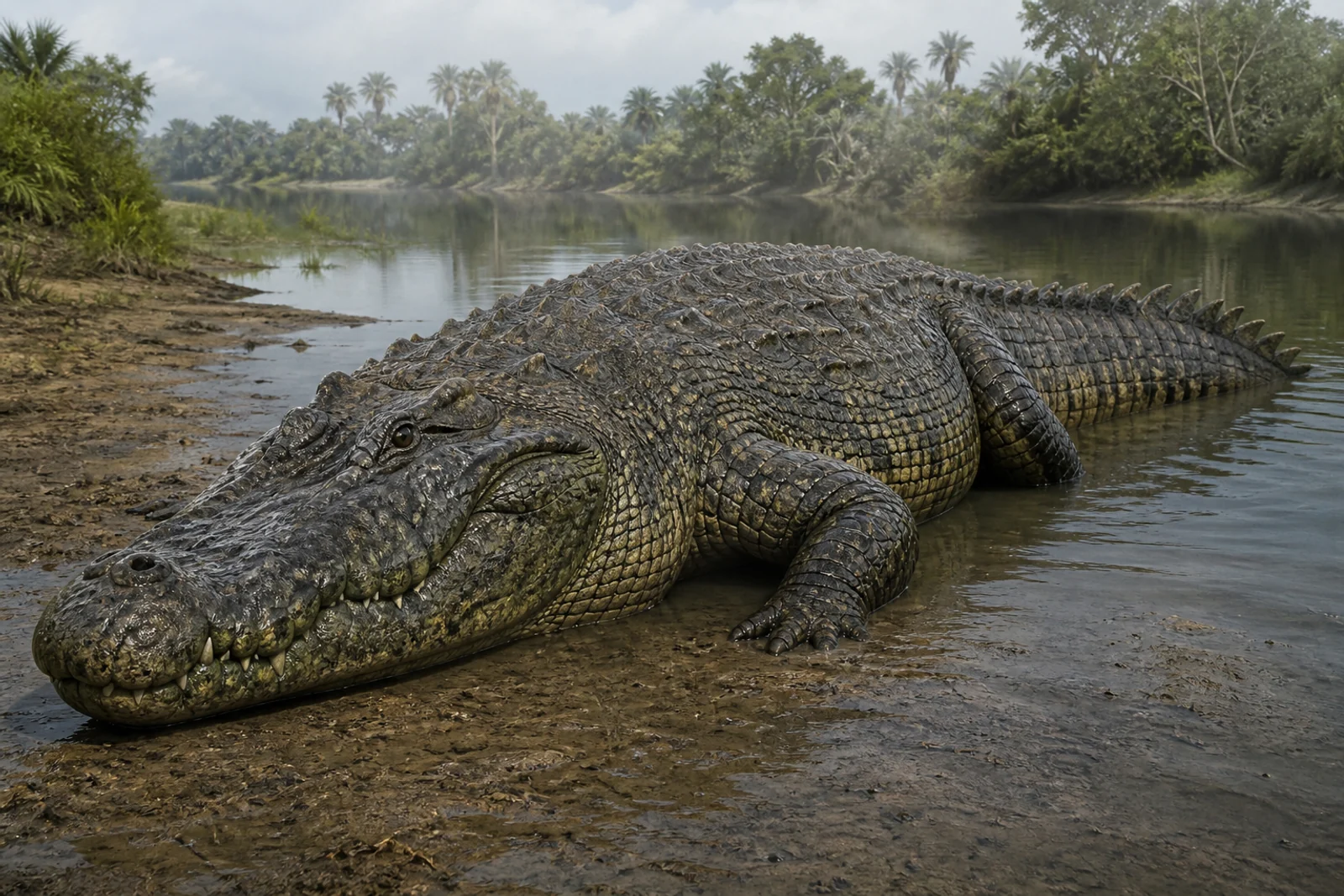
A skull over a meter long belonged to a dominant Miocene caiman.
 View original image · 1600 × 1067
- Time range
- About 13–5 million years ago
- Final stage
- End of the Miocene
- Geographic range
- Giant rivers and wetlands · South America
01 / ANSWER FIRST
What was Purussaurus?
Purussaurus brasiliensis was a giant caiman from the Late Miocene of western Amazonia. It belonged to the alligator lineage, not to true crocodiles.
Its famous length, mass and bite force come from regression equations based on living crocodylians and scaled from skull size. They are model outputs, not measurements of a complete skeleton.
02 / QUICK FACTS
Purussaurus at a glance
- Animal group
- Caimanine alligatoroid
- Length estimate
- About 12.5 m for a large adult (2015 model)
- Mass estimate
- About 8.4 tonnes (2015 model)
- Bite-force estimate
- About 69,000 N sustained
- Setting
- Late Miocene wetlands, western Amazonia
How big was Purussaurus, really?
Aureliano and colleagues used equations derived from modern crocodylians to scale from skull dimensions. For a large adult they estimated about 12.5 m in length and 8.4 tonnes, a daily food intake near 40.6 kg and a sustained bite force of about 69,000 N.
Each step adds uncertainty: the skull must be measured, the equation must fit an extinct giant well beyond living sizes, and the result describes a large adult rather than every individual. Treat the figures as approximate upper-end reconstructions.
03 / ANATOMY
What made Purussaurus a top predator?
A broad, massive skull
The skull, over a metre long in large specimens, is the main evidence for its size. A wide snout suits seizing large prey, as in some living caimans and alligators.
Size as ecological advantage
The 2015 study argues that its size allowed it to take large to very large vertebrates as an adult, with little competition from other carnivores.
04 / DIET & BEHAVIOUR
What did Purussaurus eat?
Its size and bite support an adult diet that could include large vertebrates. The published view is an inference from anatomy and scaling, not a preserved stomach content record.
05 / DIET & BEHAVIOUR
A crowded crocodylian world
Miocene northern South America supported an unusually rich crocodylian community, with several species living in the same wetland systems.
06 / RANGE & HABITAT
Where and when did Purussaurus live?
Its fossils come from the vast Miocene wetland systems of northern South America.
Western Amazonian wetlands
P. brasiliensis is known from the Late Miocene of western Amazonia, in a landscape of rivers, swamps and lakes very different from today's drainage.
07 / FOSSIL EVIDENCE
What do the fossils establish?
Skull first, body second
Skull material anchors the reconstruction. Body length, mass and bite force are derived values and should be quoted with their method.
A published correction
PLOS ONE published a correction to the 2015 article; readers checking details should consult both.
08 / DISAPPEARANCE & DEBATE
Why did Purussaurus go extinct?
Researchers link the loss of the giant Miocene crocodylians to drainage changes associated with Andean uplift.
Scheyer and colleagues documented a crocodylian diversity peak followed by extinctions in the late Cenozoic of the northern Neotropics. The link is a regional explanation, not a species-specific cause recorded in a single fossil.
09 / FREQUENTLY ASKED QUESTIONS
Purussaurus FAQ
Was Purussaurus bigger than Sarcosuchus?
Both are estimated at roughly similar giant sizes, and each estimate depends on scaling from skulls. The available figures do not settle a definitive ranking.
Was Purussaurus a crocodile?
It was a crocodylian, but specifically a caiman in the alligator lineage, not a true crocodile.
How strong was its bite?
The 2015 model estimated a sustained bite force of about 69,000 N, roughly 7 tonnes-force.
04 / SOURCES & FURTHER READING
Check the source record
Use the scientific name to compare taxonomy, occurrence records and the fossil record. Database coverage and classifications may differ.
05 / REVISION HISTORY
How has this record changed?
- Rewrote an extinction cause that presented environmental or faunal turnover as established; it is now given as context the record does not prove.
- Added a sourced bilingual topic hub covering size, discovery history, anatomy, diet, habitat, uncertainty and FAQs; updated search metadata.
- Verified authoritative entity sources and added three responsive reconstruction sizes.
- Initial bilingual species record published.
06 / CORRECTIONS & ADDITIONS