
Explore this animal in Size of Extinct Animals ↗
57 / Mesozoic
Elasmosaurus
Elasmosaurus platyurus
Elasmosaurus platyurus was a long-necked marine reptile from Late Cretaceous Kansas. A 2013 reassessment counted 72 preserved neck vertebrae in its holotype.
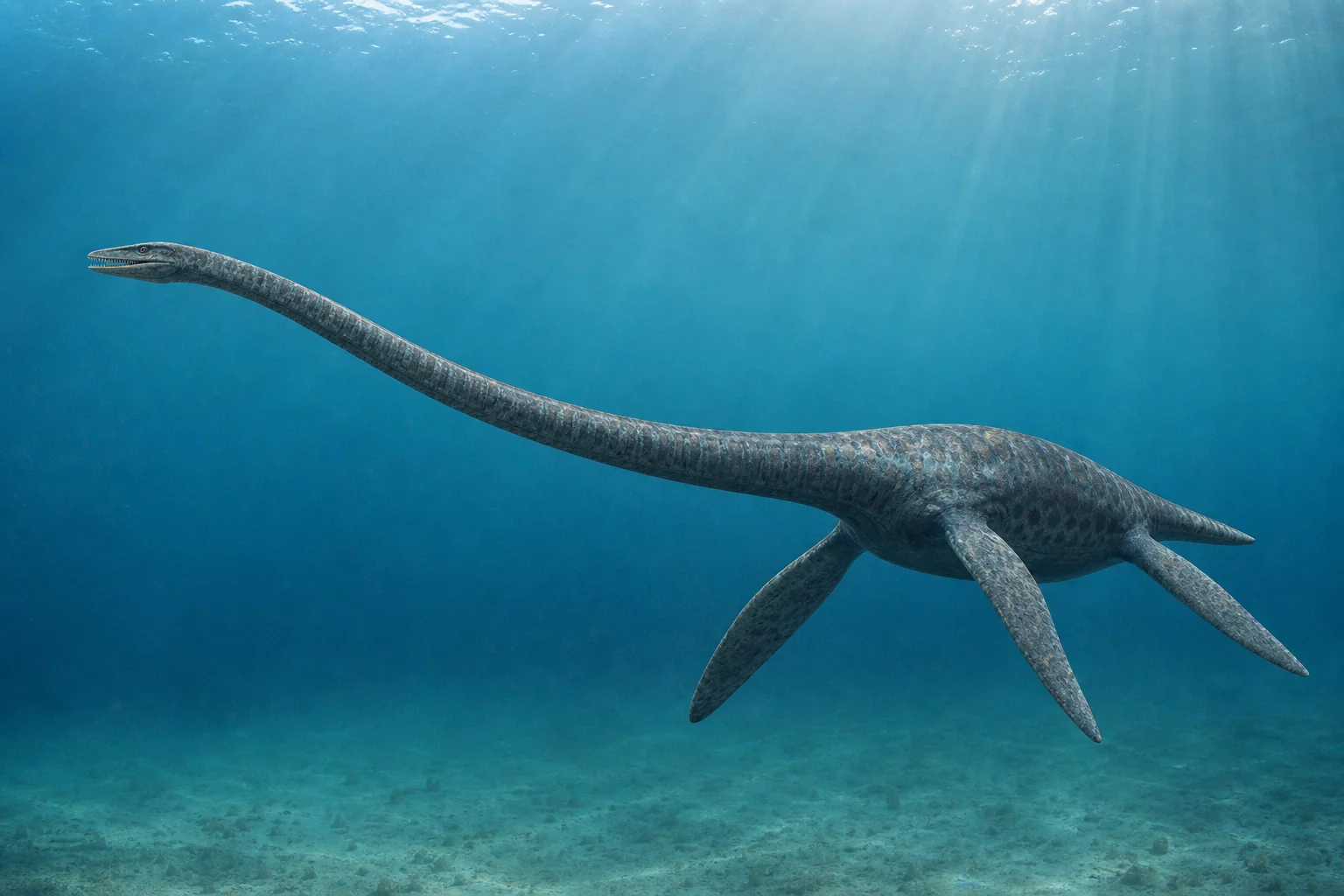 View original image · 1536 × 1024
Structured expansion · editorial review pending
- Time range
- About 80.5 million years ago
- Final stage
- Late Cretaceous
- Geographic range
- Western Interior Seaway of North America
01 / ANSWER FIRST
What does the evidence show about Elasmosaurus?
Elasmosaurus platyurus was a long-necked marine reptile from Late Cretaceous Kansas. A 2013 reassessment counted 72 preserved neck vertebrae in its holotype.
The count depends on where the neck ends and the shoulder-region vertebrae begin. Anatomical definitions matter as much as a headline number.
02 / QUICK FACTS
Elasmosaurus at a glance
- Scientific name
- Elasmosaurus platyurus
- Research focus
- A long series of vertebrae
03 / ANATOMY
How was Elasmosaurus built?
A long series of vertebrae
The reassessment includes the atlas-axis complex and separates pectoral vertebrae using rib-joint anatomy.
Four flippers
As a plesiosaur, it had paddle-shaped limbs and a small head relative to its elongated neck.
04 / DIET & BEHAVIOUR
Marine life
It inhabited the Western Interior Seaway. Marine reptile describes its ecology, not membership in dinosaurs.
05 / DIET & BEHAVIOUR
Neck use
Neck length alone cannot establish a swan-like pose or a particular feeding maneuver.
06 / RANGE & HABITAT
Where and when did Elasmosaurus live?
The central specimen is ANSP 10081 from the Late Cretaceous of Kansas. This is a species-specific account, not a summary of every long-necked plesiosaur.
07 / FOSSIL EVIDENCE
What evidence supports reconstructions of Elasmosaurus?
Recovering a misplaced fragment
Reassessment of a previously overlooked cervical fragment helped revise the count in the museum material.
Preserved is not complete
Sachs and colleagues noted that the original neck series may be incomplete because material was scattered or lost.
08 / DISAPPEARANCE & DEBATE
What remains uncertain?
Neither an exact lifetime neck posture nor the cause of this species' extinction follows from the vertebral count.
The linked sources support the specific observations above. An occurrence record alone does not identify an extinction mechanism.
09 / FREQUENTLY ASKED QUESTIONS
Elasmosaurus FAQ
Did it have exactly 72 neck vertebrae?
The study identifies 72 preserved cervicals; the original series may have been incomplete.
Was it a dinosaur?
No. It belonged to Plesiosauria, a separate marine reptile group.
04 / SOURCES & FURTHER READING
Check the source record
Use the scientific name to compare taxonomy, occurrence records and the fossil record. Database coverage and classifications may differ.
05 / REVISION HISTORY
How has this record changed?
- Replaced repeated expansion text with specimen-specific evidence, linked research and explicit limits; independent editorial review is pending.
- Completed an AI-assisted bilingual audit of the archive record, corrected identified issues and clarified evidence limits; independent editorial review is pending.
- Expanded into a structured bilingual profile with anatomy, ecology, range, evidence, debate and FAQs; independent editorial review is pending.
- Verified authoritative entity sources and added three responsive reconstruction sizes.
- Initial bilingual species record published.
06 / CORRECTIONS & ADDITIONS