
PLESIOSAURUS TOPIC HUB · SWIMMING & FEEDING
How Did Plesiosaurus Swim and Feed?
Compare four-flipper models and neck constraints.
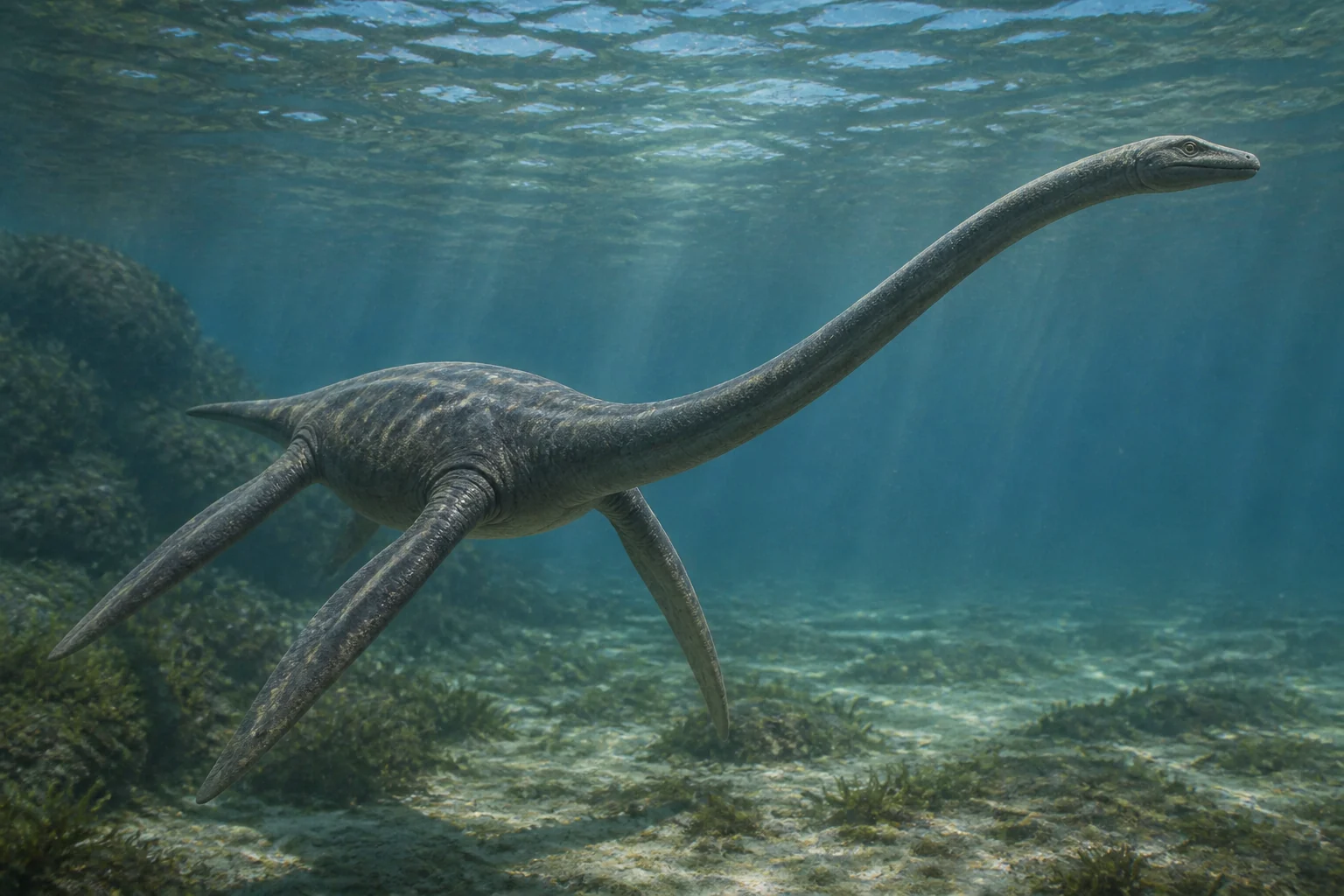 View full-resolution reconstruction ↗
This is an original generative reconstruction, not a photograph or scientific plate. Measurements and interpretations below are tied to named sources.
01 / SHORT ANSWER
How did Plesiosaurus swim and feed?
All four flippers generated lift-based thrust in an underwater flight stroke. Models differ over exact phasing, but the hind pair contributed power rather than merely steering like most living marine reptiles.
The neck probably positioned the small head near fish and cephalopods without a whole-body lunge. It was flexible across many joints but could not form the swan-like vertical curves common in old artwork.
02 / ECOLOGY
What did Plesiosaurus eat and how did it live?
What did Plesiosaurus eat?: Fish, cephalopods and other small marine prey fit its fine teeth; gastroliths may have aided digestion or ballast in some plesiosaurs.
Did it come onto land?: Its stiff trunk and hydrofoil limbs were poorly suited to walking. Plesiosaurs reproduced at sea, with live birth known from a related specimen.
03 / PLACE & TIME
Where did Plesiosaurus live?
Secure Plesiosaurus fossils come from Early Jurassic marine rocks of southern Britain and nearby Europe, especially the Blue Lias.
Lyme Regis: Complete skeletons established the body plan.
Blue Lias: Alternating limestone and shale preserved marine life.
European shelf: Warm shallow seas covered large regions.
Open water: Ammonites, fish and ichthyosaurs shared the ecosystem.
04 / SOURCE RECORD
How do scientists know about Plesiosaurus?
Complete skeletons: Articulated specimens constrain neck and limb proportions.
Joint surfaces: Vertebrae limit plausible neck motion.
Flipper models: Hydrodynamic experiments test thrust and gait.
Teeth and contents: Dental form and rare meals reconstruct diet.
05 / SCIENTIFIC DEBATE
What remains uncertain?
Exact flipper phasing.
Neck feeding posture.
Metabolic rate.
Species boundaries.
06 / EVIDENCE VERDICT
Could a Plesiosaurus survive in a modern lake?
There is no evidence that plesiosaurs survived beyond the end-Cretaceous extinction, and no modern lake has produced bones, DNA or a breeding population.
The classic long-necked silhouette helped shape lake-monster imagery, but resemblance is not survival evidence.
FREQUENTLY ASKED QUESTIONS
Questions readers ask
How big was Plesiosaurus?
About three to three-and-a-half metres long.
Was it a dinosaur?
No, it was a marine sauropterygian reptile.
How did it swim?
All four flippers generated underwater-flight thrust.
Could its neck bend like a swan?
Not vertically to that degree.
Did it breathe air?
Yes, with lungs.
Is Loch Ness evidence?
No reliable fossil or biological evidence supports survival.
SOURCES & FURTHER READING
Evidence used in this guide
Measurements and interpretations are tied to museum resources or peer-reviewed studies; disputed conclusions include evidence on both sides.
- 01What is a plesiosaur? ↗Natural History Museum, London
Museum synthesis of anatomy, swimming, reproduction and history.
- 02Plesiosaurus ↗Paleobiology Database
Taxonomic and occurrence record.
- 03Plesiosaurus dolichodeirus ↗GBIF
Stable biodiversity identifier.