
Explore this animal in Size of Extinct Animals ↗
465 / Cenozoic
Megalocnus
Megalocnus rodens
Megalocnus rodens was a large Cuban ground sloth that survived into the Holocene.
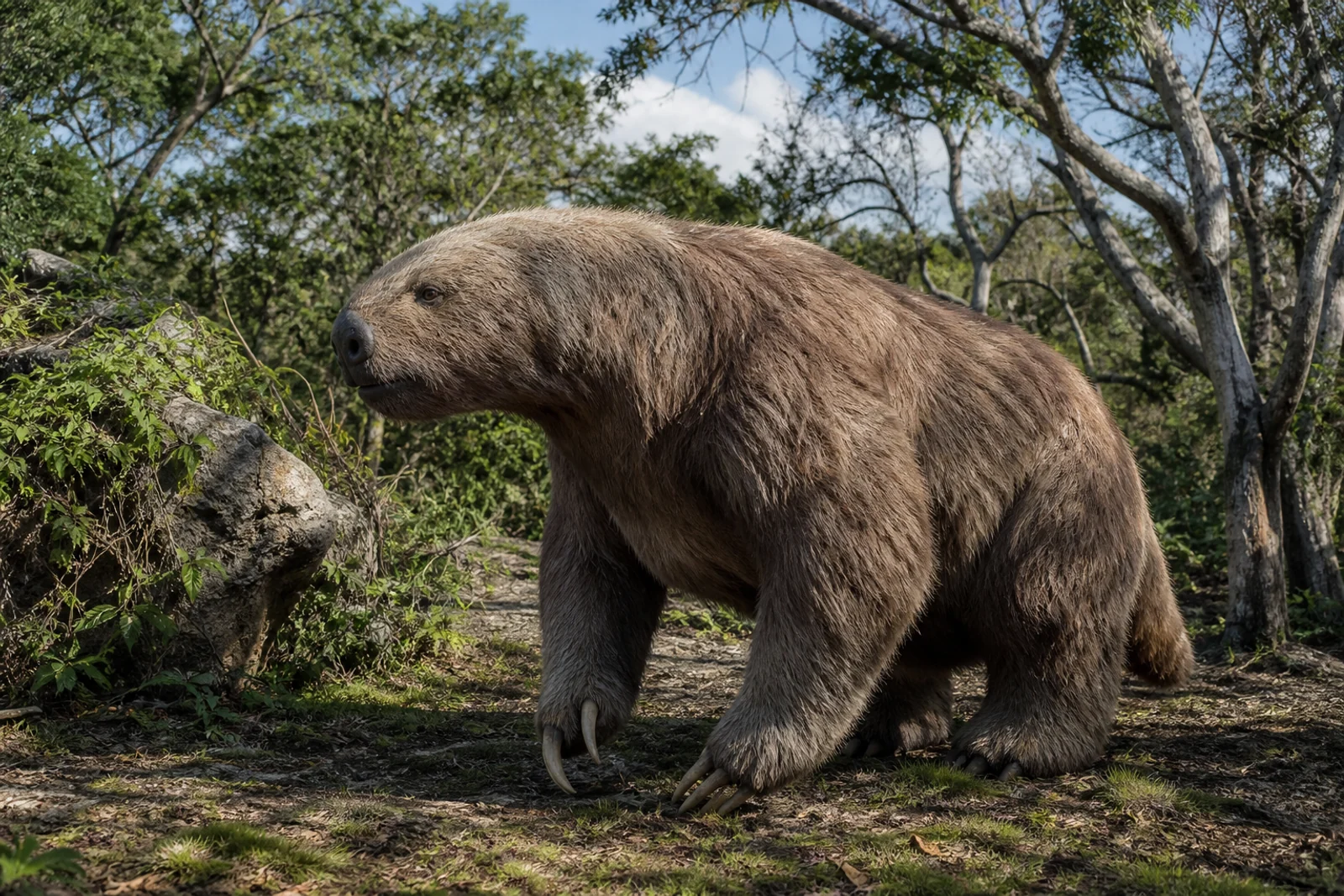 View original image · 1600 × 1067
- Time range
- Pleistocene–Holocene
- Final stage
- Holocene; exact extinction date uncertain
- Geographic range
- Caribbean · Cuba
01 / ANSWER FIRST
What was Megalocnus?
Megalocnus rodens was a large ground sloth from Cuba that survived into the Holocene. It was a mammal, related to sloths, rather than a bear or a dinosaur.
Its most useful story is a dated fossil: a tooth shows survival thousands of years after the end of the last ice age. Reading that date correctly matters more than repeating a single extinction year.
02 / QUICK FACTS
Megalocnus at a glance
- Range
- Cuba
- Records
- Pleistocene–Holocene
- 2007 tooth date
- 4,190 ± 40 radiocarbon years BP
- Published calibration
- 4,580–4,840 calendar years BP
03 / ANATOMY
How big was Megalocnus?
Different published estimates
Steadman and colleagues (2005) describe an approximately 200 kg animal. AMNH's educational overview gives about 90 kg. These sources do not provide a shared specimen-based calculation, so the numbers should not be merged into a measured 90–200 kg range.
A ground sloth
The 2005 study describes Megalocnus as graviportal, with a body adapted to supporting substantial weight. Its size makes comparison with a small, hanging tree sloth misleading.
04 / DIET & BEHAVIOUR
What did Megalocnus eat?
Sloths are generally reconstructed as plant eaters, but the dated tooth is not a preserved meal. A precise list of Cuban leaves or fruits requires dietary evidence beyond identifying a sloth fossil.
05 / DIET & BEHAVIOUR
An island with several sloths
Cuban records include other sloths, such as Parocnus. A date from an unidentified sloth or a different genus cannot automatically become a Megalocnus record.
06 / RANGE & HABITAT
Where are its fossils found?
Cuban caves and rock shelters preserve important remains. A fossil's burial location does not by itself establish that the animal spent its life inside a cave.
Solapa de Silex
MacPhee and colleagues (2007) dated a molariform tooth from this site in the Havana region. The sample was identified as M. rodens, making it more informative than a date attached only to unidentified sloth remains.
07 / FOSSIL EVIDENCE
Radiocarbon age versus calendar age
Two ways to express the date
The 2007 paper reports 4,190 ± 40 radiocarbon years BP and a calibrated interval of 4,580–4,840 calendar years BP. BP counts back from AD 1950. The calibrated interval is the paper's published result, not a new calculation using today's calibration curves.
A later island survival
Steadman et al. (2005) compared directly dated sloth remains across the Americas and Caribbean. Their chronology shows that island populations survived much later than the extinct mainland forms sampled in that study.
08 / DISAPPEARANCE & DEBATE
When and why did Megalocnus go extinct?
A dated tooth proves an individual was alive at that time; it does not identify the species' last individual. The cited work links Caribbean sloth losses with human arrival, while the 2007 study argues against assuming an immediate extinction everywhere.
Chronological overlap is not direct evidence of hunting at this shelter. The dated human remains there were younger than the tooth.
09 / FREQUENTLY ASKED QUESTIONS
Megalocnus FAQ
Did Megalocnus live in Cuba?
Yes. This profile concerns M. rodens from Cuba. Other Caribbean islands had different sloth assemblages.
Did it go extinct exactly 4,200 years ago?
No. That shorthand confuses a rounded radiocarbon age with a calendar age and treats a sampled individual as the last of its species.
Was Megalocnus as large as Megatherium?
No. The 2005 comparison places Megalocnus in the hundreds-of-kilograms scale and the largest Megatherium in the tonnes scale; these are estimates, not weights of living specimens.
04 / SOURCES & FURTHER READING
Check the source record
Use the scientific name to compare taxonomy, occurrence records and the fossil record. Database coverage and classifications may differ.
05 / REVISION HISTORY
How has this record changed?
- Expanded this profile with research sources, focused questions and explicit limits on reconstructions; updated search metadata.
- Verified authoritative entity sources and added three responsive reconstruction sizes.
- Initial bilingual species record published.
06 / CORRECTIONS & ADDITIONS