
Explore this animal in Size of Extinct Animals ↗
165 / Paleozoic
Marrella
Marrella splendens
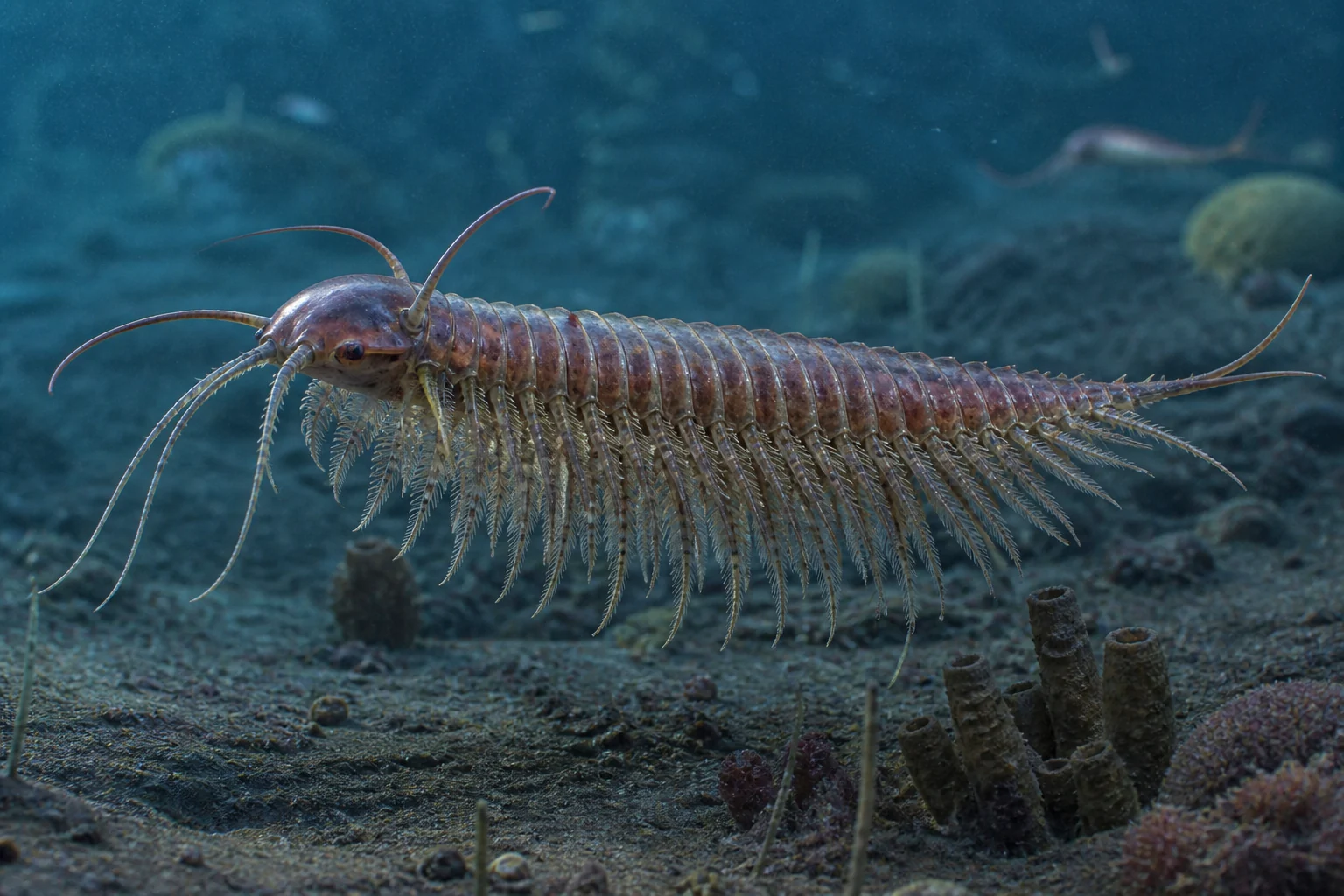
Two pairs of curved head spines, long antennae and dozens of fine legs made this two-centimeter arthropod exquisitely elaborate.
 View original image · 1536 × 1024
- Time range
- About 508 million years ago
- Final stage
- Middle Cambrian
- Geographic range
- Offshore slope of Laurentia · Burgess Shale, Canada
01 / ANSWER FIRST
What was Marrella?
Marrella splendens was a small Cambrian arthropod from the Burgess Shale of British Columbia, Canada. With more than 25,000 specimens collected, it is one of the site's most common animals.
Charles Walcott discovered it in 1909 and named it in 1912. It is sometimes nicknamed the lace crab, but it was not a crab.
02 / QUICK FACTS
Marrella at a glance
- Maximum size
- About 25 mm
- Specimens
- More than 25,000 from the Burgess Shale
- Age
- Middle Cambrian (Wuliuan), about 505 million years ago
- Body
- 26 segments, each with a pair of branched legs
What did Marrella look like?
A head shield carried two pairs of long, curved side spines. In front were long, thin antennae with as many as 30 segments. Behind the head, 26 small segments each bore a pair of biramous (two-branched) appendages, with slender gill filaments.
The Royal Ontario Museum ranks it as the second most common arthropod species in the Walcott Quarry, about 7.3% of specimens. Such abundance lets researchers compare many individuals rather than reconstructing the animal from a single fossil.
03 / ANATOMY
Why is Marrella famous?
Caught while moulting
In 2004 García-Bellido and Collins described a single specimen preserved in the act of moulting, the oldest known arthropod fossil caught during exuviation. One such specimen among more than 25,000 shows how rare the event is to preserve.
Not a trilobite
Marrella belongs to the marrellomorphs, a distinct group of arthropods. It lacks the mineralized three-lobed shield of trilobites.
04 / DIET & BEHAVIOUR
What did Marrella eat?
It is interpreted as feeding on organic particles in the water or in the sediment, combining deposit and suspension feeding.
05 / DIET & BEHAVIOUR
How did it live?
The Royal Ontario Museum describes it as an active swimmer that moved above the seafloor.
06 / RANGE & HABITAT
Where has Marrella been found?
Most specimens come from several Burgess Shale localities in Canada.
Burgess Shale sites
Principal localities include the Walcott and Raymond Quarries on Fossil Ridge, with further records from sites such as Mount Field and Marble Canyon.
Records in China
Marrella species have also been reported from the Cambrian Kaili and Balang formations of China.
07 / FOSSIL EVIDENCE
What do the fossils preserve?
Soft anatomy in shale
Burgess Shale preservation records antennae, legs and gills that normally decay, which is why Marrella's anatomy is known in detail.
08 / DISAPPEARANCE & DEBATE
Why did Marrella disappear?
The cited sources do not establish a specific extinction cause for Marrella splendens.
Its absence from later rocks may also reflect how rarely soft-bodied animals fossilize. The wider marrellomorph group persisted well after the Cambrian, so the loss of one species does not mark the end of its lineage.
09 / FREQUENTLY ASKED QUESTIONS
Marrella FAQ
How big was Marrella?
Up to about 25 mm long, about the length of a large paper clip.
Was Marrella a trilobite?
No. It was a marrellomorph arthropod, a separate group.
Why is Marrella called the lace crab?
The nickname refers to its delicate, lacy appearance. It was not a crab.
04 / SOURCES & FURTHER READING
Check the source record
Use the scientific name to compare taxonomy, occurrence records and the fossil record. Database coverage and classifications may differ.
05 / REVISION HISTORY
How has this record changed?
- Expanded answers to reader questions, clarified the scope of fossil evidence and improved routes to related explanations.
- Added a sourced bilingual topic hub covering size, discovery history, anatomy, diet, habitat, uncertainty and FAQs; updated search metadata.
- Verified authoritative entity sources and added three responsive reconstruction sizes.
- Initial bilingual species record published.
06 / CORRECTIONS & ADDITIONS