
Explore this animal in Size of Extinct Animals ↗
455 / Mesozoic
Bajadasaurus
Bajadasaurus pronuspinax
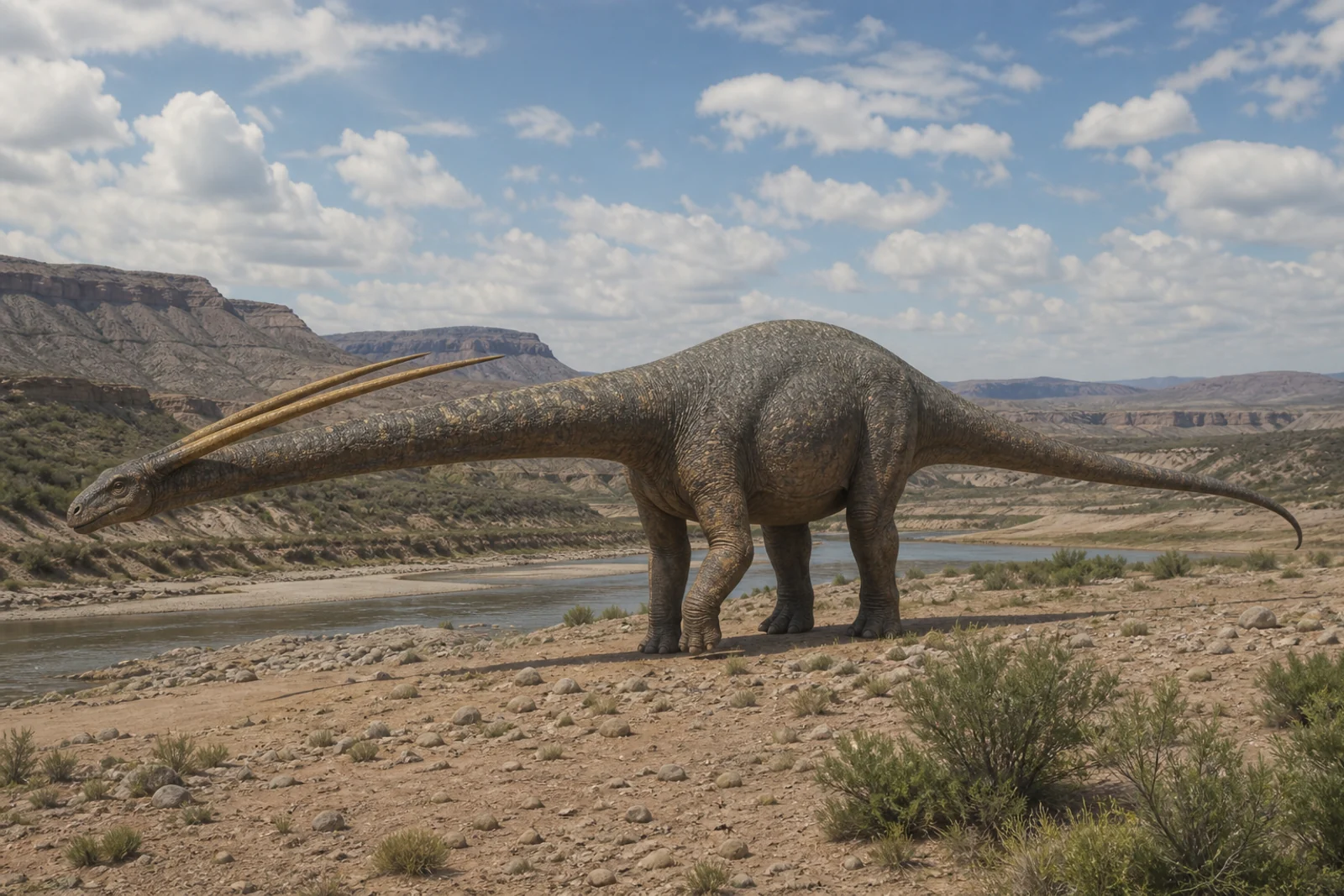
Paired neck-vertebra spines curve forward; a described pair measures 58 cm.
 View original image · 1600 × 1067
- Time range
- Early Cretaceous; Bajada Colorada Formation
- Final stage
- Early Cretaceous; exact extinction date unknown
- Geographic range
- Bajada Colorada, Neuquén · Argentina
01 / ANSWER FIRST
What was Bajadasaurus pronuspinax?
Bajadasaurus pronuspinax was a plant-eating sauropod dinosaur from Early Cretaceous Argentina, described in 2019. Its most striking preserved feature is a pair of exceptionally long, forward-curving neck spines.
A reconstruction joins preserved bones with estimates based on relatives. The familiar complete spiny-neck silhouette is not a complete skeleton found in the ground.
02 / QUICK FACTS
Bajadasaurus at a glance
- Formation
- Bajada Colorada · Neuquén, Argentina
- Age
- Early Cretaceous
- Type specimen
- MMCh-PV 75
- Measured neural spines
- 58 cm in the described cervical vertebra
03 / ANATOMY
Neck spines and body size
Bones, not preserved horns
The long rods are extensions of a neck vertebra. Gallina and colleagues measured them at 58 cm; an outer keratin sheath was proposed, not preserved.
How big was Bajadasaurus?
The described material consists of skull and neck elements. It does not directly measure total body length or mass. Whole-body estimates require reconstruction assumptions; spine length is a separate measurement.
04 / DIET & BEHAVIOUR
What did it eat?
CONICET's discovery account describes a herbivore and discusses feeding near the ground. This is an anatomical interpretation, not a preserved stomach-content menu.
05 / DIET & BEHAVIOUR
Were the spines defensive?
The 2019 authors proposed passive protection against predators. A visually intimidating barrier is a hypothesis about function; the fossils do not record an attack or demonstrate how the animal used it.
06 / RANGE & HABITAT
Where and when did Bajadasaurus live?
Its fossils come from the Bajada Colorada Formation in Patagonia. The original description assigns the beds to the late Berriasian–Valanginian of the Early Cretaceous.
A locality, not a global range
The discovery was reported from Neuquén Province, Argentina. Maps of other long-necked dinosaurs do not establish a wider range for this species.
07 / FOSSIL EVIDENCE
Bajadasaurus versus Amargasaurus: what can we compare?
Related animals, different material
Both belong to Dicraeosauridae. The 2019 neck reconstruction borrowed missing proportions from Amargasaurus; the position of the remarkable Bajadasaurus vertebra was only tentatively identified as the fifth cervical.
A later test of coverings
Cerda and colleagues (2022) studied Amargasaurus and another dicraeosaurid from the La Amarga Formation. Bone histology supported ligaments and a skin sail rather than horn sheaths. This challenges a simple horn-only reconstruction, but is not preserved Bajadasaurus skin.
08 / DISAPPEARANCE & DEBATE
What remains unknown?
Its complete body proportions, the covering and function of its neck spines, and its particular extinction cause remain uncertain.
The cited anatomical studies do not demonstrate that sauropod turnover killed off Bajadasaurus. An explanation of a striking body structure is not an explanation of extinction.
09 / FREQUENTLY ASKED QUESTIONS
Bajadasaurus FAQ
Did Bajadasaurus have horns?
Bony neural spines are preserved. Calling their proposed covering a horn sheath describes a reconstruction, not a recovered horn.
Are Bajadasaurus and Amargasaurus the same dinosaur?
No. They are distinct dicraeosaurid genera. Comparisons help interpret missing anatomy but do not make their fossils interchangeable.
04 / SOURCES & FURTHER READING
Check the source record
Use the scientific name to compare taxonomy, occurrence records and the fossil record. Database coverage and classifications may differ.
05 / REVISION HISTORY
How has this record changed?
- Expanded this profile with research sources, focused questions and explicit limits on reconstructions; updated search metadata.
- Verified authoritative entity sources and added three responsive reconstruction sizes.
- Initial bilingual species record published.
06 / CORRECTIONS & ADDITIONS