
Explore this animal in Size of Extinct Animals ↗
55 / Mesozoic
Yi qi
Yi qi
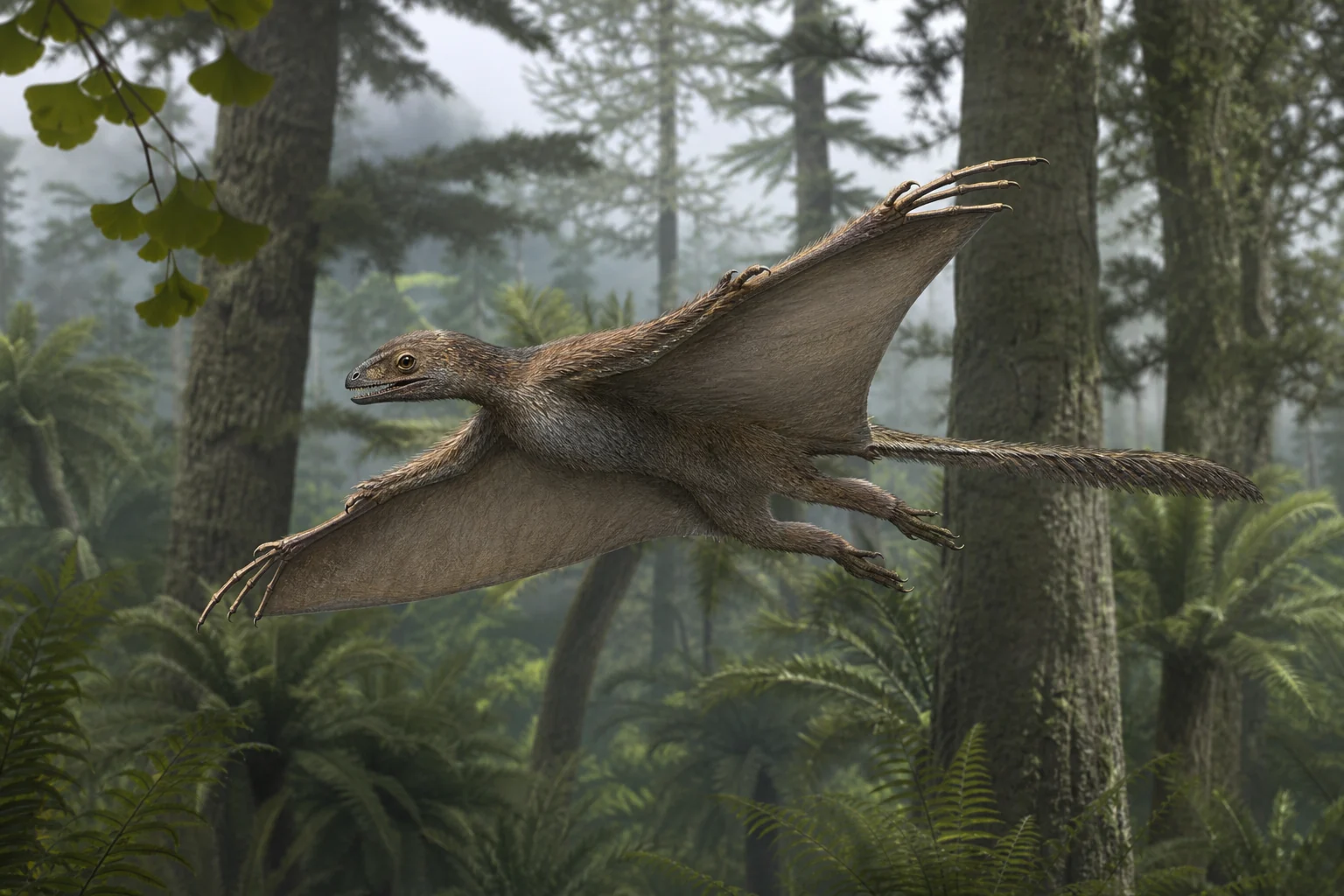
Yi qi was a small Jurassic theropod with feathers and preserved traces of a wing membrane. A rod-like element extending from the wrist made its wing unlike a modern bird's.
 View original image · 1536 × 1024
Structured expansion · editorial review pending
- Time range
- About 164 million years ago
- Final stage
- Middle Jurassic
- Geographic range
- Northeastern China
01 / ANSWER FIRST
What does the evidence show about Yi qi?
Yi qi was a small Jurassic theropod with feathers and preserved traces of a wing membrane. A rod-like element extending from the wrist made its wing unlike a modern bird's.
The 2015 description highlights a flight-related experiment within dinosaurs. A membrane alone does not turn the animal into a bat or a pterosaur.
02 / QUICK FACTS
Yi qi at a glance
- Scientific name
- Yi qi
- Research focus
- Wrist support
03 / ANATOMY
How was Yi qi built?
Wrist support
The unusual styliform element is associated with the wrist and was interpreted as supporting membrane tissue.
Feathers and membrane
Both occur in the preserved material. The complete outline of the living wing remains a reconstruction.
04 / DIET & BEHAVIOUR
Aerial possibilities
The original paper explored aerodynamic possibilities without establishing a single flight mode.
05 / DIET & BEHAVIOUR
A second membrane-winged dinosaur
Ambopteryx, described in 2019, adds independent fossil evidence for this wing design among scansoriopterygid dinosaurs.
06 / RANGE & HABITAT
Where and when did Yi qi live?
The holotype STM 31-2 was reported from the Jurassic Tiaojishan Formation in Hebei, China, around 160 million years ago.
07 / FOSSIL EVIDENCE
What evidence supports reconstructions of Yi qi?
Preserved tissue patches
Membrane traces beside the forelimb support the wing interpretation, although they do not preserve every attachment.
Comparing relatives
Ambopteryx supports the broader anatomical pattern; it is a different genus, not a second Yi specimen.
08 / DISAPPEARANCE & DEBATE
What remains uncertain?
Wing outline, launch method and the balance of gliding versus flapping remain uncertain. Neither cited description establishes a specific extinction cause.
The linked sources support the specific observations above. An occurrence record alone does not identify an extinction mechanism.
09 / FREQUENTLY ASKED QUESTIONS
Yi qi FAQ
Was Yi qi a bat?
No. It was a theropod dinosaur with a separately evolved membrane-wing design.
Is powered flight proven?
The preserved wing does not by itself establish sustained powered flight.
04 / SOURCES & FURTHER READING
Check the source record
Use the scientific name to compare taxonomy, occurrence records and the fossil record. Database coverage and classifications may differ.
05 / REVISION HISTORY
How has this record changed?
- Replaced repeated expansion text with specimen-specific evidence, linked research and explicit limits; independent editorial review is pending.
- Completed an AI-assisted bilingual audit of the archive record, corrected identified issues and clarified evidence limits; independent editorial review is pending.
- Expanded into a structured bilingual profile with anatomy, ecology, range, evidence, debate and FAQs; independent editorial review is pending.
- Verified authoritative entity sources and added three responsive reconstruction sizes.
- Initial bilingual species record published.
06 / CORRECTIONS & ADDITIONS