
Explore this animal in Size of Extinct Animals ↗
254 / Paleozoic
Waptia
Waptia fieldensis
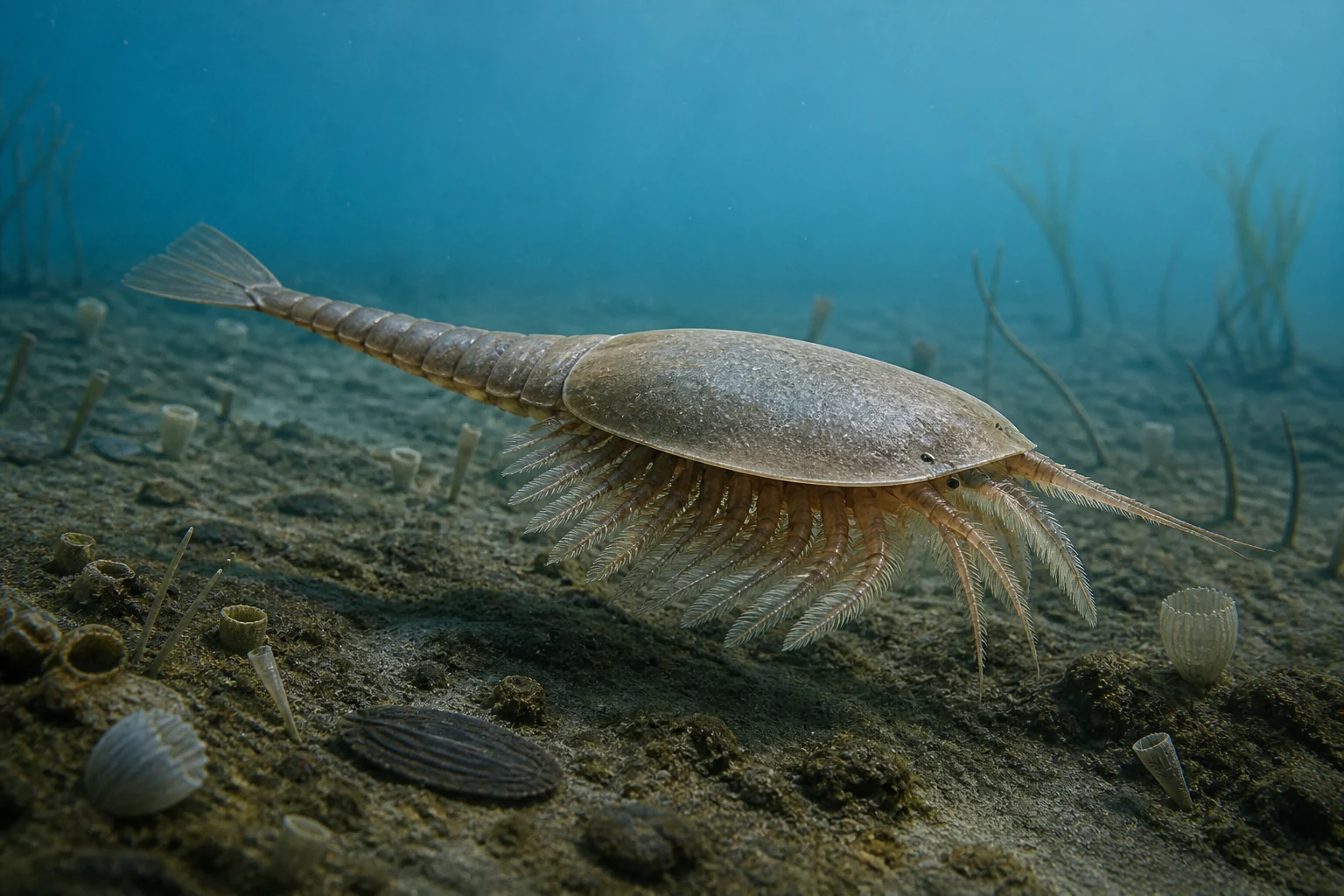
A bivalved carapace, compound eyes and mandibles reveal an early mandibulate; some fossils preserve embryos under the carapace.
 View original image · 1536 × 1024
- Time range
- About 508 million years ago
- Final stage
- Middle Cambrian
- Geographic range
- Open shelf waters · Burgess Shale, Canada
01 / ANSWER FIRST
What was Waptia fieldensis?
Waptia fieldensis was a shrimp-like Cambrian arthropod from the Burgess Shale. Detailed fossils show a bivalved carapace, stalked compound eyes, jaws and specialized limbs.
Its shape resembles a shrimp, but the 2018 anatomical study places it among early mandibulates; calling it a modern shrimp or a proven crown-group crustacean would overstate the result.
02 / QUICK FACTS
Waptia at a glance
- Age
- Middle Cambrian · about 508 million years ago
- Locality
- Burgess Shale, British Columbia, Canada
- Anatomical study
- More than 1,800 specimens examined in 2018
- Reproductive evidence
- Embryos preserved beneath the carapace
03 / ANATOMY
What did Waptia look like?
Carapace and eyes
A flexible bivalved carapace covered the front body. The 2018 study reported stalked compound eyes with preserved ommatidia, a rare level of detail in Burgess Shale arthropods.
Jaws and swimming limbs
Palp-bearing mandibles and maxillules identify a mandibulate body plan. Lamellate appendages behind the head support a swimming interpretation; anatomy is stronger evidence than the animal's shrimp-like outline alone.
04 / DIET & BEHAVIOUR
Did Waptia care for its young?
A 2016 study described eggs with embryos preserved under the carapace. This is direct evidence of carrying offspring, among the earliest such records in arthropods; it does not reveal every aspect of parental behavior.
05 / DIET & BEHAVIOUR
What did it eat?
The 2018 authors inferred active capture of soft prey from its feeding limbs and swimming anatomy. They also stated that direct gut-content evidence for an exact diet is lacking.
06 / RANGE & HABITAT
Where and when is Waptia known?
The studied species is documented in the middle Cambrian Burgess Shale of Canada. A geological occurrence is not a complete global range or a witnessed last day of the species.
Burgess Shale
Exceptional soft-part preservation lets researchers compare limbs, eyes and carapaces across many specimens rather than relying on one silhouette.
About 508 million years ago
That estimate dates the fossil-bearing deposit. It does not establish the first appearance or final extinction of every hymenocarine lineage.
07 / FOSSIL EVIDENCE
Why are the Waptia fossils important?
A tested anatomical placement
Vannier and colleagues analysed more than 1,800 specimens and identified mandibles, maxillules and differentiated limbs. These features support an early mandibulate affinity.
Eggs in position
Brooded embryos remained beneath the carapace in exceptional specimens. Egg placement is observed; how long adults carried them is not measured from these fossils.
08 / DISAPPEARANCE & DEBATE
Why did Waptia disappear?
The cited anatomical and reproductive studies do not identify a species-specific extinction cause or precise last occurrence.
Later arthropod diversification does not demonstrate that other crustaceans directly replaced Waptia by competition.
09 / FREQUENTLY ASKED QUESTIONS
Waptia FAQ
Was Waptia a shrimp?
It looked shrimp-like, but the fossil analysis identifies an early mandibulate rather than a proven modern shrimp lineage.
Are Waptia's eggs real fossils?
Yes. Eggs with embryos were preserved beneath the carapace in described Burgess Shale specimens.
04 / SOURCES & FURTHER READING
Check the source record
Use the scientific name to compare taxonomy, occurrence records and the fossil record. Database coverage and classifications may differ.
05 / REVISION HISTORY
How has this record changed?
- Expanded this profile with research sources, focused questions and explicit limits on reconstructions; updated search metadata.
- Verified authoritative entity sources and added three responsive reconstruction sizes.
- Initial bilingual species record published.
06 / CORRECTIONS & ADDITIONS