
Explore this animal in Size of Extinct Animals ↗
335 / Cenozoic
Teratornis
Teratornis merriami
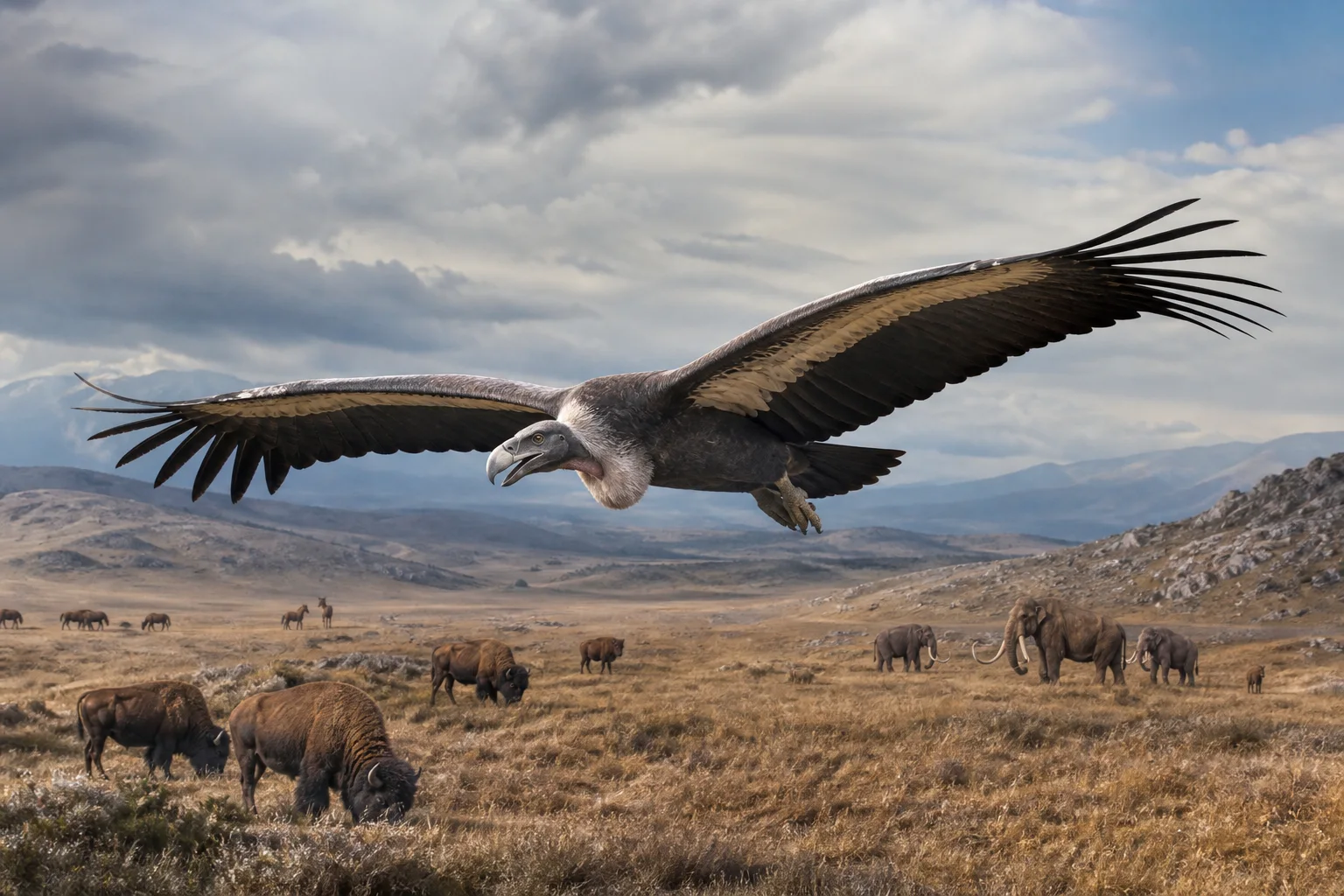
A large soaring bird with an estimated 11–12 ft wingspan; its diet involved more than a simple vulture comparison.
 View original image · 1536 × 1024
- Time range
- About 2.5 million–11,000 years ago
- Final stage
- End of the Pleistocene
- Geographic range
- Grassland and open woodland · North America
01 / ANSWER FIRST
What was Teratornis merriami?
Teratornis merriami was a large flying bird from Pleistocene North America and a member of the extinct teratorn family. It was the largest bird found at La Brea Tar Pits, not the largest flying bird of all time.
Condors provide a useful visual comparison, but a condor-like body does not settle its diet or feather pattern.
02 / QUICK FACTS
Teratornis at a glance
- Scientific name
- Teratornis merriami
- Wingspan
- About 11–12 ft (3.4–3.7 m)
- Mass estimate
- Roughly 33 lb (15 kg) · NPS summary
- Age
- Pleistocene
- Famous locality
- Rancho La Brea, California
- Flight
- Large soaring bird
How big was Teratornis?
The National Park Service gives a wingspan of 11–12 feet, approximately 3.4–3.7 metres, and a mass near 15 kilograms. These are reconstruction estimates, not measurements of a living bird. Wingspan measures tip to tip, not standing height.
03 / ANATOMY
Flight, skull and appearance
Broad soaring wings
Its large wings are consistent with soaring over open landscapes. Flight reconstructions do not establish a precise maximum speed.
More than a hooked beak
La Brea’s account explains how skull studies challenged the simple giant-vulture picture: a broad, flexible mouth could accommodate smaller prey swallowed whole.
Was its head bald?
That remains unknown. Familiar bald-headed paintings are artistic choices, not a feather pattern demonstrated by the fossils discussed here.
04 / DIET & BEHAVIOUR
What did Teratornis eat?
The NPS describes both carrion feeding and hunting smaller vertebrates. Skull mechanics and fossil context inform these interpretations; neither supplies a percentage for each food source.
05 / DIET & BEHAVIOUR
Could it catch prey like an eagle?
La Brea’s review cautions against that image. Its short, stout legs and feet do not imply the same aerial prey-grasping abilities as living eagles.
06 / RANGE & HABITAT
Where did Teratornis live?
The NPS lists Pleistocene fossils from California, Oregon, Nevada, Arizona and Florida. La Brea is especially informative, but it is not the only locality.
Rancho La Brea
The asphalt deposits preserve an unusually rich record of this bird, making them central to studies and museum reconstructions.
Tule Springs, Nevada
The NPS records Teratornis material collected during the 1962–1963 Tule Springs expedition.
07 / FOSSIL EVIDENCE
What fossils reveal—and leave open
Anatomy versus artwork
Bones constrain the skeleton and possible feeding movements. They do not automatically preserve the colours shown in a reconstruction.
Several diet clues
A 2006 isotope study sampled ten T. merriami individuals and linked their food web to terrestrial sources. The authors proposed reliance on megafaunal carrion as an extinction risk.
08 / DISAPPEARANCE & DEBATE
Why did Teratornis disappear?
It disappeared near the end of the Pleistocene. The loss of large terrestrial mammals is one proposed explanation for reduced food availability.
The dietary study supports a food-web hypothesis; it does not establish the cause of every individual death.
09 / FREQUENTLY ASKED QUESTIONS
Teratornis FAQ
Could Teratornis fly?
Yes. It was a large flying bird adapted for soaring, not a flightless terror bird.
Was Teratornis the same as Argentavis?
No. They are different genera in the teratorn family. Their sizes and fossil histories should not be treated as interchangeable.
How wide were its wings?
The NPS summary gives roughly 11–12 feet, or 3.4–3.7 metres, for T. merriami. This is wingspan, not body length.
04 / SOURCES & FURTHER READING
Check the source record
Use the scientific name to compare taxonomy, occurrence records and the fossil record. Database coverage and classifications may differ.
05 / REVISION HISTORY
How has this record changed?
- Expanded this profile with research sources, focused questions and explicit limits on reconstructions; updated search metadata.
- Verified authoritative entity sources and added three responsive reconstruction sizes.
- Initial bilingual species record published.
06 / CORRECTIONS & ADDITIONS